

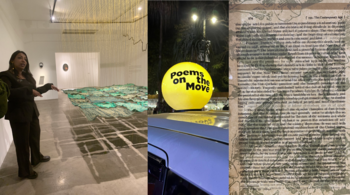

- Indian artists are using more text as an integral part of their artworks
- Text takes multiple forms in art, as posters, poetry, recipes, embroidery, and installations.
- Artworks use words to serve a purpose. Examples include exploring history, social issues, and challenging traditional meaning-making.

Cliches like “a picture is worth a thousand words” have existed for at least a hundred years — there’s some contention around whether an advertising executive used the phrase first or if the idea was originally articulated by the feted playwright Henrik Ibsen in 1890. And while cliches become cliches for a reason — they stand the test of time and contexts — there is enough evidence now of artists using words to bring a picture to life as well.
“Historically in art, artistic practices have been using text as objects. Words are entry points to something far, they are portals. It is the starting point to the unknown,” says artist-curator Sumir Tagra of Thukral & Tagra says in a text message. “We are surrounded by a combination of images and text more than ever... maybe it’s the 'prompting' which has taken up a new dimension, and more artistic practices have been adapting text as their final outcome. For us, the triggering point may be in which language do you think? Has it evolved actually. It is extremely personal; for Jiten, it can be Punjabi. For me, it can be in English... Few words which are overarching and keep our mental space are the idea of 'care and healing',” Tagra adds.
Gurugram-based Thukral and Tagra recently curated a section of the 2025 Serendipity Arts Festival in Goa, with works that took the form of booklets running into dozens of pages, AI-generated responses in a phone booth and a tiny printing press, among other things.
Goa-based artist-curator Leandre D'Souza says in response to a question: “What feels especially exciting to me about the use of words in contemporary Indian art right now is how language is not just a tool that accompanies the visual, but it is material, carrying weight, texture, labour and meaning. Words don't just communicate. They lend voice, hold space, carry traces, create friction and tension, they disturb and refuse silence.”
Curator and programme director at Sunaparanta Goa Centre for the Arts, D'Souza recently curated 'Makers & Materials: Goa Past & Present'. Among the exhibits were a series of "chapters" on Goa's ecology and traditional knowledge (in 'Two Thirds of Us') as well as deliberations on the erasure and rewriting of some histories ('No Kings (and Chronicles)').
"In works like 'Two Thirds of Us' and 'No Kings (and Chronicles)', linearity is ruptured. Language is not simply read. Rather, it breaks down. It calls us to listen, to make sense of its layers and fragments. We are living in a time where everything needs to be consumed instantly. I'm interested in how such works resist this and the ways in which both images and narratives are read today. They invite us to slow down, to inhabit uncertainty, dichotomy and incompleteness. Language becomes a site of making, shaped by excess — erasure — memory, just like wood, shell, clay, fibre, metal. Within the framework of 'Makers and Materials', words become carriers of stories — how they are formed, transmitted, shared, contained, lost. They ask us to break apart and to attend to what is left unresolved,” D'Souza says in an email interview.
Text is dead. Long live the text
At the recently concluded 2025 Serendipity Arts Festival (December 12-21) in Goa, Bengaluru-based artist Jayasimha Chandrashekar was printing out a few hundred posters every day on a refurbished lithographic press. The temperature inside the room was at least as hot as the hot Goan afternoon outdoors. The clanging 200-year-old technology and the laborious print-one-poster-at-a-time process seemed like relics of this place, another time. Seeing this in Goa, where India's first ever printing press docked in the 1550s, felt significant, like an ode to Goa's history and what it contributed towards modernizing India. Chandrashekar himself worked with the efficiency of a machine: Prepping the newsprint paper, laying it out on the press, pulling the levers, applying the ink and hanging the freshly printed paper to dry on lines. Over and over again. Nonstop. And the posters, with messages like “Every day is a cliche” and “Spine should be erect”, accumulated steadily — ready for visitors to take away, if they so desired. The process, the technology and the words were all part of the art. Paying homage to a technology that changed the world and fuelled many revolutions, but also demonstrating what it looks like to slow down and send a message more deliberately in a world of instant messaging, social media, and AI-generated copy.
Across the country, artists seem to be expanding where and how words appear, and the way they work to make meaning. To be sure, text has typically accompanied exhibits in museums and galleries. But it has traditionally served a descriptive purpose — such that when you change the text, the artwork and the audience engagement with it largely remains the same. What’s different now is that lately more artists seem to be using text in ways that are integral to the art — for investigation, communication, curation and creation within the work. It’s difficult to say if this play with words is in response to the age of social media, or an organic extension of how contemporary artists like American Edward Ruscha starting in the 1960s (with his paintings of words like 'OOF' and 'HONK', for instance) and Indian artists like Shilpa Gupta in the 21st century have been centering words in their works, or both. But examples of how artists are reimagining the word — written and spoken now — abound, defamiliarising the familiar, and making us relook at writing at a time when the consensus world over is that reading is on the decline.
The 10th Serendipity Arts Festival this year offered a few more noteworthy examples of works that used words as a medium. Consider ‘Poems on the Move 2.0’, curated by Salil Chaturvedi and Thukral and Tagra. To experience this work, visitors sat in a cab, being driven along the river in Panjim as a performer read out lines of Hindi poetry to them. When the performance worked, both the words and the drive seemed aligned in their purpose to induce a sense of calm. The drive — down a very specific scenic route along the Mandovi river, with its offshore casinos and small boats bobbing in the water, down towards Dona Paula Beach — situated the performance squarely in this historic city.
Consider also: Rajyashri Goody’s ‘Writing Recipes’ (2016 - ongoing). Set up on the first floor of the Directorate of Accounts, one of 12 venues of the Serendipity Arts Festival 2025, ‘Writing Recipes’ comprised seven, slim booklets straddling the intersection of food, caste, literature and art. With titles like “Is hunger gnawing at your belly?” and “Why must you feed others?”, the thin zine-like printed volumes held recipes and deliberations on food — often meats — adapted and curated from Dalit literature like Eknath Awad’s ‘Strike a Blow to Change the World’, Namdeo Nimgale’s ‘In the Tiger’s Shadow’, Urmila Pawar’s ‘Aaydan – The Weave of My Life’ and Bama’s ‘Karukku’. The work is part of a larger project, “exploring the politics of the written word, cookbooks and access to ample food resources in the context of Dalit communities in India”. The texts thus curated and adapted are eventually slated to become part of an anthology “tracing Dalit writers' memories of food in text”.
Across the multidisciplinary arts festival, example of how text is used in service of meaning-making extend to medical reports, letters, a handwritten recipe for orange cake, diary entries, embroideries, deliberations on silence and on the partition of language itself, interactive works where the words appear only when you cast a shadow on them or when words are beamed onto a receptacle on the floor. There are game boards with food traditions and stories. Climbing a staircase of the Old GMC (Goa Medical College) Complex, also a venue for the shows, itself is an act in reading:
"skip a step. or linger.
when did you first feel 'free'?
breathe in.
grip the handrail tightly.
breathe out. let go."
The words are printed on each step sans capital letters. Easy-going. Inviting. Making you curious, and taking the mind off the gentle climb momentarily.
Context, content
To be sure, the use of text in art is not new. Surrealist Rene Magritte’s ‘Treachery of Images’ (1929) would be meaningless without the words “Ceci n'est pas une pipe” (This is not a pipe), and pop-artist Robert Indiana’s ‘LOVE’ series — it apparently started out as a Christmas card design for the Museum of Modern Art — has since inspired variations like Google’s ‘AMOR’ tribute. Another famous example is that of Edward Ruscha, who in the 1960s started painting words like “Oof” and “Honk” on large canvases, juxtaposing imposing landscapes with words that delineate or are dissonant by turns. By the early 1980s, Ruscha had developed his “Boy Scout Utility Modern” typeface. And in the 2000s and 2010s, Ruscha painted cryptic words like “Pay Nothing Until April” stenciled against snowcapped mountains in acrylic, and the musical notation in ‘Bliss Bucket’ (2014) that drew attention to the sound of words as much as the image on the canvas. In India, too, examples abound. From Jitish Kallat to Arprita Singh and Shilpa Gupta, contemporary artists have expanded, challenged and changed what we expect words to do in an artwork. The experiments continue into 2025-26.
At the Sunaparanta Goa Centre for the Arts, a stone’s throw from one of the venues of the 10th Serendipity Arts Festival in Panjim, at least two exhibits in the ongoing 'Makers & Materials' show draw attention to text. In Wenceslaus Mendes' 'Two-Thirds of Us', an "unbound book" of eight chapters, a film and digital prints draw attention to the Konkan coastline and 'indigenous eco-futurism' - a stream that draws upon traditional knowledge systems as well as cutting-edge technology and speculation for a more sustainable future. Sample this short selection - excerpted from the popular Dekhni song "Hanv Saiba Poltodi Vetam" by Carlos Eugenio Ferreira", in one of the "unbound books" titled "a Song for Mogrem" (the Dekhni song is said to have inspired the Hindi song "Na mangoon sona chandi" from the Bollywood film ‘Bobby’):
"I am going, my lord, across the river,
I am going for Damu wedding
to the sound of that music,
under the wedding canopy,
the temple girls are dancing.
As I walked and walked, night fell on me,
A strong gust of wind blew out my small lamp...
I walked and walked, and night fell on me
The strong gust of wind blew out my lamp..."
Coming as it does at the end of several volumes on the nature of water springs, Goa's salt khazaans and gin industry, the geology of the coast and Goa's water systems and ecology, "a Song for Mogrem", through songs and photos, draws attention to how folklore passes on information about sustainability.
“'Two Thirds of Us' begins from a simple fact: most of our bodies, and the Earth itself, are made of water. Drawing from the Konkan coast and Goa, the work uses water as both subject and metaphor to think about connection, memory, and survival, while also pointing to how more than two-thirds of people and ecologies remain marginalised through histories of extraction and erasure,” D'Souza says.
A couple of rooms down from this work, Priyanka D'Souza and Nivedita Madigubba's 'No Kings (and Chronicles), 2025' draws attention to “mark-making and erasure, resistance and persistence". Within their multipart and multimedia installations, the artists print over books weeded out of a university library; and cover up cupboards-full of discarded volumes, obscuring them with cloth or paper. The overall feeling is of walking into a library, but one where you are unable to access any knowledge that's not preselected, highlighted, written over for you. The "kings", or powers that be, have ruled against these books. Curtailing what you can know and how you can think.
“'No Kings (and Chronicles)' is a layered installation about how history is written, erased, and rewritten,” D'Souza says. “Moving between India and the US, the work brings together the protest slogan 'No Kings' and a deleted Indian school textbook chapter on Mughal history to show how power shapes what is remembered and what is removed. Across floor works, prints, and vitrines, viewers are asked to walk, mark, and even erase parts of the work themselves, through footprints, gilding, and overwritten text, mirroring how political and educational systems leave their own marks on history. Using discarded books, school texts, and references to early printing in Goa, the work treats history as something unfinished: fragile, contested, and constantly being revised. The related print series छाप | chhāp (meaning imprint or mark) extends this idea, seeing history as a lingering presence that lives in materials, bodies, and patterns, and reminding us that every act of looking and printing also leaves a trace. The phrase 'No Kings' circulates as a statement as it collides with the excised NCERT chapter Kings and Chronicles. Here, words are exposed and become vulnerable - they are walked over, they are gilded into illegibility, displaced across geographies and institutions. Text becomes something you can step on, partially erase, gage but not fully access or understand. The action of reading becomes a form of mark-making and unmaking, and meaning emerges from this disruption.”
Form and function: Where words occur and how
There's a surprising array of ways in which words appear in these artworks, too. Consider Bangladeshi artist Ashfika Rahman's solo show 'Of Land, River and Body', at Vadehra Art Gallery in Delhi. In a series of works, Rahman, who is currently based in Amsterdam, uses the myth of Behula — a local woman who passed into legend for sacrificing herself for her lover — to talk about violence, displacement and suffering in present-day Bangladesh.
Like Sati Savitri in India, Behula is held up as a traditional ideal for women in Bangladesh. In the mythology, Behula is said to have travelled down the Ganga river, across the India-Bangladesh border, to beg the gods for her lovers' well-being. Rahman retraced this journey over water, gathering letters from local women to Behula. The letters are embroidered in gold thread on bits of old sari cloth in a variety of languages that are spoken locally. "Embroidery is their language," explains Rahman.
Indeed, women in many parts of South Asia still learn needlework early in their lives. Rahman has crafted these embroidered letters into a raft of sorts, to echo Behula's raft over the water. The raft hangs by golden threads. Behind them, there are photos with gold thread embroidery. Evoking ways in which contemporary women are still bound and constrained by such stories.
In other works in the show, Rahman offers prisoner testimonies and fingerprints of villagers displaced in the name of progress. There are photos, too, of a place where thousands of Bangladeshi youths were captured and killed. The testimonies pile up. "For me, it is important that these works are coming to India now," Rahman says. Protests in Bangladesh have been heating up since Sheikh Hasina resigned as prime minister and flew to India in August 2024.
Context seems to be an important deciding factor here. While in 'Dear Behula', it was the women respondents who embroidered the individual "letters" in languages that the artist can't even read sometimes, in artworks like 'Two-Thirds of Us' by Wenceslaus Mendes, words appear as they would in books. No one seems too burdened by the idea of "who's going to read so much" or how to break technical information down into 'grammable infographics. Instead, there is an unabashed embrace of text-heaviness.
“Bringing together science, oral histories, speculation, and play, the work unfolds across prints, film, books, sound, and digital media," says D'Souza, who curated 'Makers & Materials'. “'Two Thirds of Us' invites viewers to imagine water as a living archive, one that holds pasts, futures, and the possibility of a more just world formed through our shared, fluid inheritance. Here, text becomes expansive, extending beyond the page, and turning into a living, fluid archive. Chapters play out as an unbound book, combining oral histories, speculative futures, scientific registers, indigenous knowledge systems. Words behave like water, circulatory, leaky, resistant to containment. The text is not fixed; it is something you enter, navigate, and co-create. Reading becomes an embodied act, tied to memory, ecology, and collective imagination rather than authorship," she adds.
“Across these practices, words function as imprints. They record pressure, loss, movement, and survival. In their reading, there is no singular meaning. Instead, we stay with their entanglements, so that we can observe what is missing, what repeats, what refuses clarity. In that sense, the most compelling use of words in contemporary art today is in language’s stubbornness - its ability to remember, to provoke conversation, and to reframe how we understand our stories and our place within them,” D'Souza says.
Discover the latest Business News, Sensex, and Nifty updates. Obtain Personal Finance insights, tax queries, and expert opinions on Moneycontrol or download the Moneycontrol App to stay updated!





