

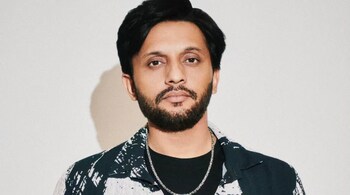
Talented actor Mohammed Zeeshan Ayyub has always surprised the audience with his roles - whether it’s the witty friend in Tanu Weds Manu, the fierce protester in Article 15, or the complex senior journalist in Scoop.
Zeeshan is now seen playing the role of a cop in Kanneda, a show set in a world far removed from the typical Bollywood portrayal of law enforcement.
When asked what makes his role in Kaneda different from what he has played in the past, Zeeshan told Money Control in an exclusive interview that this character is not the hardened, no-nonsense police officer the audiences are used to. Instead, it’s the vulnerability that pulled him in for this role.
“Experience was really good. And I just wanted to work with Rajeev Ravi and Sarjan sir. And so it was really exciting to work there. I don’t think it’s a very tough kind of a cop. I think the more beautiful part is he is a very vulnerable kind of a person. And that is what excited me about this character, not actually his toughness," he told us in the telephonic conversation.
Zeeshan believes that portraying a character simply as their profession is an outdated approach and that OTT gives an actor the time to explore different layers to the character onscreen.
“He’s not a typical cop. Cop becomes a profession—you cannot be just your profession. Like, to think that a teacher will always talk like this only… or maybe a journalist always asking questions. When you’re with your friends, you’re a normal human being. So it goes the same for a cop, for a doctor, for anyone," said Zeeshan
OTT gives exposure
"OTT definitely gives you time to explore all the characters and get to know them much better… So I’m sure OTT has brought a positive side and something is reaching somewhere—I hope," he added.
Love to play characters with shades of grey
Zeeshan has often gravitated towards morally ambiguous characters, and even in Kanneda, he said his character isn’t strictly positive.
“He’s not exactly a positive-positive character. Again, that’s why I said he’s human. Because he has that weakness also. It’s not like ki woh sahi hai aur hamesha sahi ke liye hi karega. He loses a few battles and takes a few wrong decisions also.”
The actor was loved in the role of senior journalist Imran Siddiqui in Scoop and agrees that he is getting good roles after the show's success.
Zeeshan’s nuanced performance in Hansal Mehta’s Scoop brought him recognition as a lead actor.
“After Scoop’s release, people are ready to pitch me as the main guy. I’d say pichhle saal–dedh saal mein kaafi achha response aaya hai. But still, I sometimes feel weird saying I didn’t get my worth—because Bombay mein kam se kam 10 lakh aadmi hai jo bichara wait kar raha hai iska 50% bhi paane ke liye. It feels like I’m demeaning them. But yes, post-Scoop, I’ve definitely been getting much better roles," he told us.
Role should be mazedar
When asked what draws him to a particular role, Zeeshan says it’s not strategy, but instinct. A role has to excite him on the page.
“It should excite me when I’m reading. It should be something new. Mujhe na padh ke aisa lagna chahiye ki ‘Arre yaar, yeh bada mazedaar hai, yeh kaise karenge?’ There should be something for me to learn in that script," said Zeeshan.
He recalls being both nervous and thrilled when he got the part of young Murari in Dhanush and Sonam Kapoor starrer Raanjhanaa, telling his wife, “Yeh toh bahut acha character hai, main kar nahi paaunga.” He says that it was his wife's reassurance that helped him push through.
AI and the Threat to Creativity
With the rise of artificial intelligence, many in creative fields are concerned. Zeeshan shares this worry, especially when it comes to the authenticity of artistic expression.
“Creative kaam jo hai, voh insaan ko karna chahiye. Execution aap AI se karvaiye. Art is never about perfection, it’s about those flaws. Main hamesha bolta hu ki as an actor, I love a scene jahan par halke se fumble aa jaaye mera… Real life mein bhi log fumble karte hain. That’s what makes great art," he says.
According to Zeeshan, using AI for creative purposes removes not just jobs, but also the human essence of storytelling.
“Pehle 100 log milke ek film banate the, ab toh 5–10 log lagte hain. Yeh jo 90 log chale gaye, unki spending power kam ho jaayegi. Aap unko unemploy kar rahe ho, phir bolte ho market down chal raha hai.” ("Earlier, 100 people would come together to make a film, now only 5-10 people are required. What happens to the remaining 90 people? Their spending power decreases. You're making them unemployed, and then you say the market is down.")
On the Indie Film Ecosystem
After Anatomy of a Fall (Anoura) won big at the Oscars, many are asking whether Indian indie cinema could experience a similar rise. Zeeshan says he is hopeful but pragmatic.
“Malayalam film industry bilkul issi tarah ki filmon par chalti hai. Hamare yahan logon ko ab woh hi pasand aa rahi hai. But bade studios ke liye yeh chhota market bada khatarnak hota hai. They make sure ki yeh market ko exposure na mile.” ("The Malayalam film industry is completely based on films like these. Nowadays, people here are liking only such films. But for the big studios, this small market becomes a big threat. They make sure that this market doesn't get exposure.")
He pointed out that many Indian filmmakers are now seeking funding abroad just to survive creatively: “Payal Kapadia ho ya Santosh film, sab France ya London jaa rahe hain… Toh ek tarah se chal raha hai, par hamare yahan jo bade studios baithe hain, woh monopoly tootne se darte hain.” ("Whether it's Payal Kapadia or Santosh film, they're all going to France or London... So, in a way, it's working out, but the big studios sitting here are afraid of their monopoly being broken.")
Zeeshan said Indian cinema especially Bollywood often falls into patterns - whether it’s Uttar Pradesh-based romances or horror-comedies - until they fizzle out.
“Ranjhanaa, Tanu Weds Manu—yeh sab ek naye formula ke part the. Ab sab horror-comedy ke peechhe pade hain. Par yehi toh AI jaise sochna hai. Aapko bas ek successful cheez ka remix chahiye.” ("Ranjhanaa, Tanu Weds Manu - all these were part of a new formula. Now everyone is after horror-comedy. But this is exactly how AI thinks. You just need a remix of something successful.")
“Mujhe horror ki baat karni hai toh Tumbbad sabse zyada yaad aati hai. Revolution usne laaye thi. Baaki sab uske baad aaye.”
Frustration is real, but so is the business
On the bigger question—does constant focus on money frustrate artists? Zeeshan says yes, but acknowledges its role in the ecosystem.
“As an artist, I completely agree with Anurag. It is frustrating. But 400 crore ki film agar 10-10 crore ki chhoti filme bana sakti hai toh kam se kam 10 toh banengi. It’s economics.”
Before wrapping up Zeeshan said he believes in flawed characters, and refuses to be boxed into binaries—commercial vs. indie, hero vs. villain—make him one of the most compelling actors of our time.
Whether it’s a poetic monologue or a raw fumble, his performances carry a truth rarely seen in today’s content-saturated world.
Zeeshan Ayyub began his career in theater, performing with the renowned theater group, NSD Repertory Company. His breakthrough role came in 2011 with the film 'No One Killed Jessica,' starring Rani Mukerji and Vidya Balan. It was followed by notable performances in "Raanjhanaa," "Tanu Weds Manu Returns," and "Article 15." With his impressive range and versatility, Zeeshan has established himself as a respected actor in the Indian film industry.
Discover the latest Business News, Sensex, and Nifty updates. Obtain Personal Finance insights, tax queries, and expert opinions on Moneycontrol or download the Moneycontrol App to stay updated!





