

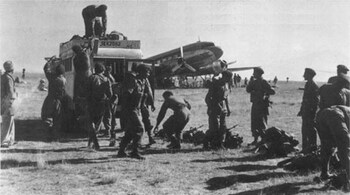
In the popular memory of the 1947-48 conflict in Jammu and Kashmir, a few names dominate: Srinagar airlift, Badami Bagh, Zoji La. Far less remembered are three distant fronts that absorbed extraordinary pressure, delayed enemy consolidation and bought India time when its position in Kashmir was still precarious.
Skardu in Baltistan, Poonch in Jammu, and Tithwal on the Kishanganga were geographically separated, yet strategically linked by the same problem — thinly spread defenders holding out against numerically superior forces in terrain that punished both man and machine.
What happened in these places rarely features in school textbooks. Yet military historians such as Srinath Raghavan and Air Vice Marshal Arjun Subramaniam have noted that the survival of the Kashmir campaign depended as much on these peripheral battles as on the dramatic events around Srinagar.
Skardu: The siege at the roof of the world
Skardu, located deep in Baltistan, was the northernmost Indian garrison in 1947. Its defence fell to a small force of State Forces and local militia under the command of Lt Col Sher Jung Thapa, an officer of the Jammu and Kashmir State Forces. According to official histories published by the Ministry of Defence, the garrison numbered barely 400 men, many poorly armed, facing thousands of Gilgit Scouts and tribal fighters backed by Pakistani officers.
The siege of Skardu began in December 1947 and stretched into August 1948. For eight months, the defenders held out under conditions that were almost medieval. Supplies dwindled rapidly. Ammunition was rationed. Food ran so low that soldiers survived on apricot kernels and horse meat, a detail recorded in multiple memoirs of State Forces officers and later corroborated in army histories.
Attempts to relieve Skardu from the air failed. Historians like Air Vice Marshal Subramaniam, writing in India’s Wars, note that the Indian Air Force lacked aircraft capable of sustained operations at that altitude at the time. Despite this, Thapa refused repeated surrender demands.
When Skardu finally fell in August 1948, the defenders had exhausted all means of resistance. Thapa and many of his men were taken prisoner. Several officers were executed, an episode documented in later Red Cross accounts and in the official Indian history of the conflict. Strategically, however, the defence achieved its purpose. For eight crucial months, Skardu tied down enemy forces that could otherwise have been used to consolidate Pakistani control over Baltistan much earlier.
Poonch: A town that refused to fall
While Skardu fought in isolation, Poonch endured one of the longest sieges of the war. Situated in the hills of Jammu, Poonch was surrounded by hostile forces by late 1947. What made Poonch unique was the composition of its defenders. Alongside soldiers of the Jammu and Kashmir State Forces were local ex-servicemen, many of them veterans of the Second World War, who organised themselves into ad hoc defensive units.
Military historian Maj Gen Ashok Mehta has written that Poonch became a rare example of civilian-military resistance working in tandem. Villagers carried ammunition, repaired defences and often fought alongside uniformed troops. The town was cut off by land, with supply routes constantly interdicted.
The Indian Air Force played a decisive role in keeping Poonch alive. Beginning in November 1947, transport aircraft flew in supplies and evacuated wounded, often under fire. Air Chief Marshal PC Lal later described these missions as among the most hazardous undertaken by the IAF in its early years.
Relief came only in November 1948, when Indian forces launched Operation Easy to break the siege by opening a land corridor. By then, Poonch had held out for nearly a year. As historian Srinath Raghavan has pointed out, the prolonged defence prevented Pakistani forces from linking up their positions in western Jammu with those in the Kashmir Valley, complicating their overall campaign plan.
Tithwal: Holding the Kishanganga line
Farther north, in the narrow Kishanganga valley, the battle for Tithwal unfolded with less drama but equal importance. Tithwal sits astride routes that connect the Kashmir Valley with Muzaffarabad. Control of this area was critical to preventing deeper incursions into northern Kashmir.
Indian troops, including battalions of the Dogra Regiment and supporting arms, advanced to Tithwal in mid-1948. According to the official Indian Army history, the fighting here was marked by relentless artillery duels and small-unit actions in steep, forested terrain. Positions frequently changed hands before stabilising along what would later become the ceasefire line.
What distinguished Tithwal was the quality of junior leadership. Company and platoon commanders operated with minimal supervision, often cut off by terrain and weather. Veterans of the campaign later recalled that survival depended less on firepower than on endurance and improvisation, digging gun pits into rock, hauling mortars by hand, and maintaining morale through months of exposure.
The eventual Indian hold over Tithwal ensured that large parts of the Kishanganga valley remained on the Indian side after the ceasefire. Analysts writing in the Journal of Defence Studies have argued that this denied Pakistan a direct route into the heart of northern Kashmir.
The common thread: Time, terrain and sacrifice
Skardu, Poonch and Tithwal differed in geography and outcome, but they shared a common strategic effect. Each imposed delay. Each forced Pakistan to commit men and material to difficult fronts. And each bought India time to stabilise Srinagar, to reorganise its forces, and to internationalise the conflict on more favourable terms.
The men who fought these battles were rarely senior commanders. They were company officers, junior leaders, state force soldiers and civilians whose names seldom appear in popular histories. Their stories survive mostly in regimental records, official war histories and the recollections of fellow soldiers.
Indian Navy Day commemorates Operation Trident. Army Day marks a broader legacy. But the defence of Skardu, the siege of Poonch and the fighting at Tithwal lack a fixed place in public remembrance. Yet without them, the map of Jammu and Kashmir might look very different today.
Why remembering them still matters
Modern military studies increasingly emphasise the importance of peripheral battles. As strategic analyst K Subrahmanyam once observed, wars are often decided not just by headline victories but by stubborn resistance in forgotten corners.
In an era when narratives around Kashmir are increasingly simplified, revisiting Skardu, Poonch and Tithwal restores complexity. It reminds us that the conflict was not a single dramatic event but a series of overlapping struggles, many fought in silence.
These were not battles of conquest. They were battles of holding on — against geography, against odds, and often against inevitability. The soldiers who fought them did not expect recognition. But history, when told fully, owes them remembrance.
Discover the latest Business News, Sensex, and Nifty updates. Obtain Personal Finance insights, tax queries, and expert opinions on Moneycontrol or download the Moneycontrol App to stay updated!





