

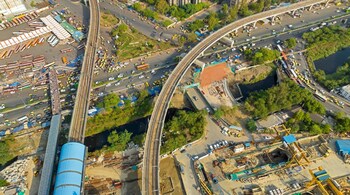
Bengaluru is poised for a dramatic urban transformation, with state authorities proposing a colossal infrastructure overhaul to rescue the metropolis from its deepening civic crises.
In a comprehensive proposal sent to Prime Minister Narendra Modi on August 10, Karnataka Deputy Chief Minister DK Shivakumar outlined a vision to remake India’s tech capital into a “truly global metropolis,” a plan totalling an estimated Rs 1.5 lakh crore.
The sweeping proposal spans urban tunnels, mass transit upgrades and critical water and waste management systems, aiming to address the immense strain exerted by a population exceeding 12 million and a sprawling technology ecosystem.
The grand plan: From deep-bore tunnels to rapid rail
The multi-pronged strategy attacks the city’s problems on several fronts. The most dramatic interventions target Bengaluru’s notorious traffic. The centrepiece is a proposed network of urban tunnels and elevated corridors aimed at decongesting 76 km of former national highways, where traffic speeds have plummeted below 10 kmph.
Two major tunnels - one from Hosur Road to Bellary Road and another from KR Puram to Mysuru Road - along with an elevated corridor on Kanakapura Road, , as reported by TOI, are projected to cost Rs 41,780 crore and reduce travel times by 60-70%.
The most ambitious single project is a 16.75 km, fully underground expressway between Silk Board Junction and Hebbal. Pegged at Rs 17,698 crore, it is slated to be India’s costliest intra-city transport corridor, promising to cut a commute of up to 90 minutes down to just 20-25 minutes.
Beyond the core city, a 73.5 km, eight-lane Peripheral Ring Road (PRR) is planned at a cost of Rs 27,000 crore to divert highway traffic, while a Regional Rapid Transit System (RRTS) is proposed to connect Bengaluru to Mysuru, Tumakuru, Kolar and Chikkaballapur, with travel times ranging from 42 to 102 minutes.
Beyond traffic: Water, waste and lake protection
The proposal acknowledges crises beyond traffic. With the city generating 6,500 metric tonnes of solid waste daily against insufficient processing capacity, a Rs 3,200 crore plan for four large waste management facilities has been proposed, seeking Viability Gap Funding under the Swachh Bharat Mission 2.0.
To secure the city’s water supply, the Cauvery Water Supply Scheme Stage VI, costing Rs 6,939 crore, aims to deliver an additional 570 million litres per day by 2030. A further Rs 3,000 crore is earmarked for constructing 300 km of roads along stormwater drain buffer zones, a measure intended to improve mobility while protecting the city’s interconnected lake system from encroachment.
Mass transit also receives a significant push. Following the success of the double-decker model on the Yellow Line, similar projects are proposed from JP Nagar to Hebbal and Hosahalli to Kadabagere at a cost of Rs 5,916 crore. The Bengaluru Metro, with Phases 2A and 2B under construction and Phase 3 sanctioned, also plans five new extensions covering 128 km to better connect peripheral regions.
A deep-bore tunnel and mounting environmental alarm
The high-stakes tunnel project, while promising relief, has ignited significant environmental concerns. The detailed project report (DPR) reveals the alignment passes directly beneath Lalbagh Botanical Garden, a cherished green lung and heritage site.
Environmentalists, including Dr Yellappa Reddy, have warned of potential damage to the 3,000-million-year-old Lalbagh Rock and the garden’s delicate ecosystem. Concerns also focus on the proximity of tunnel entry points to Lalbagh Lake and the risk of water seepage affecting adjacent areas like the Nimhans complex.
These apprehensions are bolstered by a government-appointed expert committee, led by BMRCL executive director Siddanagouda Hegaraddi. The committee’s review, as per TOI report, flagged major shortcomings in the DPR, citing inadequate geotechnical data, missing aquifer mapping, inflated traffic projections and significant cost estimation gaps. The panel has recommended a complete revision of the DPR.
The core debate: Cars versus public transport
The tunnel project has become a flashpoint in a broader philosophical clash over Bengaluru’s future. Deputy CM Shivakumar defended the car-centric approach, stating, “people can’t be stopped from using cars,” and remarking that “there’s hesitation to marry a boy who doesn’t own a car.”
This stance was sharply criticised by Bangalore South MP Tejasvi Surya. “As per RTO records, only 12% of Bengalureans own cars,” Surya argued, contending the project favours an elite minority.
Surya highlighted that a metro corridor can move 10,000-20,000 passengers per hour, dwarfing the tunnel’s capacity of around 1,600 cars. He also noted the stark cost difference: a one-way tunnel toll of roughly Rs 330 versus a Rs 50-60 metro fare.
The cost of congestion: exodus and decay Biocon founder Kiran Mazumdar-Shaw wrote on social media about an overseas business visitor questioning the poor state of the city’s roads and visible garbage, asking pointedly whether the government wished to support investment. According to the TomTom Traffic Index, Bengaluru had the world’s third-slowest traffic in 2024, ranking worse than cities such as San Francisco and London.
Entrepreneur RK Misra, co-founder of a multimillion-dollar start-up, stated to AFP his gruelling 16-kilometre commute, which can take up to two hours, as destructive to work-life balance. The frustration has driven companies, like BlackBuck, to announce departures from the clogged Outer Ring Road corridor.
BS Prahallad, technical director of Bengaluru Smart Infrastructure Limited, captured the prevailing sentiment: “Something has to be done, now or never. The next step is, we will decay.
Ecologist Harini Nagendra pointed to the environmental cost of rapid, unplanned growth. “We have flooding because water has no place to go, drought because the water is not infiltrating into the ground,” she said. “People are choking on pollution, choking on the concrete.”
Veteran investor TV Mohandas Pai remains cautiously hopeful, stating to AFP that Bengaluru’s infrastructure is possibly three to five years behind, but the long-term outlook is still positive. He expressed that the future is bright but will involve pain, adding that the city is suffering the pangs of growth because India knows how to handle poverty, not prosperity.
Discover the latest Business News, Sensex, and Nifty updates. Obtain Personal Finance insights, tax queries, and expert opinions on Moneycontrol or download the Moneycontrol App to stay updated!





