

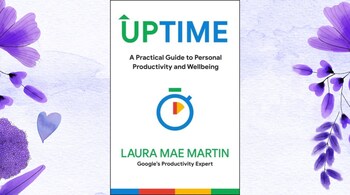
Every day, tens of thousands of Google employees, from executives to interns, rely on Laura Mae Martin’s tips and best practices for how to make the most of their time. She is the Executive Productivity Advisor at Google in the office of the CEO. Now, with Uptime, Laura brings her unique approach to productivity and wellbeing to anyone who wants to be more effective and experience “calm accomplishment” whether at work, at school, or in their own personal lives.
Laura began her Google career in sales, but quickly carved out a niche for herself as a productivity expert. For more than a decade, she’s been coaching Google executives and employees on how to achieve a state of “productivity Zen” — a holistic approach to conquering everything from the avalanche of emails in their inboxes to becoming the master of their own calendars and running excellent meetings. Her strategies have been widely adopted from entry level employees looking to amplify their individual impact to top executives working across global teams.
As many of us have moved to a hybrid environment blending work and home, managing our time efficiently and remaining productive is more important than ever. In Uptime, Laura shows us how to thrive no matter where you’re working with an approach she calls “calm accomplishment,” a focus on your priorities with good systems, routines, and tactics in place.
Uptime explains how to make technology work for you and make “productive Zen” your new normal. It’s a blueprint for operating at the highest levels of productivity while enhancing your own personal wellbeing.
Laura Mae Martin coaches Google’s top executives on the best ways to manage their time and energy and sends out a weekly productivity newsletter that reaches over fifty thousand employees. During her thirteen-year tenure at Google, Laura has worked in sales, product operations, event planning, and now executive coaching. She holds a bachelor of science in business administration from the University of North Carolina at Chapel Hill.
The following extract has been published with permission. It is from the introduction and chapter two of the book. The idea of saying “No” is anathema to many people. Usually, it is because they feel uncomfortable saying it and would rather acquiesce. Laura Mae Martin offers some practical tips that are worth reading —even imbibing.
Jaya Bhattacharji Rose
I spent last Saturday binge-watching old episodes of Heartland in a nonstop, ten-hour marathon while snacking on popcorn, broken up only by one half-hour catnap in the early afternoon.
And that day was one of the most productive days of my life. How could that be?
According to the rules of the “old productivity,” working hard, working more, and working all the time are the keys to getting things done. Why “waste” a Saturday when you could be checking things off your list? Too often productivity has been defined as how much we check off our list. But how do we know that the things on our list are the right things? How do we know that the time slot in which we’ve chosen to do some thing is going to produce the best output based on our energy levels? If we did too many things today, are we going to be too burnt-out to generate good ideas tomorrow?
When your intention matches your action, it’s productive. In the above example, my husband kindly volunteered to take my three kids to his parents’ for the day so I could have a break. My intention was to relax and finish watching one of my favorite series. My action was to comfortably enjoy it all from the couch without interruption. The combination of those two made it a productive day.
Productivity is 1) Defining clearly what you want to do, 2) Setting aside the (right) time and place to do it, and 3) Executing well within the designated time. The consistent practice of these three things we can define as finding your Uptime.
Uptime in the computer world is the time that a computer is operational and productive. In your world, Uptime is the time that you’re operational and productive, no matter what you’re choosing to do. Your Uptime may be a job but it also may be parenting, owning your own business, being a student or even an artist. Uptime does not just refer to your peak productivity hours, but rather, all of the energy that flows through you during your most productive day. Uptime is when you’re feeling “in the zone,” getting things done, checking items off your to-do list. It’s also when you’re relaxed and present during the time you’ve chosen to detach and unwind. It’s feeling great while doing whatever it is you’ve intended to do.
I like to think of finding your Uptime as synonymous with “flow.” It’s when you’re setting intentions and easily following through on them because you’ve created an environment that allows you to thrive. It’s more than just getting things done. It’s the energy that comes with having clarity and focus, the ease you feel as you navigate your day and your week. It’s feeling your best and producing results—both at work and in your personal life. Uptime means feeling productive and energized.
Let’s throw away the idea that productivity is busy, back-to-back, or being constantly “on.” Instead, let’s replace this outdated version of productivity with the idea of Uptime. Out with chaos and in with calm. Out with busy and in with balance. Out with our old ideas of productivity and in with the new state of Uptime.
Uptime starts with a grounded understanding of yourself as a whole person. What makes you happy at work and outside of work? What are your natural rhythms and peak times for creativity, focus, or efficiency? When are you most engaged in meetings? What makes you feel unstoppable when responding to emails? When do you need to take a break, do some uninterrupted thinking, or deepen social connections?
Uptime takes a holistic view—what we can accomplish, how we accomplish it, how happy we are, and how that contributes to things like innovation, job retention, and burnout. The pandemic years showed us that the “butts in seats from nine to five” model is no longer the most viable one. We now need the tools and skills to manage our workloads, our time, and our own schedules to be better workers and happier people.
Uptime is operating at a level that’s sustainable. The difference between a busy day and a productive day comes down to energy, attention, and impact. It’s about leveraging time and focus. It’s not the tools, but the intention behind the tools, that matters most.
Uptime doesn’t happen by mistake, it happens by design. It’s a matter of carefully curated priorities and excellence in execution. It follows a set of principles that I’ve refined over more than ten years of coaching executives and developing training for my colleagues at Google.
And now I’m bringing Uptime to you.
WHY ME?
I began at Google almost fourteen years ago in a sales role. Managing over fifty client relationships, at first I found myself overwhelmed by the number of requests coming in. So I organized my inbox in a way that made it a workflow dashboard. I started scheduling my sales calls Tuesday through Thursday only, so I could prepare on Monday and send client wrap-up notes on Friday. People were wondering how I was always on top of my work and keeping my clients (and myself) happy. Colleagues started asking me about how I organized myself to maintain this output. How was I hitting my targets without being the first one in the office each day, or the last one to leave? It soon became clear that sales wasn’t my sweet spot; managing my time and workflow was.
Over the next eight years I developed the Productivity@Google program and started working with all Googlers, from Nooglers (new Googlers) to executives. I developed training sessions to teach others throughout the company my methods for productivity. I now work in the Office of the CEO, where I coach and train executives on strategies for getting more done, and how to remain calm and grounded while doing it. I’ve used Google Workspace tools—from Gmail to Meet—to help interns, new employees, midlevel engineers, our most senior executives, and employees of every level at other companies to master productivity. I started publishing a newsletter that a third of all Google employees have subscribed to, and my workshops have been taken and highly rated by tens of thousands of professionals. And I’ve done it all while building a family—with three kids under the age of four!
This book isn’t a book just for Googlers. And it’s not a book just for executives or even just for workers. It’s a book for anyone who wants to be the owner of their time, anyone who wants to ride that feeling of calm accomplishment. It’s a guide for employees, students, parents, and entrepreneurs alike.
I wrote this book to bring everything I’ve learned about productivity to you. By the end of this book you’ll feel lighter, more excited, and more in control of the things you need to get done—at work and in your personal life. Perhaps more importantly, you’ll feel permission to not do something when you know it’s not the right time—so when it is the right time, you’ll execute with excellence.
The book is broken down into five parts:
What to do: How to choose your priorities and how to say no to all the rest When to do it: How to learn and capitalize on your natural productivity peaks and valleys Where to do it: How to take advantage of the environments where you work, whether you’re hybrid, always at home, or always at a workplace How to do it well: How to execute on the things you’ve decided to do with absolute excellence and efficiency How to live well while doing it: How to be happy, successful, and mindful while getting it all done
I’ll start by introducing the principles of productivity that you’ll see mentioned throughout the chapters. Many of my teachings are grounded in these ideas and we’ll continue to reference them through the book.
THE PRINCIPLES OF PRODUCTIVITY
Productivity = Vision + Execution
Ever since the industrial revolution, with its emphasis on output per worker and assembly line metrics, we’ve focused on productivity as a practice of efficiency and output. However, the most productive individuals actually have both of these important attributes: vision and execution. Let’s think of a “loop” as anything pending that’s floating around in your brain—an idea, something you need to buy, something you “thought of,” an insight, a next step, something you need to tell someone. Opening more new loops is vision—ideas coming together, letting things soak in, thinking about two items in a related sense where you haven’t before (the definition of creativity), or coming up with something you should do or a new way to solve a problem. Closing those loops is execution—crossing those things off a to-do list, taking next steps, and acting on your vision. Someone with good vision opens a lot of loops. Someone with good execution closes them. A productive person does both: they have the vision, then they execute on it.
Opening a loop is having a great idea on your daily run about how to solve an issue for your team. Closing the loop is sending an email to your team about how to act on that idea. Your day is spent in the cycle of closing and opening loops. Many people get so bogged down in closing loops that they don’t make time for the new loops to present themselves. They execute but they don’t envision. Others have lots of great ideas, but never put them into action. You need both. If you’re closing loops, or crossing things off your to-do list, but you’re not also generating new ideas, brainstorming, thinking long term, or coming up with creative solutions (opening new loops), then you’re only hitting half of the productivity equation.
When I ask executives where they think of their best ideas (or “new loops”), their top three answers are 1) the shower, 2) my commute, 3) doing something restful and unrelated (like cooking or walking my dog). Our brains need these downtimes to recuperate and spark new ideas. Conversely, their answers never include when they’re knee-deep in meetings or when they’re triaging their inbox. There’s less space in those activities for new loops to surface.
Like a rubber band, you must pull back and stop before launching at full potential. Rest time is productive time if you’re strategic about it. Understanding the full life cycle of a loop helps us understand the value of vision and execution. In its life cycle, a loop moves through what I call the 5 C’s of Produc- tivity. We’ll touch on each of these stages in the chapters to come: how to find calm moments that create new ideas, how and where to capture new ideas, and most importantly, how to have a process that consolidates all of those loops into an easy-to-follow system that makes sure you finish each loop or close it. Let’s look at an example of the 5 C’s of Productivity by following a loop through its life cycle:
Calm: You’ve made time to go on a walk after work with your dog Create: An idea comes to you that would be great to present to one of your sales clients for their upcoming campaign Capture: You make a note of that in your phone and later, transfer it into your List Funnel (more on lists and this process in Chapter 3) Consolidate: That evening you make your list for the following day and schedule time to call your client about the idea at 10:00 a.m. Close: You speak to your client and implement the addition to their campaign
This is the constant cycle that carries you from new ideas (vision) all the way to making sure they get done (execution). Each chapter will show you how to fulfill both parts of the productivity equation.
Balance Is the New Busy
When handheld personal devices entered our lives, they gave us the idea we could save time by having everything accessible from anywhere.
But suddenly, because email was just a tap away it felt more urgent.
Meanwhile, chats and texts followed us everywhere, intruding on the present moment. The irony is that devices can end up wasting more time than they’re saving, unless we’re really intentional in how we use them. Many of us also have more meetings than ever. And meetings about those meetings. Think of how many times you’ve asked someone about their day—or been asked about yours—only to reply with a mention of your slammed schedule, back-to-back meetings, and lack of time for lunch or even a bathroom break. That’s old productivity talking.
We’ve gone too far in glorifying this working style. We’ve made it cool to be too busy. We’ve confused busy with important. Hearing it from others makes us think of them as important, but it’s no way to create a sustainable working environment. Some of the highest-ranking executives have some of the loosest schedules and spend significant amounts of time brainstorming, reading industry news, creating, or just thinking alone. They see the value of unstructured time between meetings to re-group and process information. They know that simply pondering alone about problems might be their best contribution to move things forward. So why do we perpetuate this idea that being busy is a sign of achievement? Or that attending too many meetings is a badge of honor?
Instead, I argue that balance is the new busy.
Treat Your Time Like a Bank Account of Energy
We all know that time is one of our most finite resources, but why do we so often act like it’s limitless? You should ask yourself: Taking on a new project—what am I taking time from? New direct report—who or what will get less of my time as a result? New biweekly meeting—what would I have been doing instead during that time? If we maintain this trade-off mindset we can set priorities and find a healthy balance for ourselves at every turn. It’s okay to have boundaries. In fact, it’s essential. And it’s okay to be very picky about what you spend your time on. You can still build social capital and be a good colleague.
We need to think about time more like a bank account. If someone asked for money from your bank account, you wouldn’t say, “Sure! Here is my routing and account number—grab however much you’d like!” So why do we do that with our time? If someone asks for a meeting, how many of us have said, “Sure! Grab time on my calendar!” That’s a surefire way to run down your bank balance of time. Just like you’d have a certain amount of money to spend in a daily budget, you can think of your day as having a certain amount of “energy points” that you can spend. You decide where to spend the energy points, where to gain them, and where to waste them. Certain things use or require more energy points from you and you can implement strategies to conserve energy points or use them more wisely. This book will show you several strategies for saying no in a friendly way to things that seem worthy but drain your time resources and energy points. Flow + Focus = Time Better Spent
Time management is a buzzword—we want more time, we need extra time, we run out of time. But so often, even when we do find the time things happen. You block your calendar from 9:00 a.m. to 11:00 a.m. Tuesday morning to work on that really important project. You open your computer, see a new email, and suddenly it’s 9:13. You open the document you want to work on and spend a few minutes naming it before you get an instant message. It’s 9:32 and you come back to the screen, where you notice an open tab with something you’ve been meaning to finish and that’s easier to work on. Soon it’s 10:05 and you see another email out of the corner of your eye that looks urgent, and you engage. At 10:36 you’re wondering, Is it even worth it to start this now when I only have twenty minutes before my next meeting? Suddenly we see that time was the least of our problems.
Why does this happen?
Because time management is only the first step. It’s the guardrails for being productive. But the essential ingredients are our energy flows and our focus at that time. Similarly, if we made the “time” during a part of the day or week where we have low energy, that time wasn’t as valuable.
Not all time slots are equal. Asking me to create something new at 10:00–10:30 a.m. will look a whole lot more impressive than work I’ve churned out at 4:00–4:30 p.m., even though they are both thirty- minute time slots. They are not equal! My energy points are worth more in the morning than they are in the afternoon. Spending energy points at the right time gives you a better ROI on that energy spent by producing better results for those points. Knowing those patterns about yourself helps channel your energy to get the most done when you’re scheduling this time.
Focus is equally important. How do we start off with such good intentions, and two hours of time, but get so derailed that we never dive into focused work? In later chapters, we’ll discuss extensive strategies for getting ahead of distractions before they happen, training your brain to drop into flow and focus mode, knowing your common pitfalls, and creating an environment where distraction-free, focused work is the norm.
Don’t Plan for You, Plan for Future You
Psychology tells us that we all have a disconnect with our current selves and our future selves. The results of a study published in the journal Social Psychological and Personality Science show that “people who perceived greater similarity to their future self, experienced greater life satisfaction ten years later.” The same holds true for the much nearer Future You. When we try on clothes at the store, why do we sometimes think, I don’t love it but I could maybe see myself wearing it later? Won’t we be the same person later who also won’t want to wear it? When we’re asked ahead of time to schedule a meeting on Monday at 8:00 a.m. the day we’re returning from a two-week vacation, we think Sure! and add it to our calendars, but we don’t envision future 7:45 a.m.-Us that day trying to make that happen.
With this in mind, we want to be constantly planning for our future selves instead of our current selves. If we ask ourselves, What will Future Me wish I had done right now?, we find our schedules smoother, our priorities crisper, our output more effective. I challenge executives to ask, What will Future You wish you had scheduled or not scheduled after that four-hour meeting block next week? What will End-of-Year You wish that you had spent more time on? Less time on? What will Parent-with-Grown-up- Kids You say that you wished you prioritized more during these early years? This book will go through ways of using this mindset for anything from priority setting to hiring to meeting and calendar maintenance.
What I’ve outlined here might seem radically different from your current way of doing things. But trust me: I wouldn’t have written this book if I hadn’t seen these principles—and the methods I’ve developed with them—work countless times to help workers and executives at all levels achieve Uptime, a sort of productivity Zen. You’ll feel completely on top of everything you have to do and have a holistic approach to thriving while doing it. By the end of this book you’ll know exactly what you should focus on, when the best time is to do it, where to do it based on your schedule, how to do it excellently, and how to live well while you’re doing it all! My promise to you is that for every minute you spend reading this book, you’ll gain at least that much back in time savings after implementing the practices that I’ll share. The simple steps outlined in the book will enable you to capitalize on the advantages of a digital world to accomplish more while living a happy and balanced life. Here’s to achieving your Uptime!
HOW TO SAY NO
You’ve decided the things you want to focus on. You’ve identified the high-impact tasks associated with each of those priorities, and you’ve allocated time on your calendar for each. You’ve gotten buy-in from your manager/team/spouse/partner on these priorities. You’re ready to go!
The difficult part is making and keeping room for these priorities in your schedule. For example, maybe you did the calendar highlight exercise from Chapter 1 and found that you’re spending less than 30 percent of your time on your main priorities. (In a perfect world, it should be more like 70+ percent.) How do you clear out the rest of the clutter? How do you make sure your calendar stays true to your priorities? How do you say no to future things that may start to crowd out your priorities?
PRIORITIZING IS NOT REORDERING
When most people have a huge list of things to do, they think of prioritizing as putting the items or tasks in a specific order to figure out a way to get them all done, starting with the most important and finishing with the least. In Uptime, you should now think of prioritizing as figuring out
HOW TO SAY NO ▲ Say no to everything, except the things you say yes to.
what to knock off the bottom of those lists and how to say no to those things that don’t deserve a spot on your list or your calendar at all. Saying no to good things leaves room for saying yes to great things (and having time to do them well). One of my favorite ways to start shaving things off my list is to do a brain dump of everything floating around in my head that I believe I can or should do (more on lists in the next chapter). Then I identify roughly a third of the things on the list that are lowest priority. Those are usually the things that have been in my brain to do for a while and keep getting carried over without getting done from list to list. Then for each of those bottom-third items I ask myself:
What is the worst thing that would happen if I never do this? Is there any other way for this to get done without my doing it? Is there any way for me to half-do this and move on from it? These questions can get you thinking about how to delegate, how to streamline what you’re working on, and how to cut corners where possible. For example, after my family and I moved into our new house, my home office was pretty empty and I thought pleasing decor might be a good idea. I thought it might provide a nicer backdrop for when I worked by videoconference. So, Decorate office kept coming up every single time I made a list. But it kept not being a priority, because I had a lot of other things going on (remember three kids under four and a move?). So I asked myself: What would be the worst thing that happened if I never did this? Probably nothing. I’d have a plain little room that hardly anyone ever entered but me and I wouldn’t have the most interesting video call backdrop.
Is there any other way for it to get done? That got me thinking that maybe I could hire a decorator to do it. I started looking into options to delegate the task of decorating the office at a reasonable price. Or could I *half* do it and move on? It hadn’t gotten done because I was trying to make the room perfectly themed and decorated when just throwing some bookshelves and framed prints together might work just fine. Perfection can be the enemy of progress. Would anyone know the difference? I could set a timer and use just one hour to order decor, then two hours on the weekend to build and hang that decor. I could delegate part of the job (assembling the bookshelves and hanging framed prints) to someone else who would be glad to help—like my dad, who happens to be both handy and retired with extra time. Maybe I could get a satisfactory amount done in a little bit of time. And that would be good enough and much better than no decoration at all.
All of these options are ways of clearing items off my own list of priorities, but still closing the loop and completing the task. Even deciding not to decorate at all is an option. It means I’ve made a decision and can stop letting it linger in my brain and clutter my lists. (For reference, I went with the “half-do it and move on” method and my office looks great now—thanks to my dad’s help!)
HOW MUCH IS MY TIME WORTH?
One of my former managers at Google, Anas Osman, VP, Strategy and Operations at Google Cloud, taught me a great deal about the value of time. He had a crystal-clear image of how much his time was worth. When I noticed he was always cutting it close for flights, he said, “If you’re not missing five percent of your flights, you’re spending too much of your life in an airport!” He was traveling round-trip about thirty weeks a year, so by getting to the airport “right on time” and not a minute sooner for those flights, he was saving himself about sixty hours of time. Missing around three flights a year (5 percent of thirty round-trip flights) was certainly less of an inconvenience than sixty hours sitting in an airport! Not everyone would agree with his approach to air travel, but the deeper sentiment—being picky about how you spend your time—is an important insight.
Perhaps the best piece of advice he gave me is that you should always have in mind a dollar amount of how much your time is worth. Most people assume that means how much money per hour they make at work. But that’s not all he meant. It’s more about how much you would pay for an hour of your time to not do something you don’t enjoy doing. If you could get home to your family an hour earlier, how much would you pay to change that flight? How much would you pay for new furniture to arrive preassembled? If painting a room really would take you a full day, how much would you be willing to pay for someone else to paint for you? (Now, if you enjoy painting, that’s a different story and affects the value. So it has to be something you don’t particularly want to do!) Let’s go back to the example of my home office. Let’s suppose that it would take me five hours to shop and install home office items. Based on this estimate, I should know what it would be worth to me to hire a full-service decorator—if I know the average value of my time per hour to do something I don’t really want to do. The number can change based on your current priorities at work or home, your financial situation, or the flexibility of your schedule, but it’s a number you should be able to name without too much thought.
One of my friends was hand-washing her baby bottles and small pieces at the end of every day and I asked her why she didn’t just put them in the dishwasher. She said because she wouldn’t have the bottles ready in time to make them the night before for the next day, and she didn’t have enough bottles to do both. So (because I’m that annoying productivity friend) I asked her how long it took to hand-wash and dry the bottles and all their pieces every night. She estimated about fifteen to twenty minutes. I started doing the math in my head and realized that she was spending over 120 hours (or fifteen work days!) a year washing bottles!
All to save about $50 or the average cost of a new set of eight baby bottles. In this situation it would be helpful for her to know how much her time was worth an hour, multiplied by 120 hours, and to compare that to the cost of buying new bottles. Unless she values her time at less than $0.41/ hour, or enjoys washing bottles, she’s probably better off buying a new set for the year she’d be using them.
Arguments could be made for finding joy in washing the bottles, multitasking by listening to a podcast or other activity while doing the hand-washing, or for not wanting an extra set of bottles with limited cabinet storage space. But for the sake of this example, it’s certainly worth considering the value of her time for an activity she performs daily.
It’s important to think of your time as the most valuable resource. And when a task comes up that you aren’t sure is worth the value of your time, here are a few questions to ask yourself that help clarify whether it’s worth it:
WHAT ARE YOU SAYING NO TO? ▲ Saying yes to something is always saying no to something else.
Many people feel stressed about saying no and feel the need to say yes because of social pressure, or the fear of disappointing others. In these cases, it’s important to remember that time is a finite resource. Take the lens that every time you say yes, you’re also saying no to something else (even if it’s not outright). If your mother asks you to come to dinner every Friday, you may agree because you feel uncomfortable saying no. By saying yes to weekly dinner at your mom’s, you’re preemptively saying no to other invitations that may not have even be extended yet (this is why I try to do an annual No-Plans November: making no plans until the morning of for the whole month to see how my life changes when I do only what I’m in the mood to do that day). By saying yes to a weekly meeting, you’re saying no to work that would have been done during that slot each week (which might be okay, but you want to consciously recognize what you’re giving up every week going forward!).
Yes to a new committee is no to time on other projects. Yes to a mentoring opportunity is no to extra time with others on your team. Yes to an after-work commitment is no to dinner with your family. In the case of dinner, you’re not explicitly saying no (your children likely didn’t ask you to come to dinner), but you’re now saying no to them, because you’ve chosen to do something else. You’ve said no indirectly (which is fine if it’s the right trade-off!). But every yes is a no to something else, whether that’s a direct no or an indirect no. By staying aware of what that “something else” might be, you can consciously make choices about the balance of your time.
SHAVING DOWN CURRENT RESPONSIBILITIES: LAUNCH AND ITERATE
When I started coaching executives at Google I made my sessions open to anyone at the director or above job levels. Requests poured in and I found I was spending a lot of my time in coaching sessions. I was helping a lot of people, but I was feeling drained. I wasn’t finding a lot of time for my other two priorities: scalable learning at Google and consulting on Google Workspace product features. I wasn’t opening many new loops. I made the tough decision to limit my coaching to VPs only, which significantly reduced my number of sessions (and made some people unhappy).
I did have the actual time for these director sessions to land on my calendar, but I wasn’t doing a great job with preparation and follow-up for each session. I wasn’t coming up with new ideas to share or resources to help support my sessions. I was exhausted. By limiting my coaching to a smaller number of executives, I actually gave myself more breathing room to come up with an excellent, scalable group training for directors.
I was able to provide better information and share it with all of them. Furthermore, my VP sessions were more focused and impactful. This is a great example of needing more downtime, not more appointments on my calendar, to be a better worker. By doing less, I was accomplishing more. When dropping a current project or commitment, it can help to think of it as temporary. Try saying no to something temporarily in order to see if it’s the right decision for rebalancing your energy and schedule. Use the “launch and iterate” model:
For one month, I will try doing VP sessions only, see how I feel, and then check back in and go from there. For one week, I will see what it’s like to leave work right at 5:00 p.m., and then see how stressed I’m feeling about my work later that night after I’ve peeled myself away. For one quarter, I’m going to make my team meeting every other week instead of weekly and see what that does to our decision- making speed and connection.
The purpose of this approach is to launch a potential solution for a trial period, get feedback on its effectiveness, and then iterate accordingly. Each effort gives you new data to refine the approach. You can’t always radically change your commitments (for example, it’s not ideal to quit a board you joined for a two-year term after one year), but you can flag those things so that next time your seat goes up, you have the foresight to relieve yourself of that priority as you continue to balance your schedule and time.
Sometimes people tell me, Well, I have eight hours of meetings a day and every one of them is important! But there is always a way to start looking at your priorities as things that are really good versus things that are great. Imagine your manager just told you that you’re taking on a really great project that will use approximately 25 percent of your time. Ask yourself, what good and still important things are you doing now that you would drop to make room for that great thing? Whatever comes to mind is usually the “low-hanging fruit” that you can possibly move or consolidate in your schedule.
If you’re feeling like everything falls under “important” and you’re not sure how to shave down your workload or schedule, it can also be helpful to get your manager or team lead involved. If you are in five project groups and you feel like you should drop two, confer with your manager about which ones are most important. You may find out that your manager doesn’t care about the one committee you think matters most and you’ll feel empowered to know that they may be supportive, and even encouraging, of dropping something to make room for your best work on other things.
FIVE WAYS TO SAY NO TO INCOMING REQUESTS
It’s more difficult to drop current responsibilities (more about that in Chapter 6) than to say no to new requests, but declining new requests still takes a strategy. For many of us, including me, saying no does not come naturally. I had to learn—over time and with a lot of trial and error—the best way to do this. I wanted to find the balance between protecting my time and maintaining the respect and relationships I had with others. By saying no to too much, or in the wrong way, you can certainly affect social capital. It’s a careful balance. These are the five tactics that work best for me and exactly how they look in practice:
Ask more questions. Get more details, find out what else would be helpful to know before making a decision on this. Ask all possible questions. Understand the time commitment. “Hi! Thanks for asking me to join this new project. Can you give more information on approximately how much time commitment this would be a week?” See if it aligns with your top three priorities. “Thanks for the opportunity to join this new cross-team initiative you’re working on!
Can you share what a successful completion of this project would look like and what goals you’re trying to achieve?” Understand expectations and how others prioritize this assignment. “Thanks for the invitation to speak to your group! Can you let me know how many people would be invited, what their general roles are, and where/how you plan to promote this talk beforehand to increase attendance? Do you have examples of previous talks or events you’ve organized in the past and their attendance rates?”
Say you’ll think about it or don’t respond right away. This is one of my all-time favorites and can be paired with option 1 to ask more questions. Sometimes I fall into the video game trap—a hyper-in- the-moment response mode where I feel I must respond instantly and definitively to every email, question, or request that comes my way. My initial reaction is to either eagerly accept or preemptively decline. Both can be detrimental. It never fails that twenty-four hours later I have a gut feeling of what I should have said or done—and many times it’s the opposite. One of my favorite things to do is to read something that comes into my inbox or listen to a proposal from someone and then let it go without immediately deciding what I am going to do with it.
Buy yourself time. “It was great to hear about the new tool you’re working on and where you’d like my help. I’m going to think about it and get back to you with the level of commitment I can provide, if any.”
Share your thought process. “Hi! Just reviewing some of my speaking requests and after thinking about it, unfortunately, I don’t think I’ll have time for this, given some of my current priorities. Best of luck with the event!”
I’ve learned to implement this strategy with my kids. Previously, when my daughter asked me “Can I do glitter?” my knee-jerk reaction was always no, because . . . glitter. Then on a slow, rainy Sunday, when I did have time to help her and clean up, I thought, why didn’t I just say yes and let her do it? Conversely, I would say “sure” to Play-Doh too fast without thinking, only to realize that we’re actually leaving the house in five minutes and it’s way too much work to get it all out and clean it all up. So even with my own kids I’ve learned to say, “Let me think about it and let you know in a minute.” By that time I have moved past my gut reaction and rationally thought through my decision.
Imagine the two scenarios: Yes and No. This one can be extremely helpful for a long-term project or commitment request. I close my eyes and imagine how things would play out if I said yes, and if I said no. For example, let’s say someone has asked me to travel to be part of an executive summit as a speaker. I imagine myself the day before, getting ready for the flight. What am I thinking? I wish I hadn’t signed up for this. I always have so many other things going on the last week of the quarter! Or I imagine seeing a picture or snippet of the speaker list from the summit after saying no. Am I thinking, I should have been on that list, I regret turning that down? Perhaps I imagine myself on the flight on the way home. Am I thinking, Wow that was such a good use of my time! I made so many great connections? Sometimes just putting yourself in the shoes of that Future You on both sides of the situation can help you get a feel for which one seems more realistic, therefore helping you decide how to respond.
No, but . . . This is one of my favorite ways to say no to a request. It’s a good way of saying no but not flat-out refusing something. For instance, if you think that something is worth your time to email about, but not to have a meeting about, you don’t have to say no altogether to a meeting request. You can shift to another option that works better for you. Preempt with email. “Hey! Do you mind sending over your questions first via email then we can decide if we need a meeting to discuss?” Preempt with virtual comments. “Hey! Do you mind starting with some of these comments in our file and we can meet if we can’t resolve there?”
Divert/delegate to someone else. “I wish I could speak at your team event but unfortunately don’t have the bandwidth right now! However I have some self-led training modules on my site, or feel free to reach out to person X, who also does these trainings!”
This way of saying no makes the person feel supported and respected, but still protects your time and priorities. You may even go the extra mile and set a reminder for yourself to check back in with them on how the event went. No, because The simplest way (and the most difficult for many of us) is to straight-up say no and explain why. Giving the additional context about what you’re doing with your time and priorities helps the requestor feel like you’re letting them in and not pushing them away. This could look like: No time. “Thanks for sharing this new initiative with me! Looks like a great opportunity. I wish I could but unfortunately I’m blocking my calendar for a few things that will likely come up this quarter. Look forward to seeing the final product!”
Your participation would be superfluous. “Hi! I won’t be attending this meeting because I see that Amy from my team has more context on this and she’s already confirmed as an attendee!”
Other priorities. “Hi! I won’t be attending this conference because I’m using this week to work on a few heads-down items with deadlines at the end of the month but I wish you the best of luck with the content!”
MAKE IT AN EASY YES
Once you’ve mastered the power of no, you can also use similar strategies in reverse. If you’re trying to get someone to buy into your project or to join you, you can use these tactics in reverse. When I’m trying to get someone to say yes to a collaborative project or support, I think about why I say no to things and why I say yes to things. This can look like:
Explain how the ask aligns with their priorities: “Hi! I read through your public priorities for the quarter [at Google these are called OKRs—Objectives and Key Results] and found one that aligns perfectly with something I’m working on as well. I’d love to work together to achieve one of your goals for the quarter in alignment with a project I’ve started.”
Give as much detail/flexibility as possible up front. “Hi! I’d love for you to speak to my team. Here are more details that might help make your decision”: Date (give multiple options if possible) Time (give multiple options if possible) Number of people Structure of the talk (Q&A, presentation, give multiple options so they can pick one that sounds most appealing) Why we’re asking you specifically What success would look like for this event
Whether you’re saying no yourself or trying to get someone to say yes to you, these real-life tactics can be beneficial in getting exactly what you want out of your time or others’ time.
In time and with practice, these techniques for saying no and (more importantly) protecting your time will become second nature. You’ll know which tasks deserve your full attention and energy, which ones you can delegate, and which you can let go of altogether. You’ll be able to avoid the guilt that can come with turning things down and the regret that often sets in when you realize you’ve said yes (and sometimes even no) too quickly. Learning to say no clears your desk and your calendar for organizing the things you say yes to. And setting boundaries and working norms from the start will make it less likely that you’ll have to say no at all!
Laura Mae Martin Uptime: A Practical Guide to Personal Productivity and Wellbeing Harper Business, an imprint of HarperCollins Publishers, New York, 2024. Pb. Pp. 240 Rs 499
Discover the latest Business News, Sensex, and Nifty updates. Obtain Personal Finance insights, tax queries, and expert opinions on Moneycontrol or download the Moneycontrol App to stay updated!





