

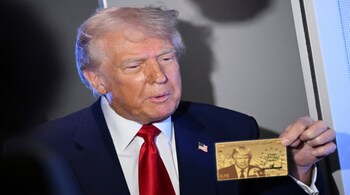
Since its flashy unveiling aboard Air Force One in April, President Donald Trump’s $5 million “gold card” visa has been promoted as a cornerstone of his second-term immigration agenda. Marketed to the global ultra-wealthy as a fast-track to US residency, the programme was hailed by the Trump administration as a way to raise unprecedented revenue and clear bureaucratic bottlenecks for rich applicants. But months later, legal experts, immigration attorneys, and even government officials say the programme has no legal footing — and may never materialize at all, the Washington Post reported.
While the Commerce Department launched a website in June to build a waiting list and touted interest from more than 70,000 potential applicants, no formal application process exists. Behind the scenes, internal records and interviews reveal confusion, legal warnings, and an absence of any legislative action — all signs that the gold card remains more political theatre than policy reality.
No law, no visa
At the heart of the issue is a simple legal barrier: the president cannot unilaterally create new visa categories. That power belongs to Congress, and lawmakers — especially in the current Republican-controlled House — have shown little appetite for immigration expansions of any kind.
“There’s no lawful basis to do this,” said Doug Rand, a former adviser to the director of US Citizenship and Immigration Services under President Biden. “If they do it anyway, they’re going to get sued, and they’re almost certainly going to lose.”
Trump’s Commerce Secretary Howard Lutnick, a hedge fund executive now leading the rollout, has floated the idea that the gold card could replace the EB-5 investor visa, which already allows wealthy foreigners to invest in the US economy in exchange for permanent residency. But the EB-5 is governed by existing law — any attempt to bypass it would likely trigger legal challenges, especially if it leapfrogged those waiting in a years-long backlog.
George Fishman, a senior legal fellow at the Center for Immigration Studies and a former DHS deputy general counsel, said the Supreme Court has repeatedly upheld Congress’s “plenary power” over immigration. “I’m very dubious it can be done without an act of Congress,” Fishman said.
A contradiction in immigration policy
The gold card proposal underscores a broader contradiction in Trump’s second-term immigration platform: aggressive restrictions for most migrants, but a fast lane for the global rich. Critics say this bifurcated approach — deporting asylum seekers while rolling out red carpets for millionaires — commodifies access to the United States and undermines the principles of equitable immigration.
“It’s pay-to-play residency,” said Kate Hooper, a senior policy analyst with the Migration Policy Institute. “And globally, we’ve seen this model falter.”
Indeed, other countries have recently scrapped or scaled back similar “golden visa” programmes. Spain, for instance, ended its scheme after a boom in luxury real estate triggered housing inflation and public backlash. Caribbean nations such as Antigua and Barbuda still offer citizenship for as little as $230,000 — a fraction of Trump’s proposed $5 million price tag.
No infrastructure, no transparency
According to internal DHS sources cited by The Washington Post, officials were asked to create a data-sharing pipeline in mid-April to process gold card applications. Though the infrastructure was built within a week, no applications ever arrived, and the programme remains stuck in legal and logistical limbo.
Meanwhile, the administration has not clarified whether the gold card would grant temporary or permanent status, how applicants would be taxed, or what security and vetting mechanisms would be applied. Immigration attorneys warn clients not to waste time signing up for a non-existent programme.
“There’s no application. There’s no law. There’s no criteria,” said Ron Klasko, a Philadelphia-based immigration attorney. “I tell my clients there’s no point until we see what, if anything, gets passed.”
Buffalo-based attorney Rosanna Berardi echoed that sentiment: “This administration keeps forgetting that the executive branch doesn’t make the law.”
A glitzy vision meets economic fantasy
In public comments, Lutnick has painted a grandiose vision for the gold card’s potential. He told Axios and the Financial Times that the proceeds from 260,000 visas — or roughly $1.3 trillion — could wipe out the federal deficit. He also floated the idea that 7 million buyers could eventually erase the $36 trillion national debt.
But experts say such projections are detached from both political and demographic reality. The UBS Global Wealth Report estimates there are about 33.5 million millionaires outside the US, many of whom already have legal access. Whether even a small portion would pay $5 million for a US residency card with no legal standing remains in serious doubt.
The plan’s origins trace back to conversations involving hedge fund manager John Paulson and executives from Elon Musk’s US DOGE Service, which created a flashy promotional website promising that “The Trump Card Is Coming.” But without legislation or legal authority, critics say, all that’s coming is another campaign talking point — not a functioning visa programme.
Discover the latest Business News, Sensex, and Nifty updates. Obtain Personal Finance insights, tax queries, and expert opinions on Moneycontrol or download the Moneycontrol App to stay updated!





