

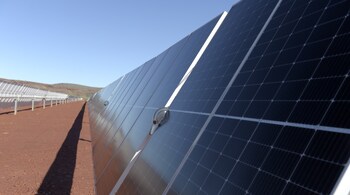


On a weekday morning in Cape Town, dentist Ismet Booley can drill, X-ray and sterilise equipment without worrying whether the lights will flicker off mid-procedure. A few years ago, that was not guaranteed. Power cuts routinely forced him to cancel appointments. Today, his clinic runs on rooftop solar panels and batteries, part of a rapid, largely unplanned energy transition spreading across Africa.
This shift is not being driven by grand government programmes or climate pledges. It is happening panel by panel, rooftop by rooftop, because Chinese-made solar equipment has become cheap enough to make economic sense for households and businesses battered by unreliable grids, the New York Times reported.
From emergency backup to primary power
For years, solar in much of Africa meant small lanterns or a single panel powering a television. That has changed dramatically. Businesses now install systems large enough to run factories, shopping malls, wineries and mines. In South Africa alone, private solar capacity has jumped from negligible levels in 2019 to roughly a tenth of national generating capacity, according to figures cited by energy analysts quoted in The New York Times.
What began as a hedge against rolling blackouts has become a structural shift. Solar plus batteries now often costs less over time than grid electricity or diesel generators. For businesses like Lanzerac Wine Estate in Stellenbosch, managers told reporters that once the system is paid off, electricity will be close to free for most of the year.
Why China sits at the centre of the boom
The price collapse is largely the result of China’s dominance of global solar manufacturing. Chinese firms produce the majority of the world’s panels, batteries and inverters, driving prices down through scale and aggressive competition. According to trade data reviewed by the British energy think tank Ember and reported by international media, Chinese solar exports to Africa surged by about 50 percent in the first ten months of 2025 alone.
Tariffs and trade barriers have limited Chinese solar penetration in the United States and Europe. Africa, where an estimated 600 million people still lack reliable electricity, has become a natural growth market. Chinese state-owned firms are also moving beyond equipment sales, bidding to build and operate transmission lines and utility-scale solar farms in countries such as South Africa.
Utilities caught in a “death spiral”
The spread of private solar is creating serious challenges for state-owned utilities. In South Africa, Eskom’s business model was already under strain from ageing coal plants, mismanagement and years of load shedding. Each new rooftop installation reduces demand from paying customers, cutting revenue further.
Energy officials and analysts have described this feedback loop as a “death spiral”: better-off customers install solar, Eskom loses income, tariffs rise, and even more consumers look for ways to exit the grid. Reporting by The New York Times notes that even senior government officials have quietly installed panels at home.
Eskom is now trying to adapt rather than resist. It has relaxed licensing rules, allowed households to sell excess power back to the grid and introduced fixed connection charges so customers pay even if they generate their own electricity. The utility also plans to build solar farms on the sites of decommissioned coal plants, acknowledging that the old model is no longer viable.
Unequal gains, unresolved gaps
While solar is transforming daily life for businesses and middle-class households, it is doing far less for the poorest. Even with falling prices, upfront costs remain out of reach for many. In low-income townships, small entrepreneurs told reporters they still rely on unreliable grid power, unable to finance systems large enough to support their operations.
This raises a deeper concern. Africa is importing high-value clean energy technology while exporting raw materials, reinforcing old trade patterns. Researchers at South African think tanks have warned in interviews that jobs are being created in Chinese factories, not African ones. Local manufacturing requirements could change that, but would push prices higher, slowing adoption.
Geopolitics behind the panels
The solar surge is also reshaping geopolitics. As relations between South Africa and the United States have cooled under new trade tariffs and diplomatic tensions, Beijing has positioned itself as a dependable partner. Chinese firms are bidding for long-term contracts to build and operate transmission infrastructure, a sensitive sector traditionally seen as a national security asset.
South African officials insist the grid will remain state-owned and secure, but analysts note that similar build-operate arrangements elsewhere have given Chinese companies long-term influence over strategic assets.
A bottom-up energy transition
Despite these risks, the momentum behind cheap solar appears unstoppable. The appeal is simple: it works. Clinics can treat patients, factories can meet deadlines, hotels can host guests without the growl of diesel generators. For retirees like Booley, solar has removed a lingering fear of unaffordable electricity bills in old age.
Africa’s energy transition, unlike Europe’s or America’s, is not being led by policy mandates or climate targets. It is being driven by consumers responding to broken systems and falling prices. Cheap Chinese solar has not solved the continent’s deepest economic problems, but it has given millions a measure of control over something basic and essential: the power to keep the lights on.
Discover the latest Business News, Sensex, and Nifty updates. Obtain Personal Finance insights, tax queries, and expert opinions on Moneycontrol or download the Moneycontrol App to stay updated!





