

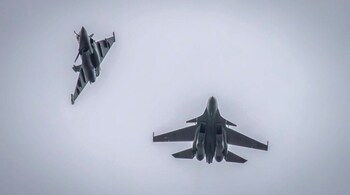
A gradual easing of India-China tensions after the Shanghai Cooperation Organisation (SCO) Summit has been overshadowed by new accusations from a United States congressional advisory body. The US-China Economic and Security Review Commission has alleged that Beijing is running a large-scale “disinformation campaign” using artificial intelligence to manipulate narratives following India’s Operation Sindoor.
According to the Commission’s annual report to Congress released on Wednesday, China allegedly deployed fake social media accounts and AI-generated images to spread misinformation about the aftermath of the India-Pakistan conflict earlier this year. “Beijing used fake social media accounts to propagate AI images of supposed ‘debris’ from planes,” the report said, claiming that Chinese operators circulated doctored visuals of Indian and French aircraft allegedly destroyed by Chinese weapon systems.
Beijing’s campaign to undermine Rafale and promote J-35
The Commission said the objective of this campaign was to undermine confidence in the French-made Rafale jet—operated by the Indian Air Force—and boost the credibility of China’s next-generation J-35 fighter aircraft in global arms markets. The disinformation drive, it noted, fits into China’s broader Grey Zone strategy, a set of tactics aimed at influencing global opinion and advancing Beijing’s interests without direct military engagement.
The report added that China “opportunistically” used the India-Pakistan confrontation in May to showcase its military technology and project an image of superiority. This propaganda, the Commission warned, served two purposes: to reinforce China’s posture amid its continuing border standoff with India, and to support its growing ambitions in the global defence export market.
Operation Sindoor and Pakistan’s losses
India launched Operation Sindoor in May in retaliation for the Pahalgam terror attack in April, which claimed 26 civilian lives. The counter-operation targeted terror infrastructure and Pakistani military assets inside the country.
In August, Air Chief Marshal AP Singh confirmed that the Indian Air Force destroyed five Pakistani fighter jets and a major airborne surveillance aircraft during the operation. The strikes dealt a significant blow to Pakistan’s air capabilities and further weakened Islamabad’s position internationally, as it struggled to deflect evidence of its continued harbouring of terror networks.
The US Commission’s findings suggest that China sought to exploit Pakistan’s humiliation, attempting to manipulate international opinion through digital propaganda rather than confronting India directly.
The uneasy India-China equation
The Commission’s report also assessed the shifting dynamics between India and China, calling their relationship “fundamentally asymmetric.” It noted that China has relied on high-profile diplomacy to create an illusion of progress on the border issue, while continuing to compartmentalise disputes to maintain economic engagement on its own terms.
India, however, has maintained that relations cannot return to normal until the border situation is fully resolved. The report pointed out that New Delhi has grown increasingly alert to the seriousness of Beijing’s military posture along the Line of Actual Control (LAC).
Despite rounds of diplomatic dialogue, the Commission said recent India-China agreements remain “largely conceptual,” offering no concrete mechanisms or real progress. Beijing’s approach, it warned, continues to prioritise optics over substance.
Dalai Lama issue could reignite tensions
Another potential flashpoint identified in the report is the succession of the Dalai Lama, which could further strain ties between India and China. The Commission said the situation may deteriorate depending on how both governments position themselves on the issue.
It remains uncertain, the report added, whether recent diplomatic gestures signify a genuine thaw or are part of India’s strategic hedging amid fluctuating relations with Washington.
India balances China and US
Prime Minister Narendra Modi’s visit to China for the SCO Summit, where he met Presidents Xi Jinping and Vladimir Putin, was viewed by Washington as a balancing move, especially after the US imposed 50 per cent tariffs on Indian goods earlier this year.
Despite recent friction, India-US ties are showing signs of stabilisation. American officials expect an initial trade package to be announced soon, marking the beginning of a reset in economic relations.
Beijing and Islamabad: A partnership in misinformation
The US report’s findings portray a China increasingly willing to act as Pakistan’s digital and diplomatic shield, even as Islamabad faces global condemnation for sponsoring terrorism. By orchestrating fake AI-generated narratives, Beijing appears intent on undermining India’s military achievements and sowing doubt about Western defence technology, all while hiding behind its propaganda machinery.
For India, the message is clear: even as border diplomacy resumes, China’s hybrid warfare and Pakistan’s terror ecosystem remain deeply interconnected, posing a persistent threat to regional stability.
Discover the latest Business News, Sensex, and Nifty updates. Obtain Personal Finance insights, tax queries, and expert opinions on Moneycontrol or download the Moneycontrol App to stay updated!





