

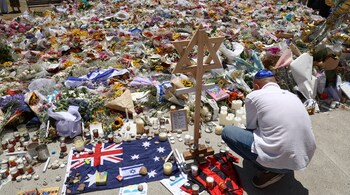
The deadly shooting at Sydney’s Bondi Beach has once again drawn attention to a problem Australia has grappled with for more than a decade: the enduring footprint of the Islamic State and its ability to inspire violence far beyond its former territorial strongholds in the Middle East.
The attack, in which 15 Jewish people were killed during a Hanukkah event, is the most lethal Islamist terror incident in Australia in years. Authorities say it was carried out by a father-and-son duo allegedly inspired by Islamic State ideology, underlining that despite losing its so-called caliphate in 2019, the group’s influence has not disappeared.
Bondi Beach attack and official response
Naveed Akram, 24, and his father Sajid Akram, 50, opened fire at the event in Bondi Beach. Sajid Akram was shot dead by police at the scene, while Naveed Akram survived and later regained consciousness in hospital. He has since been charged with 59 offences, including 15 counts of murder.
Australian Prime Minister Anthony Albanese said investigators believe the attack was ideologically driven. “Radical perversion of Islam is absolutely a problem,” Albanese said. At a later press conference, he added, “It would appear that there is evidence that this was inspired by a terrorist organization, by ISIS. Some of the evidence which is being procured, including the presence of Islamic State flags in the vehicle that has been seized, are a part of that.”
The shooting has revived concerns within Australia’s security establishment, which had assessed the terror threat as “probable” as recently as September 2024, meaning there was more than a 50 percent chance of an onshore attack within a year.
Australia’s long struggle with Islamic State
Australia’s encounter with Islamic State is neither recent nor limited to lone attacks. Between 2012 and 2019, more than 200 Australian citizens travelled to Syria and Iraq to join the terror group, according to Australia’s national security agency. Dozens more supported ISIS through financing, recruitment or planning attacks at home.
“Australians fighting with Islamic State have been involved in acts of violence including suicide bombings and holding the decapitated head of a Syrian soldier following Islamic State beheadings,” the agency notes on its website. “These incidents have subsequently been used in Islamic State’s propaganda campaign.”
In September 2014, ISIS openly called on its supporters to carry out attacks against Australia and other Western nations “wherever, whenever and however” possible. Just months later, Australian citizen Man Haron Monis took hostages inside a Sydney cafe. Monis, who had sworn allegiance to ISIS, died along with two civilians.
Australian authorities acknowledge that while ISIS no longer controls territory, its ideological pull remains. “Islamic State retains an enduring presence” in extremist online spaces, the national security agency says, adding that its propaganda “exposed susceptible Australians to an extremist ideology and influenced some toward radicalization and violence.”
Global context and why ISIS still matters
The Bondi Beach attack came just a day after another ISIS linked assault in Syria, where two US soldiers and an American civilian interpreter were killed near Palmyra. Together, the incidents have reinforced warnings from counterterrorism experts that the group remains a global threat.
“The group’s never been defeated. That’s to say nothing about its ideology, which continues to resonate clearly with individuals around the globe,” Colin Clarke, executive director of the Soufan Center, told TIME.
Clarke said ISIS no longer operates as a unified force but remains influential. Around 2,500 ISIS fighters are still estimated to be active in Syria and Iraq. He also warned that global focus has shifted away from counterterrorism. “After 20 years of the global war on terrorism, there was a certain amount of fatigue that set in,” he said. “We’ve shifted resources to other things like the rise of China, Russia’s war in Ukraine, the Israeli war against Hamas and Gaza. But terrorism will continue to remain a threat for the foreseeable future. It’s a tactic, so it’s not something that can be defeated.”
Austin Doctor, director of strategic initiatives at the National Counterterrorism Innovation, Technology, and Education Center, echoed that assessment. “The public record is clear that ISIS [is] remaining active. The related threat is not going away any time soon,” he told TIME.
Southeast Asia link and antisemitic targeting
Investigators have revealed that the Bondi Beach attackers travelled to the Philippines a month before the shooting, raising concerns about possible overseas radicalisation or logistical support. Southeast Asia has long been a hub for jihadist networks.
“There’s a number of groups that have popped up over the years,” Clarke said, pointing specifically to the Abu Sayyaf Group, ISIS’s East Asia affiliate. While weakened, he said it still has “the ability to provide logistical support, training, and provide inspiration to individuals that live in the West and harbor grievances that dovetail with ISIS ideology.”
The Bondi attack also fits into a broader pattern of ISIS driven antisemitism. In February 2023, the group’s weekly publication Al Naba ran an article explicitly titled “Kill the Jews,” calling for attacks on Jewish communities worldwide.
Australia’s counterterrorism response
Australia designated Islamic State as a terrorist organisation as early as 2005, under one of its earlier names, and has repeatedly relisted it under evolving aliases. Canberra has also worked closely with international partners, including India and the United States, to track recruiters and fighters.
Former foreign minister Julie Bishop summed up the challenge in 2015 when she said, “We are witnessing a more complex, more global, more dangerous form of terrorism than ever before. It is exemplified by IS in the Middle East. We are affected; in fact, very few countries are immune from this.”
The Bondi Beach shooting has reinforced that assessment. While ISIS may no longer hold territory, its ideology, networks and capacity to inspire violence continue to pose a serious threat to Australia’s security, one that authorities say cannot be underestimated or ignored.
Discover the latest Business News, Sensex, and Nifty updates. Obtain Personal Finance insights, tax queries, and expert opinions on Moneycontrol or download the Moneycontrol App to stay updated!





