

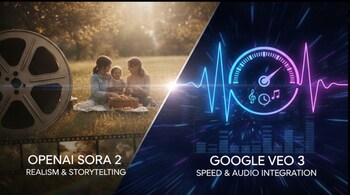
OpenAI has just announced its latest AI video generation model -- Sora 2. The model takes upon the likes of Google's recently updated Veo 3 model which also claims to deliver realistic looking gen AI videos. Talking about Sora 2, OpenAI says that it is the GPT 3.5 moment for AI video generation, a big step up over the original Sora model. Similarly, Google calls, the Veo 3 their most advanced video language model.
Having said that, the competition in generative video technology has moved beyond silent clips and basic animations. With OpenAI’s Sora 2 and Google’s Veo 3, two distinct approaches are shaping how creators, developers, and platforms think about video-AI. Both models integrate video and audio, support controllability, and target professional as well as creator workflows, but they diverge significantly in strengths, priorities, and availability.
Core focus and positioning
Sora 2 is designed as a general-purpose video-audio model that emphasises realism, physics fidelity, and narrative continuity. OpenAI has positioned it as a creative co-pilot for longer, storyboarded sequences, with features like multi-shot control and persistent world state. A standout addition is “cameos”, allowing users to insert a likeness and voice into generated scenes. Veo 3, by contrast, takes a platform-centric approach. Google stresses native audio-video synthesis, rapid creation, and seamless distribution through YouTube Shorts and the Gemini API, making it appealing for fast-turnaround creator workflows.
Audio integration
Both models break away from silent video generation, but their emphasis differs. Sora 2 integrates synchronised dialogue, sound effects, and full soundscapes in ways that match the physical dynamics of a scene. Veo 3 builds audio into its core architecture, treating speech, music, and effects as part of the same generation pass. With Veo 3 Fast, creators can rapidly output Shorts with audio in a single step, while Sora 2’s audio strength lies in consistency with visual physics.
Visual fidelity and control
On the visual side, Sora 2 prioritizes realism and physically plausible motion. Examples include gymnastic sequences or buoyancy simulations that showcase its ability to handle both success and failure under physics constraints. Multi-shot editing and steerability allow creators to build narrative continuity. Veo 3 instead highlights cinematic quality, efficient pipelines, and flexible tiers that allow for both 1080p and limited 4K generation. For rapid ideation, Veo 3 Fast favors speed over depth, while the main Veo 3 tier supports longer, higher-fidelity videos.
Ecosystem and integration
Sora 2 is being rolled out gradually via an invite-based iOS app in North America, with sora.com access and planned API availability. OpenAI has also hinted at a Sora 2 Pro tier linked to ChatGPT Pro users, suggesting a service model that spans consumer creativity and developer access. Veo 3 is already embedded into Google’s ecosystem, with Gemini API access for developers and direct YouTube integration for creators. This makes Veo 3 easier to adopt at scale today, particularly for social video production.
Both companies highlight safety and provenance. Sora 2 includes a system card addressing risks around likeness misuse and adds provenance controls to its app. Veo 3 leverages SynthID watermarking and YouTube’s expanding detection tools to prevent unauthorized AI content.
Which is the right one for you
For creators who need physics-aware realism, multi-shot storytelling, and cameo features, Sora 2 is better suited, though access remains limited. For those who value speed, integrated audio, and direct distribution, especially through YouTube and Gemini API, Veo 3 is the more practical choice today.
Discover the latest Business News, Sensex, and Nifty updates. Obtain Personal Finance insights, tax queries, and expert opinions on Moneycontrol or download the Moneycontrol App to stay updated!





