

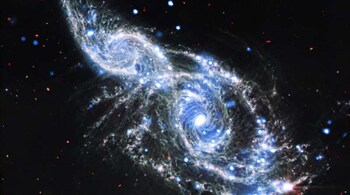

- A new image combining James Webb and Chandra data shows two spiral galaxies caught after a close encounter. Infrared and X-ray views reveal warped arms, heated gas and bursts of star formation. Although the near pass was brief, gravity will slowly draw the galaxies together, leading to a full merger over billions of years and reshaping their structures and future evolution.

A newly released composite space image is giving astronomers a rare and detailed view of two spiral galaxies caught in the early stages of a long cosmic collision. Released on 01/12/2025, the image combines observations from NASA’s James Webb Space Telescope and the Chandra X-ray Observatory, revealing how a brief close encounter millions of years ago continues to shape both galaxies today.
What the Webb and Chandra image reveals
The image blends mid-infrared data from Webb, shown in white, grey and red, with X-ray observations from Chandra highlighted in blue. Together, these wavelengths uncover structures invisible to ordinary light. Webb’s infrared view traces warm dust and dense regions where new stars are forming, while Chandra’s X-ray data exposes extremely hot gas created by energetic processes. Astronomers say this layered approach allows them to see how matter responds when galaxies interact, offering a more complete picture of the forces at work.
How gravity reshaped the spiral galaxies
Scientists explain that the two spiral galaxies passed close to one another millions of years ago, briefly but powerfully influenced by mutual gravity. During this encounter, their spiral arms were stretched and distorted, compressing clouds of gas and dust. This compression triggered bursts of star formation, while shock waves heated surrounding material to millions of degrees. The resulting hot gas emits X-rays, marking regions of intense activity caused by the interaction rather than direct stellar collisions.
What the collision means for the future
Although the closest approach is now over, astronomers say the consequences will unfold over billions of years. The galaxies are gradually losing orbital energy, a process that will draw them closer together over time. Eventually, they are expected to merge into a single, larger galaxy, reshaped by a long and complex gravitational history. Such mergers are common in the universe and are believed to play a major role in galaxy growth and evolution.
Researchers use images like this to compare real observations with computer simulations, testing theories about how galaxies change during encounters. By combining Webb’s sensitivity to dust and star-forming regions with Chandra’s ability to trace hot gas, scientists can better understand how energy moves through colliding systems. Future multiwavelength observations are expected to refine models of galaxy mergers, offering further insight into how brief cosmic meetings can shape structures lasting billions of years.
Discover the latest Business News, Sensex, and Nifty updates. Obtain Personal Finance insights, tax queries, and expert opinions on Moneycontrol or download the Moneycontrol App to stay updated!





