

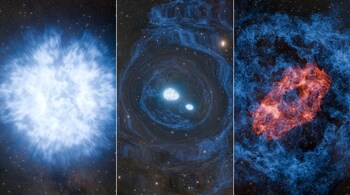
On 15 December, astronomers reported evidence suggesting a rare stellar explosion combining a supernova and kilonova, raising fresh questions about how stars die and heavy elements form.
Researchers believe the event may represent the first observed superkilonova. Such an explosion would combine two very different cosmic deaths. Scientists say confirmation could alter current stellar evolution models.
A supernova occurs when a massive star collapses violently. The blast leaves behind a neutron star or black hole. These explosions are common, with about 20,000 observed yearly. Astronomers regularly detect them across the observable universe.
A kilonova is far rarer and harder to observe. Only one confirmed example was recorded in 2017. Kilonovas occur when two neutron stars collide. They produce gravitational waves and forge heavy elements like platinum.
Signals from AT2025ulz raise questions
The new event was detected on 18 August 2025. It was first spotted by the LIGO observatory. Scientists named the signal AT2025ulz for tracking. The gravitational waves closely resembled the 2017 kilonova signal.
After the alert, telescopes worldwide began follow-up observations. They monitored visible, infrared, X-ray, and radio emissions. Early observations strongly resembled a known kilonova event.
Mansi Kasliwal from Caltech’s Palomar Observatory described the shift. For three days, the signal matched previous kilonova behaviour. Then its colour brightened and turned blue. Hydrogen signatures also began appearing clearly.
Red wavelengths initially suggested heavy element production. That matched expectations following a neutron star collision. Over time, the evolving signal resembled a supernova explosion. Some researchers lost interest, but Kasliwal’s team continued.
How a supernova and kilonova might connect
Scientists propose one explanation linking both explosions together. The original star may have collapsed into two neutron cores. These cores later collided, producing a kilonova shortly after. Such a sequence requires an unusually fast spinning star.
One theory suggests the stellar core split through fission. Another suggests a disk formed around one neutron star. That disk could clump into another neutron star. Both processes remain theoretical and unproven.
Small neutron stars have never been directly observed. Scientists also caution the signals may be unrelated. Two nearby events could have occurred coincidentally. Further observations are required to rule this out.
Kasliwal said certainty remains out of reach for now. However, she described the event as eye opening. Researchers say future detections will be decisive. Astronomers worldwide will watch carefully for similar signals.
The findings were published on 15 December. The study appeared in The Astrophysical Journal Letters.
Discover the latest Business News, Sensex, and Nifty updates. Obtain Personal Finance insights, tax queries, and expert opinions on Moneycontrol or download the Moneycontrol App to stay updated!





