

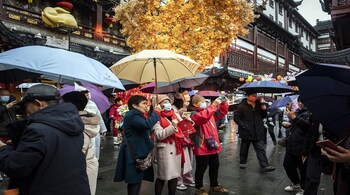
Tourist spots were swamped, movie theaters were packed and fireworks displays lit up the night sky as China celebrated the Lunar New Year with an abandon that marked the end of its three-year Covid Zero experiment.
The sudden dismantling of China’s Covid restrictions in December allowed everyone to travel and freely mingle for the country’s most important festival for the first time since 2019. More than 300 million trips were made during the holiday, nearly 90% of pre-pandemic levels, according to the Ministry of Culture and Tourism.
The upbeat mood is good news for the Chinese economy and President Xi Jinping after widespread public anger over the zero tolerance policy erupted late last year, which raised uncomfortable questions and created the potential for backlash. While the revelry is a relief after recurring lockdowns, it also carries the risk of reigniting the omicron wave that scorched the country in recent weeks, filling hospitals and overwhelming crematoriums.
“Pent-up demand is being released as many people rush to scenic spots, watch firework shows and crowd into restaurants and hotels,” Ting Lu, chief China economist at Nomura Holdings Inc., wrote in a note on Thursday. Government-released data “suggest the ‘exit wave’ is quickly coming to an end.”
Unrivaled Reopening
The speed with which China charged through its reopening is unrivaled. A month ago, the government estimated 37 million people a day were contracting the virus. The streets went quiet. Just as quickly, the population appears to have turned the page.
Nevertheless, it remains unclear how severe and widespread the outbreak is. The government stopped universal testing and changed how it defines Covid mortality, clouding official reports. According to a report from the Chinese Center for Disease Control and Prevention on Wednesday, the number of patients hospitalized with severe disease or dying from Covid has declined more than 70% from the peak in early January.
While extreme weather in some regions exacerbated traffic, many people were undaunted by the challenge or the risk of supercharging the world’s biggest Covid outbreak. Total bookings were four times higher than last year, when strict measures limited travel as well as the spread of the virus, according to Trip.com.
The jubilation of reopening was mixed with tourism-related headaches. Carol Gong, who reunited with her family in Shanghai, was overwhelmed by the crowds during a day trip to Disneyland.
“It looked as if we were watching a zombie movie, as people lined up heel-to-heel and shoulder-to-shoulder in a meandering queue,” said Gong, who waited an hour in freezing weather to get into the theme park. Still, it was worth it, she said. “People are so relieved that China has reopened. They’re starting to relax and enjoy life.”
The box office outstripped last year’s receipts and crowd control was necessary in some tourist sites like the jagged mountain ranges in Anhui province. In Huangshan, or Yellow Mountains, there were reports some people were stranded for hours into the night in the snow.
And the symbolic Spring Festival gala, a televised variety show with music, dancing and comedy performances to welcome the New Year, made no significant mention of the virus. Members of the live audience didn’t wear masks.
Local governments across China abandoned curbs on fireworks displays after unusually violent altercations between revelers and police. The move freed people in cities including Kunming, Zhengzhou and Hangzhou to mark the holiday in the traditional way. Regional media reported an exponential rise in demand. The cost of one popular brand, the Gatling, shot up to as much as 200 yuan per stick from 20 yuan before the holiday.
Surging Demand
Consumption, already on the rise, is expected to lead a rebound after China’s economy grew at its second-slowest pace since the 1970s in 2022 due to Covid disruptions. Consumer spending on the Ant Group Co.’s payment platform Alipay more than doubled at tourist destinations from a year ago, the company said. Searches for hotel bookings surged 600% and hotel spending on the platform jumped 80%, it said.
“The epidemic seemed to disappear from the vast majority of people suddenly,” Hu Xijin, former editor-in-chief of the state-owned tabloid Global Times, said in a tweet. “The Chinese Lunar New Year is very lively. The consumption has resumed rapidly.”
For people enjoying their first unrestricted visits home for years, it’s the connections that matter the most.
“I’m using this Spring Festival to make up for all the lost reunions in the past three years,” said Catherine Zhou, in Wenzhou of Zhejiang province. “Delayed weddings are taking place. I see so many faces I haven’t met for a long time. The Chinese tradition of getting together has finally restarted.”
Discover the latest Business News, Sensex, and Nifty updates. Obtain Personal Finance insights, tax queries, and expert opinions on Moneycontrol or download the Moneycontrol App to stay updated!





