

To understand why Britain has spiraled into the deepest recession of its modern history, go for a stroll in central London, no longer a ghost town but still a shadow of its once-bustling self.
Shuttered storefronts pock the shopping promenade on Oxford Street. Theaters in the West End are dark, office towers deserted. Below ground, the tube is a grim parade of signs warning passengers to wear face masks and keep their distance. With traffic at barely a quarter of last year’s levels, that is not hard.
Only restaurants, buoyed by a government stimulus program that subsidizes diners’ meals, are showing signs of life. But like the government’s widely praised furlough program that guaranteed 80% of the salaries of millions of workers, the “Eat Out to Help Out” promotion will soon wind down, and the government faces tough choices about whether to extend the support.
Unquestionably, Britain has been laid low by the coronavirus, easily the hardest hit of any European nation, both in public health and the economy.
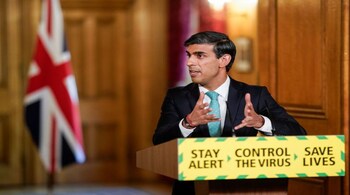
“What we’re grappling with is something that is unprecedented, and we don’t have a playbook for how to deal with it,” the chancellor of the Exchequer, Rishi Sunak, told the BBC on Wednesday after the Office of National Statistics reported that the economy shrank by an unheard-of 20.4% in the second quarter.
That was the deepest quarterly decline of any major European country, and it prompted a fresh round of hand-wringing in Britain, which has also earned the unwelcome distinction of running up the highest death toll from the coronavirus in Europe, with more than 51,000 fatalities.
In part, Britain’s dire economic numbers reflect a quirk of timing: Prime Minister Boris Johnson imposed a lockdown a week later than most of his European neighbors and lifted the restrictions later as well. That means Britain sustained more damage in the second quarter than France, Italy or Germany, which began reopening during that period.
But Britain’s economic woes are also linked to its broader ordeal with the virus. Because its outbreak was so widespread, prolonged and deadly, economists said, the fear of contagion continues to be higher in Britain than elsewhere. Despite the government’s urging, people have yet to resume normal lives, particularly in cities like London, where working from home is an alternative for many.
Google, which uses cellphone signals to track foot traffic to offices, shops, restaurants and transit stations, shows that commercial activity in Britain has trailed Germany, France, Italy and Spain since mid-May, though the gap has begun to narrow.
“If you have a massive outbreak, people are going to respond by being cautious and it will take a while for confidence to return,” said John Springford, deputy director of the Center for European Reform, a research institute. “It makes sense that London is going to be among the hardest hit places.”
For all its talk about reopening, Britain still has the strictest set of restrictions in place of any major European country, according to Oxford University’s Blavatnik School of Government, which tracks the stringency of government-imposed restrictions, from schools and workplace closings to travel bans.
It is even more locked down than Spain, which has recently seen a spike in infections that prompted the British government to impose a 14-day quarantine on people who traveled there and returned to Britain.
Like Spain, Britain is particularly vulnerable to a sudden decline in consumption because its economy is more dependent on services, including tourism and hospitality, than those of Germany or France. Economists said it was no accident that Spain’s second-quarter contraction, at 18.5%, was closest to that of Britain. The German economy, with its extensive industrial base, shrank by 10.1% while France’s fell 13.8%.
None of this eases the pressure on Johnson’s government, which has come under harsh scrutiny for its handling of the pandemic. Until now, its economic measures have insulated people from the sudden dislocation of losing their livelihoods.
But Sunak insisted the government will stop subsidizing wages altogether at the end of October. He has so far resisted fierce pressure from the opposition and other critics to soften his stand.
“A downturn was inevitable after lockdown, but Johnson’s jobs crisis wasn’t,” said Anneliese Dodds, the Labour Party’s shadow chancellor, who said the government must continue targeted support for vulnerable workers.
Sunak contends the government cannot guarantee wages indefinitely because some jobs are never going to come back after the pandemic. Encouraging people to look for new jobs is vital to giving them a sustainable future.
Still, a huge spike in the unemployment rate will be hard for Johnson’s Conservative government to withstand, especially since it ran on a platform of bringing prosperity to Britain’s industrial north. The drumbeat of job losses is already underway: On Tuesday, troubled department store chain Debenhams announced 2,500 job cuts on top of a previously announced 4,000.
Critics said it was unreasonable for the government to force people back into the job market when Britain’s test, trace and isolate system was not robust enough to give them confidence that they can move around safely. That is particularly true in parts of the country like Leicester and Greater Manchester that have suffered fresh outbreaks and have been put under local lockdowns.
“The government has taken a one-size-fits-all approach to ending the job retention program,” said James Smith, research director at the Resolution Foundation, a London research institute. “But the economic response has to be targeted to where the economy is hardest hit.”
Sunak has tried to do that with “Eat Out to Help Out,” a 500 million-pound ($654 million) program to bolster the beleaguered restaurant industry by subsidizing the meals of customers by up to 10 pounds ($13) per person. As of Aug. 9, the government said people had bought 10.5 million meals using the incentive.
At the German Gymnasium, a cavernous restaurant next to Kings Cross railroad station, the promotion drew a respectable crowd Tuesday night — comparable, General Manager Sam Bernard said, to a weekend night. He said his only request would be for the government to extend it to Thursday night.
Like most restaurants, the German Gymnasium faces murky prospects. It depends on business from Google and Facebook, which have offices nearby. But both companies have told their employees they can work from home until at least next summer. And the government’s subsidy ends on Aug. 31.
“We can’t rely on government support forever,” Bernard said. “If it does stop, we will just have to fend for ourselves and think a bit outside the box.”
c.2020 The New York Times Company
Discover the latest Business News, Sensex, and Nifty updates. Obtain Personal Finance insights, tax queries, and expert opinions on Moneycontrol or download the Moneycontrol App to stay updated!





