

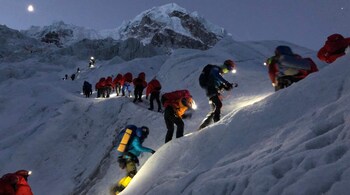
The Sherpas have been integral to mountaineering, especially in the Himalayas. Without them, several successful expeditions on mountains over 8,000 metres would have been non-starters. They are the ones who sets the ropes on Everest and guide hundreds of climbers across the forbidding Khumbu Icefall each climbing season. And yet, not much is known about them beyond this idealised view of a hardy, welcoming mountain people.
Does the modern generation of Sherpas - some of them are mountaineering celebrities in their own right - have a different relationship with Everest and other eight thousanders as compared to their forefathers?
Pradeep Bashyal: This is a question that often crossed our minds while we were working on the book. It is quite natural to begin with the hypothesis that with changing times and socio-economic realities, the priorities of Sherpas and their relationship with the mountains may have changed. However, our finding was quite the opposite.
It is true that Sherpas have grown to become mountaineering celebrities in their own right, and lead expeditions both in Nepal and globally. But no matter how high they may have gone, and how vastly the narrative defining them may have changed over the years, the Sherpas we met during our research were all closely attached to their grounds – the mountains.
If we start connecting the dots between a modern-day celebrity Sherpa and good old Tenzing Norgay, the big picture that will emerge will tell us the same story of the Sherpas’ bonding with the mountains.
Mountaineers such as Nims Purja want the role of Sherpas to be acknowledged. Are there any like him in the Sherpa community? (Purja summitted all 14 8000-metre peaks in the world in a record six months and six days in 2019; in January 2021, he and his team of nine Sherpas became the first group of climbers to summit K2 in winter.)
The work of Nims Purja is a clear statement that Sherpas are no longer going to remain invisible. Purja fully highlights their invaluable contribution to making his mission possible. Like Purja, there are many within the Sherpa community who think it is high time the world gave them their long overdue recognition as the guardians of the mountains. The work and achievement of many Sherpas are only noticed when they break records. For example, we know Kami Rita Sherpa has climbed Everest for the most number of times, but we usually have no idea about who his challengers are. When only the records are acknowledged, the Sherpas' invaluable contribution to the industry, their sacrifices, among others, get easily overlooked. The Sherpas we met while writing this book, especially those from younger generations, feel that Sherpas should be acknowledged not just in terms of the numbers they achieve, but also for their wider contribution to the history of climbing, their sacrifices, and devotion.
Also read: Mountaineer Nims Purja: "Whatever you do in life... it’s about how you achieve those goals"
How central was Darjeeling to the development of Sherpas as the ultimate mountaineers?
Ankit Babu Adhikari: Before Nepal opened up for -tourists/foreigners/climbers in the 1950s, Darjeeling was the absolute hub for all climbing activities. In that sense, Darjeeling has witnessed a significant part of the world’s climbing history. All early expeditions since the 1920s, right from the time of George Mallory, were planned and operationalised in Darjeeling. Sherpas were recruited and trained in Darjeeling. In a way, we can say that Darjeeling was the life and blood of climbing before climbers found an easier access directly through Nepal. That’s how Tenzing Norgay, Ang Tharkay, Nawang Gombu, Kushang Lama, all ended up in Darjeeling. There was a time when the Sherpas used to have Darjeeling Dreams, just like most people today dream of going to the US. And Darjeeling has given a lot back to the Sherpas. They have made it their home, started families there, and received recognition and prestige.
You write in your book that the Sherpas took to mountaineering relatively recently, and obviously it has benefitted them immensely. But there is always the other side of the coin…
ABA: That’s true. People started showing up in the Sherpa villages of Khumbu only when the first mountain explorers from Great Britain started getting interested in Mount Everest.
Before that, the Sherpas’ only major source of livelihood was their trade with Tibet. Yet, that trade was hardly enough to sustain their needs and it came to an end when China entered the picture in the late 1940s and '50s.
However, the Sherpas’ mother goddess Miyolangsangma, believed to be the resident goddess of Mount Everest and known for her giving nature, had different plans for her children.
China occupied Tibet in 1951. Two years later, Tenzing Norgay Sherpa and Edmund Hillary reached the top of Everest for the first time. With this, the Sherpas became popular, and started being recognized for their unique expertise.
However, even after 1953, getting climbing gigs was not easy for many Sherpas, as commercial expeditions simply didn’t exist. The Cold War era saw just a couple of national scale expeditions by rich countries each year and only a limited number of Sherpas got climbing jobs.
When commercial expeditions started taking place after the inception of multiparty democracy in Nepal in 1990, things started changing for the Sherpas.
The other side of the coin, however, is the scale of loss that this community has lived through all these years. Every year Sherpas lose their loved ones in the mountains, trying to make someone else’s dream come true. Their incredible achievements—how can some people keep climbing Everest year after year?—might inspire curiosity and amazement in outsiders like us, but for them, it is their destiny, work that they must stick to, and the only way to make ends meet. Behind every great story of bravery and success is a more tragic one of constant fear, cosmetic smiles, and death.
Which are the other ethnic groups that are steadily entering the trade?
PB: Climbing Everest or guiding people on Everest is no longer limited to Sherpas today. While Sherpas’ geographical, physiological, genetic, and psychological benefits persist when it comes to climbing, with an ever-increasing number of aspiring climbers, the work of guiding them has spilled over from the Sherpa community to other different ethnicities all over Nepal, particularly from hilly regions and some from the lowlands.
This is also evident in the increasing number of climbing guides emerging from countries and villages without any mountains. In today’s technology-backed reality, climbing is more about training, technology, and passion, than just inheritance. With passion, training and technology, anyone can become a climbing guide today. But — it’s kind of funny — anyone from any ethnicity guiding people up on Everest will likely be called a ‘Sherpa’, for that’s how big and all-encompassing this brand has become today.
How has climate change affected the Sherpas?
PB: Nobody will have ever experienced the impact of climate change more than Sherpas themselves. The grazing pastures for the yaks have been engulfed by expanding glacial lakes and the number of yaks has gone down. Unpredictable weather and snow patterns have impacted farming or whatever little of it is practiced at that altitude.
Most significantly, the mountains are changing and so are the climbing conditions and fears associated with climbing. For instance, the treacherous Khumbu Icefall region on Mount Everest is becoming less stable with each passing year.
Avalanches have become more frequent. The crevasses and ice seracs that were mostly evident in Khumbu Icefall region between basecamp and Camp 1 have started showing an upward movement, and climbers sometimes encountered crevasses between Camp 1 and Camp 2 – highly unusual and highly risky.
Due to the melting of snow, the bedrock has surfaced out at many places on the way. Crampons designed to walk on snow are of no use as they can’t hold grip against rock. At such altitudes, climbers can be found struggling to put their crampons on and off. The Sherpas have been raising their voices for more Everest Clean Up campaigns; they are the ones volunteering to carry down garbage from as high as the Death Zone on Everest. Mount Everest is their mother goddess, and they know that she is hurting.
Discover the latest Business News, Sensex, and Nifty updates. Obtain Personal Finance insights, tax queries, and expert opinions on Moneycontrol or download the Moneycontrol App to stay updated!





