

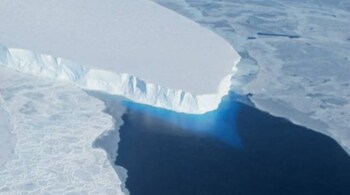
There's a reason why Antarctica's Thwaites Glacier is nicknamed 'Doomsday Glacier': it is one of the largest glaciers in the world with a high risk of collapse and the threat it poses to global sea level.
And, it is melting at a rate much faster than previously anticipated, scientists announced this month. In a study, published in Nature Geoscience, scientists said that a sudden melting event occurred over the course of six months which caused the Thwaites Glacier to retreat as much as 2.1 kilometres per year. That's twice the rate that scientists have observed in the past decade or so, the study stated.
According to People magazine, the Thwaites glacier--about the size of Florida--accounts for around five per cent of Antarctica's involvement in sea-level rise around the world.
Read more: Salty groundwater system found under ice sheet in Antarctica, implicating sea level rise
Robert Larter, a marine geophysicist who co-authored the study, said, "Thwaites is really holding on today by its fingernails, and we should expect to see big changes over small time scales in the future - even from one year to the next - once the glacier retreats beyond a shallow ridge in its bed."
The study also indicated that should the "Doomsday Glacier" dissolve fully, it will lead to four per cent of climate change-caused sea-level rise and its sudden collapse would raise sea levels by another 25 inches causing flooding in low-lying areas and submerging coastal regions.
Read more: In Antarctica, scientists discover 'hidden world' of creatures swimming under ice shelf
Discover the latest Business News, Sensex, and Nifty updates. Obtain Personal Finance insights, tax queries, and expert opinions on Moneycontrol or download the Moneycontrol App to stay updated!





