

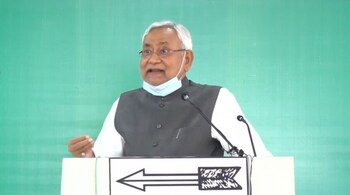
In one of his virtual rallies on October 13, Bihar Chief Minister and Janata Dal (United) president Nitish Kumar said he wanted to learn Urdu language when he was a student, but could not find anyone to teach him.
“I regretted,” said Kumar, who aims at retain power by leading the National Democratic Alliance (NDA) along with the Bharatiya Janata Party (BJP) in this month’s Legislative Assembly polls. The ruling coalition is being challenged by the ‘Grand Alliance’ of Tejashwi Yadav-led Rashtriya Janata Dal (RJD), the Congress and other smaller parties.
“We want to have Urdu teachers in all middle schools. We want people to learn Urdu. This will enhance their language skills,” Kumar said.
In the same address, he spoke about how his government had ensured justice for victims of the Bhagalpur communal riots of 1989. “We re-opened the Bhagalpur riot cases and gave Rs 2,500 per month compensation to the victims (mostly Muslims),” Kumar said, hitting out at opposition parties for seeking votes from minority communities and not working for their welfare.
“Others believe in dividing the society. We believe in progress of all communities. We treat Bihar as a family,” Kumar asserted in the rally.
With references to initiatives such as promotion of Urdu language, scholarships for students in government-affiliated madrassas, re-opening of Bhagalpur riot cases and fencing of graveyards, Kumar is wooing Muslim voters in his rallies with his alliance partner BJP by his side.
After the Bhagalpur riots, Muslims who comprise 17 percent of total voters, voted against the Congress and shifted towards the Janata Dal (and later the RJD) government in Bihar led by Lalu Prasad Yadav – who ruled the state for 15 years. Lalu Prasad benefitted from what many call the “Muslim-Yadav” combination.
Also read: Opinion | What’s the road ahead for Nitish Kumar and JD(U)?
But for quite some time now, Kumar’s JD(U) has been making inroads among Muslim voters through minority welfare schemes, re-opening the riot cases, setting up the NN Singh Commission for probing these cases and providing financial assistance to the victims.
But analysts say that he started losing trust of the community in 2017 when he went back to BJP to lead an NDA government in the state.
In between, there were flip flops. In 2019, for example, JD(U) tried to hold on to Muslim votes by opposing the Triple Talaq Bill. Members of Parliament (MP) from the party walked out of both Houses of Parliament during the passage of both, the Triple Talaq Bill and the Jammu and Kashmir (Reorganisation) Bill. The latter was moved to abrogate provisions of Article 370 of the Indian Constitution that granted special status to Jammu and Kashmir.
However, the JD(U) subsequently supported the Citizenship Amendment Bill in Parliament. Now an act, it amended the Citizenship Act, 1955 to allow members of Hindu, Sikh, Buddhist, Jain, Parsi and Christian communities who came from Pakistan, Bangladesh and Afghanistan till December 31, 2014 and facing religious persecution there to not be treated as illegal immigrants and make them eligible for Indian citizenship. The law excludes Muslims, which critics say is discriminatory in nature.
Kumar’s pro-CAA stand surprised his close confidantes, including party’s vice-president Prashant Kishor and former MP Pawan Verma. The two leaders were expelled from the party after they expressed reservations about CAA.
“He (Nitish Kumar) has always tried to get Muslim votes. His popularity within the community was, however, affected after 2017 and, more so, when he supported CAA,” Mohammad Sajjad, professor of history at the Centre of Advanced Study in History, Aligarh Muslim University told Moneycontrol. Some suggest that Kumar supported CAA to ensure his party gets a greater share of seats and the chief ministerial position in the assembly polls.
Voting for electing the 243-member Bihar Legislative Assembly will happen in three phases starting from October 28. Counting will be held on November 10. JD(U) and BJP are contesting the elections on 122 and 121 seats, respectively. JD(U) has given seven of their seats to former chief minister Jitan Ram Manjhi’s party. Of all these constituencies JD(U) is contesting from, 10 fall in Muslim-dominated regions. Thus, the party has fielded Muslim candidates for these seats.
In 2019 Lok Sabha polls, the NDA – including the JD(U) – had won 39 of the 40 seats in the state. The Kishanganj seat, which has nearly 70 percent Muslim population, was won by Congress’ Mohammad Jawed. However, a CSDS-Lokniti post-poll survey suggested that 77 percent of Muslims in the state voted for the opposition ‘Grand Alliance’, and only 6 percent had supported the NDA.
While the ‘Mahagathbandhan’ is hoping to get a major chunk of Muslim votes in this election, others such as All India Majlis-e-Ittehad-ul-Muslimeen (AIMIM) leader Asaduddin Owaisi are also expected to get some support in the Seemanchal belt.
With an eye on Muslim and Dalit votes, Owaisi’s AIMIM, Mayawati’s Bahujan Samaj Party (BSP) and Upendra Khushwaha’s Rashtriya Lok Samta Party (RLSP) have formed an alliance called the ‘Grand Democratic Secular Front’. In 2015, AIMIM failed to win any of the six seats it had contested. The party’s Qamrul Hoda, however, won Kishanganj seat by a margin of over 10,000 votes in the bypolls held in October 2019.
“Muslim votes will stick to the grand alliance. But there is a portion among the community that thinks Nitish Kumar should be the leader and in a way to keep BJP at bay. I think it will depend on the candidates how Muslims will vote,” Prof Sajjad said.
In the 2010 assembly polls, JD(U)-BJP had won 206 of the 243 seats, with many Muslims saying they had voted for the alliance.
Bihar Election 2020: Follow Moneycontrol’s full coverage here
Discover the latest Business News, Sensex, and Nifty updates. Obtain Personal Finance insights, tax queries, and expert opinions on Moneycontrol or download the Moneycontrol App to stay updated!





