

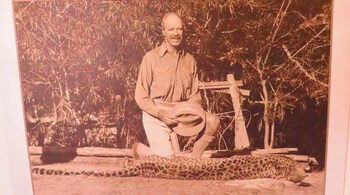
I first heard of Jim Corbett in standard VI. A classmate’s notes on the Corbett chapter brought the house down with a faux pas – he wrote ‘men-eating tigers’ instead of ‘man-eating’, a single erroneous alphabet changing the entire meaning. A few years later, I came across a dusty, 1940s edition of ‘Man Eaters of Kumaon’ in the library of a military establishment in Bareilly. To a teen who had never been in a real forest alone, the vivid descriptions and line sketches of the jungle, its creatures and inhabitant people, brought alive the woodlands of the Himalayan foothills.
Within weeks of that, I was trekking in the Kumaon hills. This was 1993 and the place was still part of Uttar Pradesh. Road connectivity, while much improved from Corbett’s time, was not a patch on what it is today. This had a positive in the form of fewer visitors and those that walked in the forest were the passionate ones. With ‘Man Eaters…’ in my knapsack, and armed with a camera and a stout stick, I felt prepared.
Decades after Corbett’s time, his descriptions still held true. Many Kumaoni villages were still isolated. The forests remained dense in parts, alive with the sounds of their denizens and promising larger creatures in their green depths. Thankfully no large member of the cat family was spotted.
Corbett’s writing doesn’t just show his deep understanding of forest life, but his being perfectly at home in the Kumaon. The big game hunter could speak the language of the local folk, was mindful of their traditions, and above all, was deeply compassionate towards their hardships. For a person with deep roots in India, and with such a love of the land, perhaps the greatest contradiction in his life was his exit from India shortly after Independence.
Third generation in India
To understand Corbett’s worldview, one needs to dive deep into his past. The British gained control of Bengal in 1757, and a steady stream of Europeans came to India seeking their fortune. Post the defeat of the Marathas in 1803, that stream became a flood. With it came Joseph Corbett, Jim’s grandfather, who left Dublin to seek his fortune in Bengal. Arriving in February 1815 with his wife and daughter, he served in the military of the East India Company. The couple had six more children, including Christopher William, who was born in Meerut in 1822. However, following another European trend in that India of that time, Joseph died an early death in 1830, aged just thirty-three, and was buried in Meerut. Joseph’s youngest son was tied to a tree and burnt in Delhi during the events of 1857.
Christopher William’s first wife died young, leaving him with three children. In 1859, he married again – the widow of another European killed in 1857-58, with three children of her own. The couple proceeded to have nine children. Jim Corbett, baptized Edward James, arrived on July 25th, 1875, in Nainital. Bringing up fifteen children could not have been an easy task. At that time of Jim’s birth, Christopher worked as a postmaster, having been an army doctor earlier.
A childhood at the periphery of forests
Unimaginable now, Nainital of the end-19th century was an idyllic place with houses dotting the hills and bazaars on both sides of the lake. The Upper Mall was out of bounds for almost all Indians, barring a privileged few. Winters for the family were at Kaladhungi, closer to the plains. In both places, the forests around were a source of game, adding to the dining table.
Walks through the forest were Jim’s first exposure to flora and fauna. His first ‘weapon’ was a catapult, given by an elder brother who also taught him to skin animals. Young Jim also learnt not to use the catapult on birds in their breeding season. As he moved from catapult to bow & arrows to a muzzle loading shotgun to rifle, he learnt the ways of the forest. Among the most valuable lessons learnt was to understand the sounds of forest creatures, something that would serve him well in his years of hunting. Gradually, his proficiency as a hunter grew.
The railway man
His first job, though, was far removed from the forest - in the Railways. Moving up from fuel inspector to assistant storekeeper to assistant station master, he became trans-shipment inspector at Mokama Ghat. Located on the Ganga, the ghat was a crucial link in transporting goods to the east. Congestion at the railway ghat in 1897 was mentioned as a reason for not being able to alleviate the Bengal Famine. It was around this time that a 21-year-old Jim was assigned crucial duties in managing a labour force numbering in hundreds, eventually achieving success.
Too old for active military service in the First World War, Jim created a labour unit of 500 Kumaonis and served in Europe. In a conflict known for immense casualties, Jim was proud of having brought back all but one person of his contingent. In the Second World War, he trained allied troops in jungle-craft.
Beginning with the Champawat Tiger in 1907, Jim was often called upon to eliminate man-eaters in the Kumaon. Notable were the leopards of Rudraprayag and Panar, and the tigers of Talla Des, Kanda, Mohan and Thak. His last ‘kill’ was at the splendid age of 71. A year later, just after Indian Independence, Corbett left for Kenya, the departure a well-kept secret from his tenants – even though he continued to look after them remotely. Over decades, Corbett had developed property there, so the move was carefully planned. He lived out his days in Kenya, famously hosting the future Queen Elizabeth in 1952. He died there in 1955.
Stratified British India
Author DC Kala, in his biography of Corbett, has thrown light on the ‘White social structure’ of that era, which may explain Corbett’s exit from India. At the top of this hierarchy were Britons with their home connections intact, and even this segment was headed by those who served the Crown. Next were Domiciled Europeans who were multiple generations in India but retained racial ‘purity’ – such as the Corbetts. The Anglo Indians brought up the tail. Quoting Kala, “to rise on the social ladder, the Domiciled and the Anglo-Indian had to be more British than the British.”
Throughout his varied roles, Jim was a loyal servant of the British Empire, as also seen in his organizing hunts for British Governor-generals while speaking of conservation at the same time. He was compassionate towards Indians, but was that because they were undoubtedly a subjected people, and he was comfortable being magnanimous from a pedestal? Perhaps he did not desire to be on par with them in an independent land. His exit was to Kenya, another colony, albeit with similar wildlife attributes.
‘Carpet Sahib’s’ memory stayed on in the Kumaon, with people recalling his courage and work decades later. The wildlife reserve he had helped develop was renamed after him in 1956. His house at Kaladhungi is now a museum in his memory. Regardless of his strange exit, his understanding of wildlife is worth emulating lest ‘men-eating tigers’ figuratively becomes a reality.
Discover the latest Business News, Sensex, and Nifty updates. Obtain Personal Finance insights, tax queries, and expert opinions on Moneycontrol or download the Moneycontrol App to stay updated!





