

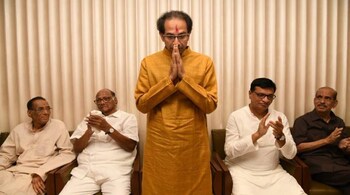
Maharashtra Chief Minister Uddhav Thackeray is having to gingerly goose step through the political minefield where two issues are likely to pull his three-party Maha Vikas Aghadi coalition government in opposite directions.
The easier of the two to negotiate is the case relating to the Bhima Koregaon riots of January 1, 2018, in which several activists have been arrested and lodged in prison without much progress in the case. Thackeray has nimbly avoided a confrontation with the Centre, and yet maintained the equanimity of the partners in his government by differentiating between the Elgar Parishad that preceded the commemoration at Bhima Koregaon and the riots that followed.
The Pune police were investigating both the cases and the central government was quite content with the progress, though it was moving at a slow pace. Events suddenly picked pace after Nationalist Congress Party President Sharad Pawar called for a re-investigation and speedy trial in the cases. The Centre suddenly swung into action and decided to hand the case over to the National Investigation Agency (NIA).
At first the Maharashtra government resisted handing over the papers to the NIA, but caved in when it became apparent that the NIA could secure a special court order to force the government to hand over the investigation to them. Also with Thackeray making a difference between the Elgar Parishad and Bhima Koregaon cases, Pawar has now called for a Special Investigation Team (SIT) investigation into the riots. Since the previous investigation had linked Elgar Parishad to Bhima Koregaon, it is likely that different results by different agencies will embarrass the Centre, which has already been accused of a politically-motivated witch-hunt against the activists jailed in both the cases.
It is also a battle for the votes of both the Marathas and the Dalits who were pitted against each other during the 200th year of the commemoration of the victory of the Mahars, a lower caste, against the army of the Peshwas that finally ended the Brahmin domination in Maharashtra during the British regime. Pawar is now pitting the rest of Maharashtra against the Brahmins of yore, which in today’s polarised times are synonymous with the Rashtriya Swayamsevak Sangh (RSS) and the domination of the BJP over the body politic.
While this plays out in the background, the more crucial difference that could arise between the three coalition partners is the triple issues of the Citizenship Amendment Act (CAA), the National Register of Citizens (NRC) and the National Population Register (NPR).
Thackeray has tried to deal evenly with all three and keep everyone happy: He has outright rejected the NRC, he has accepted the NPR with the caveat that the newly-introduced questions in the enumeration will be rejected, and has sought some clarifications from the Centre over the CAA. Thackeray’s Shiv Sena had supported the CAA in the Lok Sabha, but walked out of the Rahya Sabha while the Bill was being discussed.
While on a recent visit to New Delhi, Thackeray maintained a tight balancing act by calling on both Narendra Modi and Congress interim President Sonia Gandhi. What the CM might soon realise is that it is not easy to protect the interests of all people of Maharashtra. As senior Congress leader Manish Tewari pointed out to him in a tweet, the CAA, the NPR and the NRC are intricately linked and accepting even one of these could endanger the citizenship of large sections of the people.
However, for the moment, neither the Congress nor the NCP wishes to upset the apple cart over the CAA issue. Protests against the Act have been allowed to take place across Maharashtra and have been by and large peaceful with no State violence against the protesters, unlike in New Delhi or Uttar Pradesh.
Nawab Malik, NCP spokesperson and minister in Thackeray’s Cabinet, has said they will cross the bridge when they come to it. However, with growing protests across the country and even increasing violence, as seen in the national capital Delhi, both the Congress and the NCP hope it will not come to the point of confrontation with the Shiv Sena. The Sena, too, hopes it will not be forced into a position of retreat or endangering its government if the Centre is put in a tight spot over the implementation of the Act.
Meanwhile, BJP leaders in the state, including former Chief Ministers Devendra Fadnavis and Narayan Rane, are hoping the state government will collapse under the weight of its own contradictions over the CAA. However, political power is a strong adhesive that will likely hold the three parties together. Rane has given 11 days and Fadnavis six months for the government to collapse. Rane’s deadline will soon come and in all probability Fadnavis’ deadline will also come and go unnoticed.
Sujata Anandan is a senior journalist and author. Views are personal.
Discover the latest Business News, Sensex, and Nifty updates. Obtain Personal Finance insights, tax queries, and expert opinions on Moneycontrol or download the Moneycontrol App to stay updated!





