

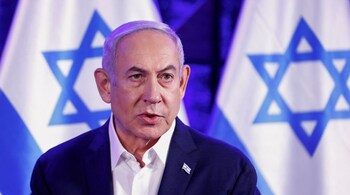
At least it’s now clear: Benjamin Netanyahu has a strategy for the war in Gaza, and it commits his country to indefinite conflict.
That seems the only logical conclusion to draw from the TV interview Israel’s prime minister gave to Channel 14 on Sunday, which was as worrying as it was clarifying. In his first sit-down with domestic media
since Hamas carried its terrorist assault more than eight months ago, Netanyahu rejected the terms of a US-mediated and United Nations Security Council-approved cease-fire proposal for Gaza, and said he was prepared to open a second front against Hezbollah, in Lebanon.
None of this is to deny that Israel faces extraordinarily difficult decisions, or to exonerate Hamas from the primary guilt it bears for the disaster it has brought on Gaza’s Palestinians since Oct 7. Yet it’s increasingly difficult to dismiss the claims of critics in Israel, who say Netanyahu needs the war to avoid right wingers collapsing his government, leaving him to face a personal reckoning for the security failures. Hamas’ leader in Gaza, Yahya Sinwar, shares this need for the war to continue. He believes — correctly — that it serves his purpose of weakening and ultimately destroying Israel.
Netanyahu told reporters the intensive phase of the war in Gaza would wind down “soon,” giving way to a new stage in which Israel retained security control in the strip, while “mowing” Hamas’s remaining forces whenever necessary. He also said Israel would transfer responsibility for civilian administration to unspecified Palestinians (though not the Palestinian Authority), backed by countries from the region.
At the same time, however, Netanyahu ruled out any path to a Palestinian state and said he’d accept only a temporary cease-fire to secure the release of hostages still held by Hamas, after which fighting must resume. The prime minister's office has since appeared to walk that back, saying Israel remained committed the US-led peace proposal, which aims for a lasting end to hostilities — even if the process is divided into stages. Israel’s Arab neighbours, meanwhile, have made clear they would get involved in post-war Gaza only with a permanent cease-fire and road map to Palestinian statehood in place.
In other words, the only achievable element of Netanyahu’s strategy is Gaza’s long-term military occupation. Factor in the explosive situation in the West Bank, where hardliners in Israel’s cabinet have starved the Palestinian Authority of funds and supported the activities of Jewish settlers, and the outlook for any kind of settlement looks worse still.
Most concerning of all for the still-young Israeli state is that Netanyahu said he’d move troops freed from the war in Gaza to Israel’s northern border with Lebanon, saying Israel would fight on multiple fronts if that’s what it took to stop Hezbollah from firing the rockets and missiles that have forced evacuation of Israeli towns and villages along the border.
Last week, clearly concerned that Netanyahu now plans a full-scale invasion, Hezbollah’s leader Hassan Nasrallah threatened a war with “no restraint and no rules and no ceilings” if Israeli forces should invade. That looks increasingly likely.
All of this conflicts with the core aims of the US administration, which are to end the bloodshed in Gaza that’s adversely impacting both American interests across the Middle East and President Joe Biden’s re-election prospects, while at the same time avoiding any escalation to a regional war that might draw in not just Hezbollah, but also its patron Iran. Here, too, Netanyahu is playing hardball. On Sunday, he doubled down on his claims — roundly denied by officials in Washington — that the US has cut back on arms supplies to Israel, with only a trickle arriving for the last four months.
The details of US arms shipments aren’t public, but this seems an obvious attempt by Netanyahu to scapegoat the US for his own failure to deliver on the unrealistic goal he set of eradicating Hamas. As I and many others have said before, it is possible to punish Hamas militarily and to degrade its capacity to attempt a second Oct 7, but not to make it disappear, short of removing all Palestinians from Gaza. No quantity of weapons will change that.
Next month, Netanyahu looks set to take his brinksmanship a step further, addressing the US Congress amid a presidential election campaign. No matter what Israel’s extraordinary political survivor may say to the contrary, this is an aggressive and deeply partisan move.
As with so much he’s doing, Netanyahu’s uncompromising approach will have the backing of many Israelis still traumatized by Oct 7 and anxious to restore the sense of security they enjoyed before. Yet that confidence proved an illusion. Netanyahu’s strategy risks expanding the war on multiple fronts, distancing potential Arab partners, and causing lasting damage to the bipartisan American support that has sustained Israel’s security for decades.
This will delight Hamas and keep Netanyahu’s government from collapse. In the longer term, it promises disaster for Israel, Lebanon and the Palestinian people. Tens of thousands of Israelis protested at the weekend, calling for the return of all hostages and early elections to elect a government better able to lead Israel out of the cul-de-sac of violence that Netanyahu and Hamas have led it into. They were right.
Credit: Bloomberg
Discover the latest Business News, Sensex, and Nifty updates. Obtain Personal Finance insights, tax queries, and expert opinions on Moneycontrol or download the Moneycontrol App to stay updated!





