

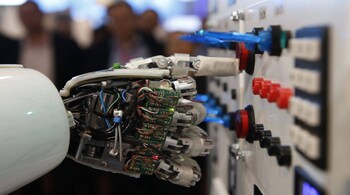
Artificial Intelligence (AI) is advancing so rapidly that even its developers are being caught off guard. Google co-founder Sergey Brin said in Davos, Switzerland, in January that it “touches every single one of our main projects, ranging from search to photos to ads … everything we do … it definitely surprised me, even though I was sitting right there.”
The long-promised AI, the stuff we’ve seen in science fiction, is coming and we need to be prepared. Today, AI is powering voice assistants such as Google Home, Amazon Alexa and Apple Siri, allowing them to have increasingly natural conversations with us and manage our lights, order food and schedule meetings. Businesses are infusing AI into their products to analyse the vast amounts of data and improve decision-making. In a decade or two, we will have robotic assistants that remind us of Rosie from “The Jetsons” and R2-D2 of “Star Wars.”
This has profound implications for how we live and work, for better and worse. AI is going to become our guide and companion — and take millions of jobs away from people. We can deny this is happening, be angry or simply ignore it. But if we do, we will be the losers. As I discussed in my new book, “Driver in the Driverless Car,” technology is now advancing on an exponential curve and making science fiction a reality. We can’t stop it. All we can do is to understand it and use it to better ourselves — and humanity.
Rosie and R2-D2 may be on their way but AI is still very limited in its capability, and will be for a long time. The voice assistants are examples of what technologists call narrow AI: systems that are useful, can interact with humans and bear some of the hallmarks of intelligence — but would never be mistaken for a human. They can, however, do a better job on a very specific range of tasks than humans can. I couldn’t, for example, recall the winning and losing pitcher in every baseball game of the major leagues from the previous night.
Narrow-AI systems are much better than humans at accessing information stored in complex databases, but their capabilities exclude creative thought. If you asked Siri to find the perfect gift for your mother for Valentine’s Day, she might make a snarky comment but couldn’t venture an educated guess. If you asked her to write your term paper on the Napoleonic Wars, she couldn’t help. That is where the human element comes in and where the opportunities are for us to benefit from AI — and stay employed.
In his book “Deep Thinking: Where Machine Intelligence Ends and Human Creativity Begins,” chess grandmaster Garry Kasparov tells of his shock and anger at being defeated by IBM’s Deep Blue supercomputer in 1997. He acknowledges that he is a sore loser but was clearly traumatised by having a machine outsmart him. He was aware of the evolution of the technology but never believed it would beat him at his own game. After coming to grips with his defeat, 20 years later, he says fail-safes are required … but so is courage.
Kasparov wrote: “When I sat across from Deep Blue twenty years ago I sensed something new, something unsettling. Perhaps you will experience a similar feeling the first time you ride in a driverless car, or the first time your new computer boss issues an order at work. We must face these fears in order to get the most out of our technology and to get the most out of ourselves. Intelligent machines will continue that process, taking over the more menial aspects of cognition and elevating our mental lives toward creativity, curiosity, beauty, and joy. These are what truly make us human, not any particular activity or skill like swinging a hammer — or even playing chess.”
In other words, we better get used to it and ride the wave.
Human superiority over animals is based on our ability to create and use tools. The mental capacity to make things that improved our chances of survival led to a natural selection of better toolmakers and tool users. Nearly everything a human does involve technology. For adding numbers, we used abacuses and mechanical calculators and now spreadsheets. To improve our memory, we wrote on stones, parchment and paper, and now have disk drives and cloud storage.
AI is the next step in improving our cognitive functions and decision-making.
Think about it: When was the last time you tried memorizing your calendar or Rolodex or used a printed map? Just as we instinctively do everything on our smartphones, we will rely on AI. We may have forfeited skills such as the ability to add up the price of our groceries but we are smarter and more productive. With the help of Google and Wikipedia, we can be experts on any topic, and these don’t make us any dumber than encyclopedias, phone books and librarians did.
A valid concern is that dependence on AI may cause us to forfeit human creativity. As Kasparov observes, the chess games on our smartphones are many times more powerful than the supercomputers that defeated him, yet this didn’t cause human chess players to become less capable — the opposite happened. There are now stronger chess players all over the world, and the game is played in a better way.
As Kasparov explains: “It used to be that young players might acquire the style of their early coaches. If you worked with a coach who preferred sharp openings and speculative attacking play himself, it would influence his pupils to play similarly. … What happens when the early influential coach is a computer? The machine doesn’t care about style or patterns or hundreds of years of established theory. It counts up the values of the chess pieces, analyses a few billion moves, and counts them up again. It is entirely free of prejudice and doctrine. … The heavy use of computers for practice and analysis has contributed to the development of a generation of players who are almost as free of dogma as the machines with which they train.”
Perhaps this is the greatest benefit that AI will bring — humanity can be free of dogma and historical bias; it can do more intelligent decision-making. And instead of doing repetitive data analysis and number crunching, human workers can focus on enhancing their knowledge and being more creative.
(The author is Distinguished Fellow at Carnegie Mellon University College of Engineering.)
Discover the latest Business News, Sensex, and Nifty updates. Obtain Personal Finance insights, tax queries, and expert opinions on Moneycontrol or download the Moneycontrol App to stay updated!





