

Over the years, the Stockholm International Peace Research Institute (SIPRI) annual factsheets that get global audience and readership, have metamorphosed into predictable and boring documents since they ‘increase a percent here and decrease a percent there’. The statistical presentations get repeated year after year without much verification of changing ground-level realities. Most importantly, they fail to capture the changing narratives in their respective field reports. The recent SIPRI factsheet on ‘trends in international arms transfers (2022)’ is no different from its previous editions and is, at best, ‘old wine in new bottle’.
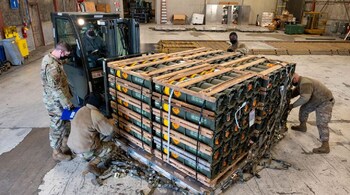
International arms transfers have gained momentum within Europe in the wake of the Russia-Ukraine war since the latter has been pitching for weapons transfers either on credit or on a grant basis all over the continent. To that extent, SIPRI has done a good job by highlighting a 47 percent increase in European arms transfers. However, the SIPRI factsheet does not come out with any substantial analysis of the five percent decrease in arms transfers at the global level from 2013-17 to 2018-22. At best, it comes out with continental and sub-continental variations, either in terms of increases or decreases. That is not sufficient enough to understand the changing dynamics of international arms transfers.
Unexplained Paradox
In fact, neither the SIPRI factsheet nor any other supplements published by other think tanks or universities help us understand the noticeable paradox in international arms transfers. On the one hand, defence expenditure trends are on the rise in many parts of the world. Justification in terms of the ongoing Russia-Ukraine war may not be sufficient since it is localised to Eurasia with marginal impact in other parts of the world. On the other hand, there is a recorded decline in international arms transfers in all continents except Europe. This paradox is perhaps due to the rise of nationalism in defence production in many countries, best evident in the consolidation and expansion of domestic military industrial complexes (MICs) and public policy pledges to reduce weapons dependence. India is an example. Even though the country remains the lead importer, its weapons imports have come down by a whopping 11 per cent from 2013-17 to 2018-22 as per SIPRI’s own estimations.
Misreads Local Developments
The factsheet also does not explain the changing dynamics in India’s defence acquisition process and blames a ‘slow and complex arms procurement process’ as one of the reasons for the negative growth in India’s weapons imports. Defence acquisitions by themselves are a tedious process all over the world. Defence innovation is a costly exercise, technology transfers are difficult across borders and MICs take time to respond to the demand for weapons in the international market. Very few countries have a robust and hassle-free defence acquisition process. India is no exception to this global trend. However, in the last decade, a series of procurement reforms have taken place. These include constant revision and revamping of the procurement manuals on capital and revenue stores, the delegation of financial powers at more vertical levels for capital and revenue stores and even fast-track procurements for capital procurements. It seems the SIPRI experts are simply clueless about India’s defence acquisition reforms.
Chinese Puzzle
Similarly, the factsheet does not offer explanations for the decline in Chinese weapons exports by almost a quarter from 2012-17 to 2018-22. Is it because of the underperformance of Chinese weapons? Is it because Pakistan, the largest buyer of Chinese weapons, is not able to invest in new weapons imports? That sounds illogical since Pakistan’s weapons imports have grown by 14 per cent despite its domestic financial crisis for quite some years. Is it because other important buyers of Chinese weapons like Bangladesh are looking at new sellers or simply bringing down their weapons imports? These issues warrant further research since China was always competing in the international arms market at affordable rates, luring away many Afro-Asian countries from established weapons exporters.
The Rise Of Qatar
Finally, the SIPRI factsheet is also guilty of ignoring big data. For instance, Qatar has emerged as the third largest importer in the list, with an increase of 311 per cent from 2012-17 to 2018-22. These are astronomical numbers. West Asia may be volatile but certainly does not warrant high volume weapons imports by one country, while others like Saudi Arabia, United Arab Emirates, Turkiye and Jordan have recorded significant declines in their weapons imports. The factsheet has nothing to offer as causal factors.
One may counter the above arguments on the pretext of SIPRI factsheets being structured along a particular proforma that has not been ‘tampered’ with in a long time. But if SIPRI reports are to retain their popularity and relevance, probably it is time to work and expand on the causal factors in these reports than summarise mere ‘facts’ and ‘figures’.
Bhartendu Kumar Singh is in the Indian Defence Accounts Service. Views are personal, and don’t represent the stand of this publication.
Discover the latest Business News, Sensex, and Nifty updates. Obtain Personal Finance insights, tax queries, and expert opinions on Moneycontrol or download the Moneycontrol App to stay updated!





