

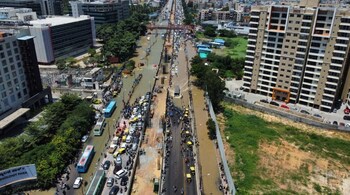
Bengaluru, famed as the ‘Silicon Valley of India’, and the country’s leading information technology exporter, had large portions of the city underwater for two days (August 29 and 30). Unprecedented and relentless rains, said to be the third-heaviest ever recorded in Bengaluru, inundated the city. Bengaluru’s lakes were full; some breached their banks and the water, finding little egress, camped on the city’s streets, in parking lots, and houses. In some areas, residents had to be evacuated on tractors. Other concomitant failures were also visited upon the city. There were huge traffic disruptions, power outages, loss of productivity, and many normal activities had to be halted. The flooding of the pump houses hit the water supply to the city, and some areas had to depend on water from bore wells and tankers.
Some of the reasons behind the disaster were specific to the city. Bengaluru was long celebrated as the city of lakes. Unfortunately, its governance has been unkind to the elaborate ecosystem that had sustained the city in the past. Many of the lakes have been filled up; others have been curtailed through slow and stealthy encroachment and concretisation. Additionally, the interconnectivity between water bodies has been disrupted. The drainage system of the city has also been compromised due to large-scale encroachments. Other items of city infrastructure that have a bearing on floods have been equally mismanaged. The upkeep of stormwater drains in the city has been poor, and its solid waste management leaves a lot to be desired.
Bengaluru also has an extremely fractured governance system. The urban local body has truncated functions, and several parastatals have been created to manage separate services. Water and wastewater are managed by the Bangalore Water Supply and Sewerage Board; city transport is in the hands of the Bangalore Metropolitan Transport Corporation; and fire services are provided by the Karnataka Fire and Emergency Services. On the planning side, Bangalore Development Authority is the principal planning authority for the city, and the Bangalore Metropolitan Management Authority is responsible for the planning of the Bengaluru metropolitan region. It is apparent that co-ordination among these agencies during a crisis would pose enormous problems.
It must, however, be recognised that urban floods have now become a national phenomenon, affecting many mega and metropolitan cities in India almost annually. For example, in July, heavy rainfall inundated Ahmedabad. Many areas of the city were waterlogged, and the ground floors of many housing societies and bungalows disappeared underwater. In November 2021, Chennai came to a standstill as several areas were submerged on account of heavy rainfall. The city recorded 17 deaths; there were power outages and several Chennai localities were marooned. In October 2020, Hyderabad struggled with unprecedented levels of precipitation that left nearly 50 dead and destroyed property worth around Rs 5,000 crore. Delhi, Mumbai, Patna, Pune, and many other metros have also flooded at different points in time, bringing them to a halt for several days.
On the strength of these events and many more, it would be safe to conclude that this is on account of the forces of climate change that have accentuated the severity of rainfall in cities. These render the current urban drainage systems unable to cope with such bursts of rain, leading to flooding. India already ranks very high among countries in terms of disaster events, disaster victims, and economic losses. An additional disaster that has now been added to this list is urban floods, which is now proving to be a huge national challenge.
For quite some time, urban floods did not receive much attention as the National Disaster Management Authority (NDMA) focused on riverine floods that wreaked havoc in the rural areas. The turning point in this regard was the deadly deluge in Mumbai in July 2005, when an unprecedented cloudburst caught the city unprepared to tackle a disaster of that magnitude. It was then that NDMA decided to address urban flooding as a separate disaster and delinked it from other floods.
A study of the reasons behind these floods reveals a commonality of causes that combine matters of urban planning and urban governance across India’s cities. The 10 most-significant reasons can be listed as: Absence of storm water drains in many localities; poor maintenance of existing storm water drains leading to their clogging with mud and material; filling up water bodies and nullahs; incapacitating drainage through encroachments or poor maintenance; truncating and concretising open space, depriving them of their permeability; uncontrolled built and demographic densification beyond the city’s infrastructural capacity; failure to prevent rampant unauthorised construction; allowing construction in low-lying areas without adequate mitigation measures; indiscriminate disposal of solid waste; illegal dumping of construction debris; and overlooking the maintenance and upkeep of the city’s overall infrastructure that impacts egress of water.
Several committees have gone into the reasons behind urban flooding and have suggested remedial measures. The first group of recommended action points includes the preparation of contour maps, augmentation of the storm water drainage network, cross-drainage works, and augmentation of pumping capacity. The second set of jobs includes removal of obstruction to storm water drains, removal of blockages caused by floating debris, restoration of the nalla system that stands constricted due to encroachments, effective garbage handling, desilting, and preservation of holding ponds. Regulatory measures include a ban on plastics and prevention of further encroachments.
Some of the above cited jobs need to be undertaken by the cities. There are some others that are in the state’s domain. Even if it is conceded that urban development is a state subject, the Union government cannot be a bystander watching city infrastructure failing to support the needed quality of life in large Indian cities. Such cities are national assets and growing contributors to the Indian economy. It cannot be denied that the national government has played a role in the financial emaciation of cities and has not taken steps to support their financial sustainability. Inaction on the government’s part can worsen the condition of Indian cities; the country’s economic growth can be seriously impacted, and the image of Indian cities can take a global battering.
At the same time, this new paradigm of disaster will have to be sufficiently imbibed by the states. First, the fractured governance architecture witnessed in Indian cities is not designed to cope with disaster situations. The multiplication of city parastatals needs to be eschewed, and a new structure ought to put urban local bodies in command. Second, the dovetailing of Climate Change and urban floods into disaster management by all vulnerable states will help rivet more attention to pre-disaster policies and planning, thereby, making Climate Change mitigation an essential component of disaster risk management. Cities themselves will have to consider urban floods as a recurring phenomenon, and complement the states in providing an equal emphasis on floods and mitigation strategies.
Beyond the states, community approaches are critical for disaster mitigation, and management. This will include integration of disaster risk reduction into development policies and plans of urban local bodies. Furthermore, capacity building programmes for citizens across cities need to be taken up through a massive educational effort so that risk reduction behaviour becomes part of their daily lives.
(This article first appeared in the ORF.)
Ramanath Jha is Distinguished Fellow at Observer Research Foundation, Mumbai. Views are personal, and do not represent the stand of this publication.
Discover the latest Business News, Sensex, and Nifty updates. Obtain Personal Finance insights, tax queries, and expert opinions on Moneycontrol or download the Moneycontrol App to stay updated!





