

A blockbuster new research paper on college admissions confirms in dramatic detail what nearly everyone has long suspected: The elite admissions game is played on a tilted playing field that gives students from wealthy families substantially higher odds of admission than less-privileged students with similar academic credentials.
The findings are interesting, but more striking to me is the broader public fascination with high-stakes college admissions. That’s driven in part by the observation, confirmed by the researchers, that graduates of the most prestigious schools — which they consider to be the Ivy League plus Stanford, the University of Chicago, MIT and Duke — are overrepresented in the top 1 percent and certain other prestigious social roles even relative to their students’ test scores.
But it also reflects a kind of artificial scarcity of slots at the top schools. As one of the authors, David Deming, observes in his newsletter, every year there are 30,000 to 35,000 students with scores of either 1550 (on the SAT) or 34 (on the ACT), but there are only 20,000 slots in these 12 schools. At the same time, globalisation and the rise of a global middle class have only increased the level of international interest in the crown jewels of the American higher education system.
There is a relatively simple way to reduce the tensions and build on one of America’s great national strengths: Make these schools larger. And the main obstacle to doing that isn’t necessarily some quasi-conspiratorial effort to preserve exclusivity. It’s the much more banal force of NIMBYism.
Harvard, for example, has expanded its campus footprint aggressively in Boston in recent years because that’s where it’s been able to get permission to grow. But the historic center of the university is in Cambridge, on the other side of a river, so the expansion doesn’t include new dorms for undergraduates or the larger class sizes they could accommodate. Yale, located in much poorer and more growth-friendly New Haven, has built new residential colleges and expanded admissions.
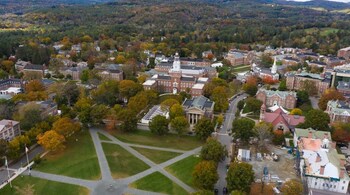
Dartmouth’s administration developed an ambitious plan to create new transitional housing while existing dorms were renovated, allowing for greater enrollment — but it was squashed by faculty opposition to the location, more than a mile from the existing center of campus. Why not build someplace closer? Because closer housing sites “have a degree of complexity which makes them difficult to unlock,” a Dartmouth vice president told the local Valley News. Translation: It would be more expensive and time-consuming to build near the center of town.
Thus the quintessential local issue of zoning squabbles ends up generating a national scarcity of elite college admissions slots, fueling zero-sum competition and ultimately reducing America’s ability to increase global “exports” of its best-in-class high-end higher education product.
In a 2008 paper on land use trends, economists Ed Glaeser and Bryce Ward looked at towns that include a top-50 university. They found that in the 1990s, such university towns became sharply more hostile to permitting new housing — an unintended, under-discussed and unconsidered shift in US higher education policy that’s made it harder for universities to expand along with population.
The national and even global significance of US colleges and universities is yet another reason why state governments ought to take a larger role in land-use policy and overrule local stakeholders. It is entirely understandable that longtime residents of Hanover, Princeton or Cambridge might oppose new dorms because they will bring more traffic and less parking. What’s harder to understand is why economic-development officials in New Hampshire, New Jersey or Massachusetts aren’t advocating more vigorously for campus expansion and all the new jobs it would bring.
Quality universities are engines of economic development, and both their teaching and research missions are inherently tied to specific locations. Letting them grow where they already are — and allowing new complementary residential and commercial development near campus — is too important to allow the people who happen to live close-by have veto power over the whole thing.
So am I saying that the key to redressing this longstanding social, economic and educational injustice is … zoning reform? Not even I would go that far (though as I like to point out, better zoning can help solve a lot of problems). Still, over and above all the other questions around the future of US higher education, one thing is clear: There is an oversupply of highly talented students. America’s best schools should expand to accommodate them — and the states in which they are located ought to make the policy changes needed to let them grow.
Matthew Yglesias is a columnist for Bloomberg Opinion. Views are personal and do not represent the stand of this publication.
Credit: Bloomberg
Discover the latest Business News, Sensex, and Nifty updates. Obtain Personal Finance insights, tax queries, and expert opinions on Moneycontrol or download the Moneycontrol App to stay updated!





