

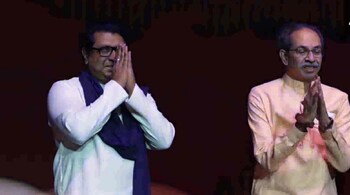
Shiv Sena (UBT) chief Uddhav Thackeray and Maharashtra Navnirman Sena supremo Raj Thackeray on Wednesday announced the alliance between their parties for the Brihanmumbai Municipal Corporation elections, scheduled for January 15, in an attempt to dramatically alter the political dynamics in the race to bag the crown of the nation's richest civic body.
While the reunion is being projected as a direct challenge to the BJP and the ruling Mahayuti, it also throws up an equally complex dilemma for the Thackeray cousins themselves, whose core appeal remains tightly tethered to the 'Marathi Manoos' vote.
At the heart of the challenge lies a simple arithmetic. Marathi-speaking voters constitute roughly 35–37% of Mumbai's population. For decades, this bloc formed the backbone of the undivided Shiv Sena's dominance over the BMC. It is also a fact that the Thackerays have historically failed to shore up 100 per cent of these Marathi votes, with their best figures reaching approximately 50 per cent during Shiv Sena founder Balasaheb Thackeray's era.
Balasaheb is no longer with us and the once consolidated Shiv Sena vote is now fragmented, especially after the split in the party engineered by Eknath Shinde. Backed by the organisational muscle and resources of the BJP, Shinde's Sena continues to command loyalty among local corporators, shakhas and grassroots networks that have not shifted to the UBT camp in several Marathi-dominated pockets of Mumbai, particularly in the eastern suburbs and parts of the city's mill-worker belts.
This means that even where the Marathi vote is numerically strong, it no longer remains monolithic. The split within the Sena has ensured that Marathi voters stood divided between three claimants — Uddhav Thackeray, Raj Thackeray and Shinde — diluting the impact of any singular ‘sons of the soil’ mobilisation in contests that were once considered natural Sena strongholds.
Reports suggest that the Mahayuti may field strong candidates from the Shinde Sena on seats where the Thackeray brothers' alliance hopes to field one from the Marathi community.
Furthermore, Mumbai's demographic profile has changed significantly over the past decade. Non-Marathi voters, including North Indians, Gujaratis and others, now account for nearly 40–45% of the electorate, while Muslims make up another 11–12%. This diversified voter base has enabled the BJP to steadily expand its footprint in the city during this period.
The BJP's rise in Mumbai was clearly visible in the 2017 BMC elections, when it won 82 of the 227 seats, just two short of the undivided Shiv Sena's 84. Since then, the political landscape has fragmented further.
The Shiv Sena split in 2022 weakened Uddhav Thackeray's organisational control, while Raj Thackeray's MNS has struggled to convert its vocal Marathi-first politics into electoral success, failing to win a single seat in recent Assembly and local elections.
The coming together of the Thackeray brothers is expected to consolidate a section of the Marathi vote that had been divided between Shiv Sena (UBT) and MNS. However, can even a near-total consolidation of this bloc suffice on its own to secure control of the BMC?
A campaign centred predominantly on Marathi identity risks capping the alliance's reach, especially among non-Marathi and floating voters who have increasingly aligned with the BJP.
For the BJP and the Mahayuti, the Thackeray reunion is a challenge but not an existential one. The ruling alliance enters the BMC contest with a broad and relatively stable vote base. The BJP's strength among non-Marathi communities, combined with the organisational machinery of Eknath Shinde's Shiv Sena and Ajit Pawar's NCP in pockets of the city and suburbs, gives it access to a wider electoral canvas.
Together, Mahayuti partners are estimated to command close to 55-60% of Mumbai's voters across communities, even if the Muslim vote remains largely out of reach.
This wider social coalition allows the BJP to position the BMC election less as an identity contest and more as a governance and development battle. The party is expected to foreground large infrastructure projects, civic services, and its record in Mumbai since 2014, while portraying the Thackeray brothers' alliance as a desperate attempt to revive a politics rooted in the past.
At the same time, the reunion also creates internal pressures for Shiv Sena (UBT) and MNS. Seat-sharing between two parties competing for the same voter base will be a delicate exercise, especially in Marathi-dominated pockets where both have overlapping ambitions. Any misstep risks reviving old rivalries at the cadre level and diluting the very consolidation the alliance hopes to achieve. It is precisely for this reason that the Thackeray brothers have refrained from even announcing the seat-sharing and naming candidates.
In effect, the Thackeray brothers' reunion tightens the fight for the BJP in select Marathi-heavy wards like Lalbaug, portions of Mahim, Bandra, Vikhroli, Bhandup, Dadar, Worli, among others, it also underscores a larger reality of Mumbai politics. Electoral victory in the BMC now requires coalitions that extend well beyond a single identity.
The 'Marathi Manoos' plank, though powerful, may not be a sufficient strategy on its own.
Discover the latest Business News, Sensex, and Nifty updates. Obtain Personal Finance insights, tax queries, and expert opinions on Moneycontrol or download the Moneycontrol App to stay updated!





