

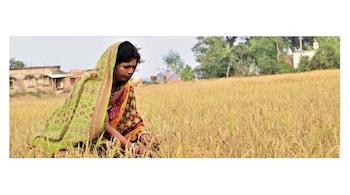
Saraju Nayak is a woman farmer based at Jirabadi village under the Bhanjnagar Block of disaster-prone Ganjam district in Odisha. Her family owns around 10 acres of land in the village on which she and her husband cultivate paddy, vegetables and other crops. Her village, surrounded by three forest ranges, has around 250 households but half of them have members who have migrated to Gujarat to work in the state’s textile industries. Ganjam district, located along the Bay of Bengal, has seen several cyclones like the Super Cyclone of 1999, Hudhud and Phailin which impacted standing crops, livestock and the farming sector.
It is common for men in Ganjam’s households to pick up work outside the state. Consequently, a large section of women are actively engaged in farming, working through a suite of gender-specific challenges, but the lack of acceptance of these women as farmers is a setback to their financial wellbeing. However, technological interventions and climate-resilient farming are helping them navigate the barriers to their recognition.
Living in this disaster-prone district, Nayak and other women farmers have been attempting to minimise the impact of cyclones on their farms by implementing practices learned in a training from agricultural scientists.
“Around five years ago I received training from the Central Institute of Women in Agriculture (CIWA) in Bhubaneswar where I was introduced to the concept of growing green fodder on our farmlands. Earlier we were giving cattle only the byproducts of farming such as straw mixed with pulses, jaggery and other items. The results of using green fodder instead of conventional fodder soon had a positive impact on the health and milk production capacity of cows and goats, she told Mongabay-India.
Green fodder refers to feed produced from green crops like cereals, legumes and grasses. “While the conventional fodder cost us around Rs. 3000 per month, with green fodder the monthly costs have come down to around Rs. 500 per month. Moreover, the cows and goats that eat this fodder are healthier and produce more milk,” she added.
Nayak explained that, unlike other crops, green fodder is climate-resilient and less likely to be affected by cyclonic storms or destroyed by animals. It also does not involve season-wise sowing of seeds, like in paddy or some other crops, because once their shoots are cut, the plants can grow again. Nayak said that buoyed by the utility of such fodders, she has decided to sell the green fodder commercially and claims that even a land of one acre could give her an income of around Rs. one lakh (Rs. 100,000) per year.
Kavita Swain, also a woman farmer, from Khalagan village from Odisha’s Jagatsinghpur district, around 10 km away from the Bay of Bengal, has a similar story. She farms pulses, potatoes, rears goats and sells milk to the local cooperative.
“We have often seen disasters wreak havoc in our areas. So I have tried to diversify farming with other allied works like rearing goats and selling milk to reduce the impact of disasters on our incomes. With the help of scientific training that we received from some organisations, I tried to use better tools and technologies to reduce losses and maximise production. I am also selling milk to our local dairy cooperative society which has helped us in ensuring a smooth flow of income irrespective of the farm productions,” she told Mongabay-India.
Swain said that while most of the mechanised forms of farm labour such as using tractors and agricultural machinery are executed by her husband, most of the manual work related to farming such as harvesting and taking care of the animals is done by the women of the village. The village with a milk collection centre collects around 800 litres of milk per day while the majority of cattle rearing tasks like feeding the cows are taken care of by women in the village.
Despite there being a large number of women farmers in Odisha, their work is not recognised as farming and is often passed off as farm labour. Plagued by inequity in land ownership, women face issues in getting credit from financial institutions like banks and informal sectors.
As per the 2011 government reports, in rural Odisha, while 50.69 percent of the total male population involved in agriculture are male farm labourers, 81.75 percent of the total female population involved in agriculture are female farm labourers.
To overcome these issues of recognition, women farmers in different parts of the state are forming Self Help Groups (SHGs) for improved distribution of finances.
One such effort is led by Gauri Priya Mohapatra from Balanga village in Puri district who was one of the first women farmers from her village who trained at CIWA, Krishi Vigyan Kendra (KVK) and a Gujarat-based institute. She later took the scientific learnings to her village and in 2017, formed an SHG with other women from the area to start mushroom cultivation.
“I formed an SHG in 2017 and slowly started persuading others to do so and work together to cultivate mushrooms. It helps us in procuring loans from banks easily, otherwise, a single woman farmer often finds it tough to get a loan. Now in my area, there are around 57 panchayats where SHGs sell around 5 quintals of mushrooms per day,” Mohapatra told Mongabay-India.
Puri district where she lives is also a few kilometers away from the coast and susceptible to cyclones that destroy farmlands. Working together as a community helps share profit and loss.
Mohapatra cited the example of the 2019 cyclone Fani when individual farmers who had taken loans from moneylenders and banks faced many difficulties to pay off their loans after the cyclone uprooted the kuccha houses besides destroying their farming assets. It took years for the farmers to recover from the losses, he said, adding that working in communities in the form of SHGs can help them weather financial burdens during such disasters.
Migration and feminisation of farmlands
Experts and social scientists see a direct relationship of out-migration of men to what the social scientists and researchers call ‘feminisation of agriculture’, where the inclusion of women into managing farmlands and associated work is enhanced.
In Odisha, Ganjam is known in the state for out-migration, especially of the young men. “In Ganjam district, at any point of time as per conservative estimates there are around five lakh (500,000) people who have migrated and are working outside the state, mostly in the textile industries of Gujarat. Although the land holdings are in the name of males, there is a larger share of women farmers who really do the main manual work on the farms but do not get ample recognition,” Ganjam-based Loknath Mishra, Programme Director, ARUNA (Association for Rural Uplift and National Allegiance), told Mongabay-India.
Mishra, who had been working in the migration sector said that youth, especially between 18 years to 45 years often move out to other states for better income while the women and the elderly stay in the rural households taking care of their farmlands.
“In several rural households here you can see women not only handling their daily household chores, taking care of their kids and the elderly but also have the additional burden of handling farm work too. However, the majority of finances are taken care of by remittances by the large section of migrants staying outside the state,” he added.
Bhubaneswar-based Central Institute of Women in Agriculture (CIWA) is the country’s only full-fledged organisation working on the issue of women in agriculture which helps them in training, extension of women farmers from across the country including Odisha. But there is a dearth of data relating to women in agriculture, says CIWA Director Anil Kumar which restricts policymaking.
“There is a lack of data, especially gender-based data in agriculture which can help in better policymaking for women farmers of the country. However, there is a large-scale participation of women in farming besides what the existing data says. And this is in addition to the workload they handle in the form of doing the household chores and taking care of their families. They are often underpaid and unrecognised for their work in the society,” Kumar told Mongabay-India.
He also said that women farmers have different challenges like occupational hazards but smaller scientific interventions could help them in overcoming the same. Studies by CIWA show that women farmers are more prone to injuries and hazards like back pain, neck pain, tendon, shoulder disorders, carpal tunnel syndrome among others. Their research shows that activities such as weeding, harvesting, dehusking maize, grain drying, cleaning grains are mostly confined to women.
“There are several cheap agriculture-related tools available which can cater to the farming-related needs of women farmers which can help them in warding off occupational hazards but due to lack of awareness, such technologies are not available to many of them. We at CIWA are trying to bridge the gap and working to boost their comfort of working on the fields,” Kumar said.
CIWA has created a dedicated ‘gender knowledge system’ for women in agriculture which is a single-point database on all available information on women engaged in agriculture. The database has information on the women, schemes meant for them, solutions available to ease farming activities.
Notwithstanding, the societal, environmental and policy-based issues confronting women farmers, the lack of women grassroots workers in the sector unlike the healthcare sectors often hamper the extension of technology to the women farmers of the state.
“In the agriculture sector in Odisha and majority parts of the country majority of the grassroots agriculture workers are males. When they go to rural areas, they are bound to interact with males more and the technology often fails to reach the women farmers who take care of most of the labour-intensive work on the farmers,” an agricultural scientist told Mongabay-India requesting anonymity.
Technological interventions often fail after their programme period due to lack of backward and forward linkages at the local level due to poor response from the local government.
Studies also validate that most labour-intensive work on the farms are done by women farmers while most mechanized activities are confined to males. The National Council of Applied Economic Research (NCAFR) report of 2018 states that while women form 42 percent of the agricultural labour force in the country, only two percent of them own agricultural lands.
Banner image: A woman farmer in Jagatsinghpur village working on her farms. Photo by Manish Kumar/Mongabay.
Discover the latest Business News, Sensex, and Nifty updates. Obtain Personal Finance insights, tax queries, and expert opinions on Moneycontrol or download the Moneycontrol App to stay updated!





