

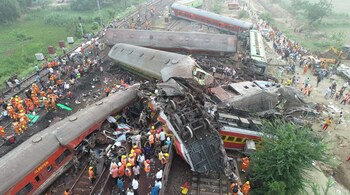
Railways Minister Ashwini Vaishnaw said on June 4 that a change in electronic interlocking led to the Odisha train accident that has killed around 290 people and injured more than 1,000, one of India's worst rail disasters.
“The commissioner of railway safety has investigated the matter and let the investigation report come but we have identified the cause of the incident and the people responsible for it... It happened due to a change in electronic interlocking,” Vaishnaw said.
He added that “whoever did it and how it happened will come out during the detailed investigation".
Senior ministry officials, too, said that while the electronic interlocking system was robust, it was likely that it was manipulated.
A final investigation report is awaited on the mishap.
The Coromandel Express was supposed to pass through Odisha’s Balasore station, however, instead of passing through the main 'up line' of the station, the train changed tracks at a speed of more than 125 kmph due to an incorrect signal.
As a result of this “electronic interlocking” failure, the signal for going in the main line was taken off and the Coromandel Expres switched into the loop line from the main line and crashed into a goods train that was parked there.
The Coromandel Express derailed and some of the coaches crashed into the Bengaluru-Howrah Superfast Express train passing on the main "down line".
So, what is electronic interlocking?
Electronic interlocking (EI) is a type of railway signalling system that uses electronic components to control signals and points. EI systems are designed to prevent train collisions by ensuring that signals are only cleared to proceed when the route ahead is clear.
The interlocking system ensures that the points – movable sections of the track that allow trains to change direction from one track to another – are properly aligned and locked in the correct position before a train passes over them.
Track circuits are electrical circuits installed on the track that detect the presence of a train. They help determine whether a section of track is occupied or vacant, enabling the interlocking system to control train movements accordingly.
By employing electronic interlocking, the risk of potential accidents and collisions is significantly reduced, enhancing the overall safety and efficiency of railway operations.
What does 'change in electronic interlocking' mean?
A "change" in electronic interlocking, could have led to incorrect signalling or improper routing that forced the Coromandel Express off the main line.
The train, running at over 120kmph, took the loop line, or side track, crashing into a parked freight train.
Was the 'change in electronic interlocking' due to a manual error?
While it isn't confirmed that the change in electronic interlocking was due to human or manual error, however, railway officials said that “it is possible that it was manipulated manually".
The exact cause of the accident will only be known after the commissioner of railway safety submits a detailed technical inquiry report.
It was found that the concerned staff had not observed proper procedure while attending to the repair/maintenance of the signalling gear, a spokesperson of South West Railways (SWR) said. Prompt action was taken. A committee of officers conducted an inquiry and took strict action against errant staff as per the Discipline & Appeal Rules, the spokesperson said.
A month-long intensive counselling drive ordered for about 2,277 frontline staff involved in the maintenance of signalling gears across the zone, the spokesperson said.
Can the electronic interlocking system malfunction?
Yes, the electronic interlocking system can malfunction and when it does, it flashes a red signal, indicating a need to be checked.
Since electronic signal interlocking is a fail-safe mechanism, issues could have been caused by external interference, such as human error, malfunction, etc.
"The interlocking system can malfunction under certain conditions, such as its sensors being damaged, human manipulations, wrong rewiring during maintenance," a signalling expert in the Indian Railways told Moneycontrol.
He added that in the Odisha rail accident, it was unlikely the error was not due to human interference.
"In this case, the point should have been set on the normal line and not on the loop line. The point was set on the loop line, it is something that cannot happen without human interference," the expert said.
Was the electronic interlocking system at Balasore station faulty?
Preliminary reports suggest that human error is the main reason behind the change in the electronic interlocking system.
However, officials within the Railway Board had warned about “serious flaws in the system” and raised concerns about the failure of interlocking in February and sought immediate action.
A Principal Chief Operating Manager of the South Western Railway zone had raised concerns in February about the signal failure of an express train.
In a letter in February, he pointed out that an incident that took place at Hosadurga Road station of Birur-Chikjajur section of Mysore division on February 8 indicates that there are “serious flaws in the system". Moneycontrol has reviewed a copy of the letter.
The officer, who didn't wish to be identified, said that the electronic interlocking system was faulty as the route of dispatched trains was getting altered after a train starts on signals.
Furthermore, despite a train changing tack, its movement was showing with the original intended appearance of the route in the system monitoring station (SMS) panel.
He also warned if the signal maintenance system was not monitored and corrected immediately, it could lead to “re-occurrence and serious accidents”.
Discover the latest Business News, Sensex, and Nifty updates. Obtain Personal Finance insights, tax queries, and expert opinions on Moneycontrol or download the Moneycontrol App to stay updated!





