

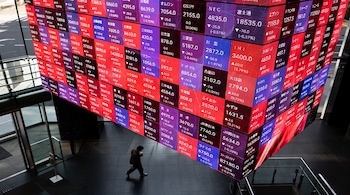


Asian stocks look set to begin trading cautiously after ending 2025 on a subdued note, following an otherwise buoyant year for equities.
Trading is likely to be thin with several regional markets shut for holidays, including Japan and China, while South Korea has a delayed start. The S&P 500 extended a stretch of post-Christmas losses on Wednesday and the Nasdaq 100 had a fourth day of declines. Even so, both indexes have posted double digit gains for three consecutive years.
Precious metals also closed out the year on a down note, despite posting their best year since the 1970s. The dollar recorded its worst year since 2017, with investors saying more declines are coming if the next Federal Reserve chief opts for deeper interest-rate cuts. US Treasuries posted their best year since 2020.
Despite the recent pullback, global stocks posted their strongest year since 2019, as expectations for higher earnings and optimism around artificial intelligence supported investor demand. Even so, uncertainty over the outlook for US monetary policy and elevated valuations remain key risks.
“The end of 2025 was a fizzer in global markets but it doesn’t detract from the fact it was a very good year for investors,” Kyle Rodda, a senior analyst at Capital.com, wrote in a note. “Naturally, the start of the new year comes with the question everyone asks moving from one year to the next: will this continue? The consensus is that, yes, it will.”
Looking ahead into 2026, market research firm Bespoke Investment Group cautioned against expecting solid market performance during the first trading day of the new year.
Since 1953, the S&P 500’s median change to kick off a new year has been a 0.3% drop, with gains less than half the time, according to a note by Bespoke. The stock market has also traded lower on the first trading day of the each of the past three years, the note said.
Investors have at least one reason to be optimistic heading into the new year. MSCI’s gauge for global stocks has climbed an average 1.4% in January over the last 10 years and advanced in six of those instances, data compiled by Bloomberg showed.
In economic data Wednesday, applications for US unemployment benefits fell last week to one of the lowest levels this year.
Initial claims decreased by 16,000 to 199,000 in the week ended Dec. 27, according to Labor Department data released Wednesday. The median forecast in a Bloomberg survey of economists called for 218,000 applications.
Some of the main moves in markets:
Stocks
S&P/ASX 200 futures fell 0.4%
Currencies
The Bloomberg Dollar Spot Index was little changed
The euro was little changed at $1.1749
The Japanese yen was little changed at 156.76 per dollar
The offshore yuan was little changed at 6.9776 per dollar
Cryptocurrencies
Bitcoin rose 0.1% to $88,375.57
Ether was little changed at $2,987.78
Bonds
Australia’s 10-year yield advanced five basis points to 4.81%
This story was produced with the assistance of Bloomberg Automation.
Discover the latest Business News, Sensex, and Nifty updates. Obtain Personal Finance insights, tax queries, and expert opinions on Moneycontrol or download the Moneycontrol App to stay updated!





