

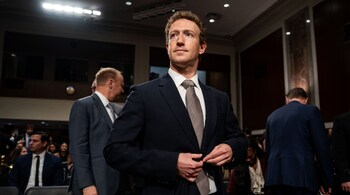
Meta Platforms Inc.’s Mark Zuckerberg, months into building one of the priciest teams in technology history, is getting personally involved in day-to-day work and pivoting the company’s focus to an artificial intelligence model it can make money off of.
One new model, codenamed Avocado, is expected to debut sometime next spring, and may be launched as a “closed” model — one that can be tightly controlled and that Meta can sell access to, according to people familiar with the matter, who declined to speak publicly about internal plans.
The move, which aligns with what rivals Google and OpenAI do with their models, would mark the biggest departure to date from the open-source strategy Meta has touted for years. Open-source models allow outside developers and researchers to review and build upon the code. Meta’s new Chief AI Officer Alexandr Wang is an advocate of closed models, according to the people.
Meta’s strategy shifted dramatically earlier this year after the company released Llama 4, an open-source model that disappointed Silicon Valley and Zuckerberg, Meta’s chief executive officer. He sidelined some of the people who worked on that project and personally recruited top AI researchers and leaders, in some cases offering them hundreds of millions of dollars in multiyear pay packages, and some, like Wang, who came in through a $14.3 billion investment deal. Now, Zuckerberg spends much of his time and energy working closely with those new hires, in a group called TBD Lab.
The TBD group is using several third-party models as part of the training process for Avocado, distilling from rival models including Google’s Gemma, OpenAI’s gpt-oss and Qwen, a model from the Chinese tech giant Alibaba Group Holding Ltd., the people said.
Training the new model on Chinese technology signals a shift in tone for Zuckerberg, who raised concerns on Joe Rogan’s podcast in January that Chinese models could be shaped by state censorship. Zuckerberg has since repeatedly advocated for US government support for American tech companies seeking to dominate the global AI race before China can, and said his open-source strategy was part of leading that mission. But Llama and other US efforts have fallen behind. “China is well ahead — way ahead on open-source,” Nvidia Corp. CEO Jensen Huang said earlier this month.
A spokesperson for Meta declined to comment.
Zuckerberg has long maintained that giving the public access to emerging tools and technologies, particularly in AI, strengthens Meta’s products and encourages wider adoption. He’s likened Meta’s open-source approach for AI to Google’s Android operating system for smartphones. While Meta already builds some closed models for internal use, and Zuckerberg has teased the idea of developing other closed models in the past, several iterations of Meta’s current flagship AI model, Llama, are open-source.
On an earnings call with investors in late July, Zuckerberg hinted that the company would pursue both open and close models moving forward.
AI has become Meta’s top priority, commanding the bulk of spending and attention from executives as Meta races against rivals to become the first company to achieve AI models that can surpass human-level capabilities. Zuckerberg has pledged to spend $600 billion on US infrastructure projects over the next three years, most of them AI-related. He’s also redistributing some of Meta’s investments internally, planning meaningful cuts to its virtual reality and metaverse efforts in favor of putting that spending into AI glasses and other related hardware, people familiar with the matter have said.
Still, Meta’s AI spending has become the focus of Wall Street investors, who recently balked at Zuckerberg’s pledge to continue investing heavily into 2026. While Meta maintains that its AI investments already pay off by making the company’s advertising business stronger, and Zuckerberg has argued for the need to quickly “front-load” capacity, others have worried that its expensive bet on building data centers and acquiring other infrastructure may not contribute to profit for years, if at all. After Bloomberg reported that Meta was considering steep cuts to its metaverse efforts, the stock jumped on optimism for more disciplined spending.
If Meta is to deliver something industry-leading next year, it will depend heavily on Wang, the 28-year-old wunderkind who joined the company after its deal with his startup, Scale AI. Zuckerberg has positioned himself as a mentor to Wang, according to people familiar with their relationship, entrusting him with arguably the company’s most important and expensive product endeavor. While Wang isn’t considered a technical AI researcher, he knows the industry through relationships he built at Scale and has impressed his new colleagues with his ability to get things done quickly and offer a big-picture vision, the people said.
Yet Wang has at times been frustrated by what he sees as micromanagement, according to people familiar with the matter. Zuckerberg has a long history of getting intensely hands-on with the company’s most important products. Members of the TBD Lab group have been situated around the CEO’s desk at Meta’s Menlo Park, California, headquarters so it’s easier for Zuckerberg to check in on their progress, the people said.
Meanwhile, Meta has de-prioritized its open-source strategy. Some Meta employees were directed by leadership to stop talking publicly about open-source and Llama products after the Llama 4 launch while the company recalibrated whether those efforts still made sense moving forward, according to people familiar with the moves.
Yann LeCun, known as one of the godfathers of AI, recently left the company after years leading Meta’s long-term AI research group, in part because of frustrations that he couldn’t get enough resources, Bloomberg News reported. Prior to his departure, some employees had been encouraged to keep LeCun, who was a big proponent of open-source technology, out of the spotlight, including at public speaking events, the people said. Meta no longer saw him as emblematic of the company’s AI strategy, and couldn’t trust that he’d stay on message, they added.
The model after Llama 4 had the internal code name Behemoth — but Zuckerberg was disappointed in its direction and scrapped it in pursuit of something new, the people said.
Since then, pressure on the new team has ratcheted up, thanks in large part to Meta’s exorbitant spending to build what Zuckerberg has called “the most elite and talent-dense team in the industry.” Roughly six months into Meta’s AI pivot, the team has been mostly heads-down without much to show publicly, yet. The news that has trickled out has skewed negative. Some new hires from Meta Superintelligence Labs have departed within weeks of arriving. In October, Meta eliminated 600 jobs from its AI unit, with deep cuts to its more academically focused unit, FAIR. LeCun left the company a month later, intent on doing his research elsewhere.
The most high-profile product to come out of MSL has also received mixed reviews. To get ahead of OpenAI’s release of Sora 2, a video-generation tool, Meta rushed out its own product called Vibes using technology that it licensed from AI startup Midjourney Inc. While Meta insiders insist that Vibes is performing well in terms of usage, Sora’s launch just one week later quickly overshadowed Vibes in the press and online.
Success could also depend on Zuckerberg’s ability to sell his vision to users, regulators and investors. The group’s stated goal is to achieve “superintelligence,” which broadly refers to AI systems capable of completing tasks better than humans. But the term has also left people confused and concerned both inside and outside the company.
This summer, Meta leadership tasked data-focused employees with conducting market research on how the term would land with policymakers in the US and abroad. Working with external consultants, they found that “superintelligence” triggered fears of AI’s unchecked power, particularly in Europe, where regulators have already come after Meta’s AI offerings, the people said.
In the US, some high-profile AI academics and other technologists, including Apple Inc. co-founder Steve Wozniak and Virgin Atlantic Airways Ltd.’s Richard Branson, have gone so far as to encourage a ban on developing “superintelligence” until more is done to prove it can be built safely.
Discover the latest Business News, Sensex, and Nifty updates. Obtain Personal Finance insights, tax queries, and expert opinions on Moneycontrol or download the Moneycontrol App to stay updated!






