

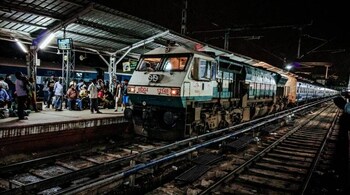
Nearly two years after the outbreak of the COVID-19 pandemic in India, Indian Railways has still not completely recovered in its passenger operations, as average daily railway ticket sales in May have been lower compared with the same period in 2019.
Senior officials from the Railway Board and Indian Railway Catering and Tourism Corporation (IRCTC) told Moneycontrol that average daily railway ticket bookings had risen significantly in March and April, but have been tapering off since.
In February this year, railway ticket bookings came in at around 12 lakh, up from around 9 lakh in January, right after the outbreak of the third wave of COVID-19 in India. The average railway ticket bookings recorded by IRCTC rose to 15.5-16.5 lakh a day in March and April, but fell to around 12.5 lakh in May, a railway ministry official said, against 13.2 lakh in May 2019, before the pandemic hit.
Senior railway officials said that the fall in bookings seen right after the Holi festival period is cyclical in nature, but added that factors like slow resumption of catering services in trains, gradual restoration of train service in some states, shortage of locomotive pilots seen in some states, partial restarting of booking at stations and changing customer patterns have all contributed the fall in sales seen in May.
“The problem is that even though the COVID-19 pandemic is behind us, ticket booking at railway stations has not been completely restored, and many trains’ tickets are available only online. This has led to more passengers travelling without tickets and a fall in daily bookings,” another senior government official said.
He added that while in most states train services were restored to pre-COVID levels, ticket prices were still high for daily commuters as monthly pass services have not yet been restored.
Similarly, fare concessions for senior citizens, students, journalists and army personnel, which were withdrawn during the pandemic, have not been reinstated yet.
Another government official added that while ticket bookings from general, sleeper and air-conditioned (AC) three-tier categories had surpassed pre-COVID levels, premium services like AC two-tier and AC first-class tickets were seeing lower traction.
“Customers are still trying to avoid crowded places and hence premium tickets sales have been slow to recover after the pandemic,” a third government official said.
Market experts and industry participants said that the fall in railway ticket bookings seen since May can be attributed to Indian Railways being forced to cancel trains due a rise in COVID-19 case in parts of India after Holi, and having to cancel trains to prioritise the transport of coal to meet the shortages at power plants.
Indian Railways said on April 29 that it cancelled 657 trips of mail and passenger trains to prioritise the movement of coal rakes. The 657 trips on 42 trains that were cancelled were made up of 500 mail and express trains and 148 commuter trains.
A former member of the Railway Board also said that Indian Railways may be facing a shortage of locomotive pilots in some states like Kerala and Karnataka, which may be contributing to slower restorations of train services in these states.
“Indian Railways had in 2019 invited applications for over 4,000 loco pilot posts, but till 2021 had managed to fill only 3,200 of these posts. A shortage of loco pilots is also limiting the railways from fully restoring services across the country,” the former Railway Board member said.
Discover the latest Business News, Sensex, and Nifty updates. Obtain Personal Finance insights, tax queries, and expert opinions on Moneycontrol or download the Moneycontrol App to stay updated!





