

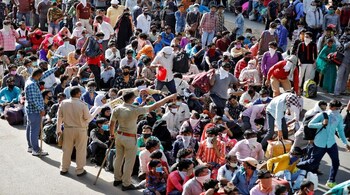
For migrants who chose to stay and those looking to return, there may not be any drastic changes. At least not right away.
However, access to better quality of life and health will be a priority as they return to work as fear of novel coronavirus, or COVID-19 pandemic continues, say hiring executives and blue collar employers.
Recent times have seen thousands of migrant workers returning home to states such as Bihar, Uttar Pradesh and Odisha. Reverse migration of these workers, who are a critical workforce across industries, have led to labour shortage as offices and factories resume operations.
Companies are now managing with workers who chose to stay back and thinking of other ways to continue the business. This includes employing more local workforce and reskilling. However, most agree that migrant labour is critical.
But what is their incentive for coming back? Wages are unlikely to increase. However, companies will be mindful of how they treat their labour, says experts.
Anjali Raghuvanshi, Chief People Officer, Randstad India, said the crises has brought to the surface the plight of migrant workers and that there is no protection for them during such times.
Raghuvanshi explained that the reason the workers returned to their home towns is because they did not have accommodation and some of their employers did not pay them. "That should change."
Companies, another executive pointed out, will now offer better accommodation and access to health.
At this juncture, employers will be forced to ensure that living conditions of labourers are hygienic. “Health factor would be priority,” said Pravin Agarwala, co-founder, BetterPlace, a blue collar management platform.
“Enterprises don’t want to risk their factories shut down just because one of the workers tested positive. So, they will be careful about it even if they have to invest as the cost of non-compliance is far greater."
What about wages? Agarwala said it is unlikely that their wages will increase. Migrant workers on average earn Rs 12,000 to Rs 13,000 per month. What would happen, Agarwala pointed, is that they would get additional pay in terms of bonus and incentives.
Factories will incentivise people to come back to work, said Alok Kumar, Director – Sales, Account Management & Global Accounts, ManpowerGroup India, a staffing firm.
For instance, if workers clocked attendance through the week, they might be given an extra day salary as bonus. Some firms are now willing to offer accommodation and maybe given additional allowance at the back of COVID-19, he added.
Is this enough? No, but at least its a good start. Industries, staffing firms and unions are now talking to the government about the issue at the back of COVID-19. These dialogues, Raghuvanshi, said should continue. Labour reforms planned should have a clause for protection of such workers during crises.
Discover the latest Business News, Sensex, and Nifty updates. Obtain Personal Finance insights, tax queries, and expert opinions on Moneycontrol or download the Moneycontrol App to stay updated!





