

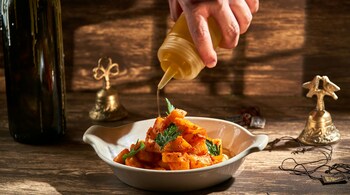
If you want to understand what has gone wrong with modern life, you do not need a think-tank report or a behavioural economist. Just walk into any Indian kitchen at 7 am. The scene tells you everything. A kitchen that once produced wholesome healthy meal without any show or pretences has now evolved into a low-budget reality show where the contestants are sleep-deprived adults who only wanted to make breakfast but instead find themselves competing with the finest chefs of Copenhagen and whichever 20-year-old runs a popular cooking channel on Instagram.
There was a time when the Indian kitchen had a single job. It produced food. That was it. Nobody expected it to produce sensory experiences or philosophical feelings or evocative English adjectives for dishes that have survived unchanged for a thousand years.
Now every plate wishes to be a personality. Every chutney wants its close up. Every sabzi behaves like it has a fan base waiting outside the door.
You and I live in this pressure cooker world. Every morning the day begins not with work but with the first reminder that breakfast has become a life audit. A child wants a paratha that must be round and soft and browned in a pattern approved by social media. If the paratha resembles a map of Australia, it will be classified as a mistake. If the dosa tears, somebody will sigh in a tone normally reserved for national disappointments. If the chutney looks too runny, an amateur cook in the family will offer advice that nobody asked for.
At some point we lost control of the situation. Food now has an image to maintain. Dal does not simply arrive on the table. It arrives looking like it has been tinted, moisturised and taught confidence. Chutney will not appear unless its texture meets certain global standards. The humble idli, once an innocent cloud of carbohydrate-protein comfort, now wants you to photograph its good side before touching it, as if it is about to enter politics.
As contemporary wisdom goes: “Everyone’s a masterchef until the oil splashes.”
What silently grew beside this madness is the belief that cooking is an aesthetic exam that never ends.
Colours must pop.
Textures must speak.
Aromas must behave like shy philosophers.
And every dish must be captured on a phone which, in its own mysterious way, has more opinions about food photography than any human being you will ever meet.
We must ask the important question. When did breakfast become a performance review? When did dal decide that it wanted an audience? When did lunch become a referendum on our ability to manage work and life?
Well, it’s our own doing. We want acknowledgement. We want likes on our social media. We ape what our TV and OTT dish out, apart from social media videos that glorify these.
In the old days we cooked to feed ourselves and people. Now we cook to impress them. The tragedy is that the people we are trying to impress live with us and have known our culinary flaws since the liberalisation era. Yet the pressure remains. The cooker whistles and somewhere between whistle three and whistle four you are reminded that this is not merely pressure. This is judgement. As if the entire household is waiting to evaluate what emerges when you open the lid.
Naturally the tempers rise with the steam. Pots are slammed with passion. Tavas are lifted with a kind of righteous disappointment. Ladles become emotional weapons. A kitchen is supposed to nurture the soul but these days it behaves more like a disciplinary committee.
What makes this even more absurd is that we survived for decades on repetition. Many homes served the same menu every day.
Aloo sabzi was eternal.
Curd rice was the national peacekeeping force.
Upma was a constant presence even if you disliked it.
Nobody asked for innovation. Nobody had the vocabulary to demand it.
Then the world changed and we changed with it. Suddenly everyday cooking needs innovation, English and flair. Repetition becomes a sin. Families have begun to speak in the tone of restaurant critics. Children evaluate food as if they were reviewing it for a school project submission. Probably they are more critical of food than their own homework and projects.
And then arrives the golden age of pretentious naming. You can no longer serve upma without some additional effort. It must be introduced as Warm Semolina Grain Bowl with Nutty Tempering and a Whisper of Crunch.
Idli cannot remain idli. It becomes Steamed Fermented Rice Cloud with a Gentle Southern Soul.
Dal tadka is reborn as Rustic Yellow Lentil Reduction Infused with Aromatic Spices.
Even tomato soup goes for some makeup and returns as Roasted Tomato Elixir with a Silken Mouthfeel. All this effort while the person making the dish is trying not to burn it.
The truth is that none of us signed up for this. Ordinary home cooks have been pushed into an elite league without warning. We had to learn new words like plating and portioning. We were informed that coriander must be sprinkled, not added into the vessel. Oil must be drizzled, not poured. And food look fresh for the camera even when the cook wants to cry out of sheer tiredness.
This has transformed the kitchen into a site of self-criticism. Every dish carries the fear of being called out. The upma is slightly lumpy. The idli is a shade less fluffy. The dosa is not geometrically loyal.
There is also a new skill nobody talks about. The art of pretending that the food was made with love when it was actually made under existential dread. The cook must smile. They must appear serene. They must act as if the dosa flipping perfectly was a divine miracle and not the result of ten minutes of inner panic.
At this point home cooking faces more scrutiny than corporate governance. Which is surprising because food cannot even file an annual report.
The domestic politics do not help. Family folks who have never lifted a pan now walk in with advice. They have watched three episodes of a cooking show and suddenly speak in the tone of visiting faculty at a hospitality institute. They ask why the dal does not resemble the one on a food blogger’s feed. They enquire whether the chapati is having an identity crisis. They forget that the food they critique is the food they will soon eat.
Those who comment about home food are usually the ones who believe opening a food-delivery app counts as cooking.
And here is the one message for every home cook who feels an ache in their chest when a dosa tears or a chutney looks too watery: please breathe. Nobody in your family is running a Michelin inspection unit. They are hungry humans who will survive even if the coriander is not sprinkled at a 45-degree angle.
Your worth is not measured in geometric chapatis or photogenic idlis. You do not owe your loved ones perfection; just love, presence, calm, and food that doesn’t poison them — everything else is decoration. Civilisations have fallen for many reasons, but never because the idli was not fluffy enough.
Discover the latest Business News, Sensex, and Nifty updates. Obtain Personal Finance insights, tax queries, and expert opinions on Moneycontrol or download the Moneycontrol App to stay updated!





