

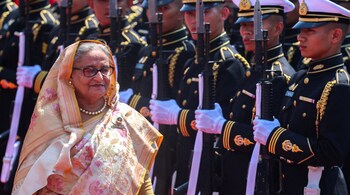
Bangladesh’s former prime minister Sheikh Hasina, who was ousted during the July 2024 student uprising, has been sentenced to death by the International Crimes Tribunal (ICT). The tribunal found her guilty of crimes against humanity for allegedly ordering a violent state crackdown on student-led demonstrations that ultimately toppled her government in August 2024.
The verdict, delivered in absentia as Hasina remains in India, marks a dramatic escalation in the country’s political crisis, raising profound questions about judicial legitimacy, political vendetta, and the path ahead as Bangladesh heads towards its next general election.
A landmark verdict in absentia
The ICT delivered its ruling on Monday after dictating a 453-page judgment over nearly 40 minutes. This is the tribunal’s first verdict related to the July–August 2024 protests, which the United Nations has said left up to 1,400 people dead.
Hasina fled to India in August 2024 at the height of the revolt and has since refused to return to Bangladesh to face trial. She ignored multiple court summons, prompting the tribunal to proceed without her.
According to the judgment, the ICT concluded that Hasina either directly ordered or condoned lethal force against protesters in several locations. The court held her responsible for incitement, operational orders, and oversight of “helicopters, drones and lethal force” used to suppress the uprising.
Key charges: How the tribunal found Hasina guilty
The tribunal convicted Hasina on five broad charges. These included issuing directives that led to fatal shootings, authorising the deployment of helicopters and drones, and instructing security personnel and ruling-party cadres to launch coordinated attacks on protest sites.
One of the central charges relates to the killing of six unarmed protesters in Dhaka’s Chankharpul area on 5 August 2024. Judges ruled that the attack was carried out on her orders and imposed a death sentence for this count. A second death sentence was issued for the killing of six protesters in Ashulia the same day, where five bodies were allegedly burned after being shot and one victim was “set on fire while still alive.”
Hasina was also found guilty of ordering the killing of Abu Sayed, a student at Begum Rokeya University. The tribunal cited witness accounts, forensic reports, and video evidence, including a phone call in which Hasina allegedly instructed a senior university official to “hang the protestors”, which the court found authentic.
Judges further stated that her public remarks in July 2024 — including disparaging comments about freedom fighters’ descendants and Razakars — inflamed tensions and contributed to violence on campuses.
The evidence behind the judgment
The prosecution presented a 135-page charge sheet supported by 8,747 pages of documents. Of the 81 witnesses listed, 54 testified. Among them was former inspector general of police Chowdhury Abdullah Al-Mamun, who pleaded guilty and turned state witness — the first time anyone has done so in the ICT’s history since its creation in 2010.
Evidence submitted included videos showing police firing at students, eyewitness testimonies of torture, and medical accounts describing severe injuries. Some witnesses told the court that protesters had arrived at hospitals “without skulls” due to beatings. Judges also noted allegations that injured students were denied treatment.
Hasina’s defence argued that drones and helicopters were never used and insisted she was innocent. But the tribunal concluded the defence had failed to counter the material evidence. The court also ordered the confiscation of property belonging to Hasina and her former home minister Asaduzzaman Khan Kamal.
Who else was convicted?
Two senior members of Hasina’s administration were sentenced alongside her. Former home minister Asaduzzaman Khan Kamal was given the death penalty on two charges and remains a fugitive.
Former police chief Al-Mamun, who cooperated with investigators, received a five-year prison term.
Hasina’s rejection of the verdict
Hasina, now 78, reacted sharply to the ruling from India. She has previously described the proceedings as a “jurisprudential joke” and told AFP in October that a conviction was “preordained”.
After the verdict, she issued a statement calling the ICT a “rigged tribunal” operating under an “unelected government with no democratic mandate”. She said the charges were fabricated and claimed she had been denied even the “basic standards of justice”, alleging that she was not allowed to choose her lawyers or present evidence.
She accused interim leader Dr Muhammad Yunus of weaponising the judiciary and added that the process reflected “the brazen and murderous intent of extremist figures within the interim government”.
Hasina said she was prepared to face an international court: “I am not afraid to face my accusers in a proper tribunal where the evidence can be weighed and tested fairly.” She concluded: “The future of Bangladesh belongs to its people,” urging a “free, fair and inclusive” election next year.
Awami League’s response
The Awami League has called the judgment political. Its general secretary, Obaidul Quader, told News18 the case was “politically motivated” and had been tried by “an illegal tribunal conducted by anti-liberation forces”. He said the “judges, prosecutors, lawyers are all Razakar, Al-Badr forces and their children who committed war crimes in 1971”.
Quader added that the party “condemns this farcical verdict and rejects it”, noting that “even the people of Bangladesh will throw it in the Bay of Bengal except Yunus and his loyalists”. He claimed the interim government had “bulldozed the historic residence from where Bangabandhu declared our war of liberation”, vowing that “until Yunus steps down, we will fight”.
Following the verdict, the party declared a nationwide shutdown.
What happens next?
Hasina can appeal the ruling only by appearing before the Appellate Division of the Supreme Court — meaning she must physically return to Bangladesh. She is also facing three more ICT cases related to alleged enforced disappearances and the 2013 Shapla Chattar killings.
With elections expected in February 2026, and the Awami League banned and its leadership scattered, the verdict adds another volatile layer to Bangladesh’s political turbulence. The judgment is likely to deepen polarisation and intensify questions about the nation’s democratic and judicial trajectory.
Discover the latest Business News, Sensex, and Nifty updates. Obtain Personal Finance insights, tax queries, and expert opinions on Moneycontrol or download the Moneycontrol App to stay updated!





