

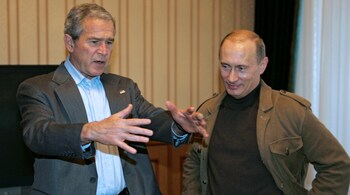


Freshly declassified documents have exposed how deeply worried world leaders were about Pakistan’s nuclear weapons, even as Islamabad was publicly treated as a strategic ally. Records released after a Freedom of Information Act lawsuit and processed by the National Archives and Records Administration show private conversations between former US President George W. Bush and Russian President Vladimir Putin from 2001 to 2008.
Behind closed doors, both leaders openly questioned Pakistan’s stability, the role of its military, and the dangers of nuclear proliferation. Their remarks paint Pakistan as a volatile, military-run state holding nuclear weapons with weak civilian control. The documents also reveal how Western powers privately echoed the same fears India had long raised, even while continuing to shield Pakistan for short-term geopolitical needs.
Putin’s blunt warning on Pakistan
During their first meeting in Slovenia in June 2001, Putin did not mince words about Pakistan under military rule. Referring to General Pervez Musharraf, Putin told Bush, “I am concerned about Pakistan. It is just a junta with nuclear weapons. It is no democracy, yet the West does not criticise it. Should talk about it.”
The remark captured Moscow’s view of Pakistan as a dangerous mix of authoritarian rule and nuclear capability, a combination that made global security risks far worse.
Shared fears of nuclear proliferation
The conversations show both leaders were uneasy about Pakistan’s role in spreading nuclear technology. Putin warned about Pakistan’s links to Iran, saying, “But it’s not clear what the labs (Iran) have, where they are… Cooperation with Pakistan still exists.”
Bush responded by pointing to the murky handling of scientist A Q Khan, telling Putin, “I talked to Musharraf about that. I told him we’re worried about transfers to Iran and North Korea. They put AQ Khan in jail, and some of his buddies. Under house arrest. We want to know what they said. I keep reminding Musharraf of that. Either he’s getting nothing, or he’s not being forthcoming.”
‘That makes me nervous’
In a later exchange in 2002, the two leaders again returned to the issue of Pakistani nuclear material. Putin said, “As far as I understand, they found uranium of Pakistani origin in the centrifuges.”
Bush replied, “Yes, the stuff the Iranians forgot to tell the IAEA about. That’s a violation.”
“It was of Pakistani origin. That makes me nervous,” Putin said.
“It makes us nervous, too,” Bush added.
Putin then remarked, “Think about us,” to which Bush replied sharply, “We don’t need a lot of religious nuts with nuclear weapons. That’s what Iran has running the country.”
India’s long-held warnings vindicated
India has for decades warned that Pakistan’s nuclear arsenal was uniquely dangerous because of political instability, military dominance, and links with extremist groups. Those concerns were often dismissed publicly by Western powers.
The declassified transcripts now show that Washington and Moscow privately shared the same fears. Pakistan was seen as unreliable, opaque, and risky. Yet strategic needs, especially the US dependence on Pakistan after the 9/11 attacks and during the Afghanistan war, meant these concerns were downplayed in public.
What the documents ultimately show
The Bush-Putin conversations expose a stark reality. Pakistan was never viewed as a responsible nuclear power behind closed doors. It was seen as a military-run state with a troubling record of proliferation and weak civilian oversight.
What India said openly, global powers admitted privately. The difference was that geopolitical convenience outweighed long-term security, allowing Pakistan to escape sustained international pressure despite being regarded as a nuclear risk by its own allies.
Discover the latest Business News, Sensex, and Nifty updates. Obtain Personal Finance insights, tax queries, and expert opinions on Moneycontrol or download the Moneycontrol App to stay updated!





