

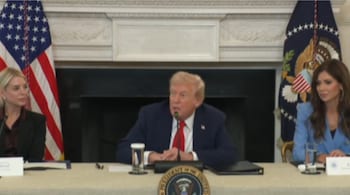
President Donald Trump, during a White House roundtable held on Wednesday, spoke strongly against Antifa, accusing the movement of promoting “left-wing violence” and “terror.” Referring to what he described as escalating unrest at universities, Trump stated, “Antifa has organized riotous mobs to attack campus speakers... These are bad people. These are people that want to destroy our country. We're not going to let it happen.”
This event followed Trump’s September executive order, where he officially labeled Antifa a “domestic terrorist organization.” Attorney General Pam Bondi, present at the meeting, reinforced the administration’s stance, saying, “This is not activism, it's anarchy. We can't, and we will not, let masked terrorists burn our buildings, attack our law enforcement and intimidate our communities.”
Antifa -- short for anti-fascist -- is not a single organization but, as defined by the Anti-Defamation League, “a decentralized, leaderless movement composed of loose collections of groups, networks and individuals.” Its roots are often traced back to early 20th-century Europe, where activists clashed with fascist regimes in the 1920s and 1930s.
According to Hindustan Times report, the historian and writer Mark Bray, author of Antifa: The Anti-Fascist Handbook, points out that the movement’s American form emerged much later. He connects modern U.S. Antifa groups to the Anti-Racist Action network of the 1980s. These groups often confronted neo-Nazi skinheads at punk shows across cities in the Midwest and beyond, forming the foundation of what became a distinct anti-fascist subculture.
Antifa’s opposition targets typically include neo-Nazis, white supremacists, and other far-right groups. But its activism has also broadened. When the BBC interviewed members in 2017, one protester explained, “It's not just resisting the federal administration but also resisting moves that can lead to fascism,” emphasizing that such resistance “happens locally whether from local officials or from local alt-right movements.”
Violence is a controversial aspect of Antifa’s tactics. Unlike many left-wing movements that focus on nonviolent protest, Antifa members have at times physically confronted far-right demonstrators. According to BBC reports, their actions have succeeded in disrupting or even halting certain rallies and speeches. However, members interviewed by the network stressed that they “denounce the use of weapons and violent direct action.”
The movement’s distinctive dress black clothing, masks, and helmets—has symbolic and practical origins. BBC traced the practice to West German anarchists during the Cold War. The attire conceals identities from law enforcement and promotes solidarity during demonstrations. The “black bloc” style also carries an element of intimidation, allowing participants to act collectively while remaining anonymous.
Although Antifa lacks formal leadership or centralized structure, its confrontational stance and visible presence have made it a flashpoint in American politics. To its critics, including President Trump, it represents chaos and disorder. To its supporters, it is a necessary counterforce against fascism and racism.
Discover the latest Business News, Sensex, and Nifty updates. Obtain Personal Finance insights, tax queries, and expert opinions on Moneycontrol or download the Moneycontrol App to stay updated!





