

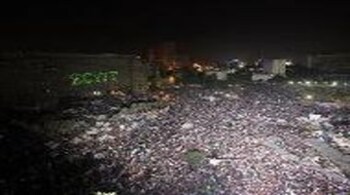
When military helicopters monitoring Egypt's protests whirr over downtown Cairo, storekeepers and shoppers stop talking and crane their heads to catch a glimpse.
The talk is largely of the army anyway. In a dramatic re-entry into politics on Monday, the armed forces gave President Mohamed Mursi 48 hours to meet the demands of millions of protesters to yield power or face an imposed solution.
Those hours run out later on Wednesday, but neither side shows any sign of flinching. The rhetoric has got hotter.
The army ultimatum has bred relief among many Egyptians, weary of what they see as Mursi's clumsy, power-grasping rule, and who see the army as the only national institution capable of getting a chaotic revolutionary transition back on track.
It has also revived mixed memories of the 17 months the armed forces spent running the country after the 2011 uprising that toppled Hosni Mubarak. Their rule was marked by violent protests and, watchdog groups say, flagrant human rights abuses.
Senior members of Mursi's Muslim Brotherhood have called the army's warning a "coup" and in an impassioned speech early on Wednesday, the president warned Egyptians not to let democratic legitimacy and their revolution be stolen from them.
Watching the address on a cafe television on Tahrir Square, where anti-Mursi demonstrators gathered to celebrate the army's move, Mutwali Sayed Mutwali retorted that Mursi's defiance was risking bloodshed: "He wants to kill his people? He wants to turn it into another Syria? We will tell him no, Mursi.
"Our legitimacy is from the square, Tahrir Square. Even if I die or if all these people die, we have our view, our principles. Our principal demand is for Mursi to leave."
Farther from the square, Ahmed Fatouh, 33, a downtown shop owner, said the army statement took him off guard - he thought it was through with politics - but it was probably for the best given Egypt's deep economic and political malaise.
"The military returning is a tough thing," he said. "But it's better for the country in these circumstances."
Fatouh said he did not vote in the elections that brought Mursi to power because he was unhappy with the second-round choice between the Brotherhood candidate and a former military officer many saw as a symbol of Mubarak's rule.
Now, Fatouh said, he expected the army would oversee the formation of a representative government including Islamists and liberals alike to run the country for a transitional period.
Karim, a 24-year-old lawyer, echoed those sentiments while sitting at a nearby street cafe as thousands of people waving flags and cheering marched past towards Tahrir Square, the epicentre of the protests.
The crowds massing against Mursi made it clear that "the people are the source of authority" in Egypt, Karim said. A unity government and preparations for a new constitution would follow the expiration of the army's deadline.
Safwat Kamel, a 55-year-old accountant sitting next to him, said Islamists were using violent rhetoric but that if they tried taking up arms - as some groups did in southern Egypt in the 1990s - he was sure the army could handle it.
"If they try that, they'll throw them in prison," he said.
But did the two trust the armed forces with such a transition, even after the messy period they only recently oversaw? "Of course," they said in unison.
"The armed forces are the only organised institution capable of keeping down the Brotherhood," Karim said. 'WE'VE LEARNED OUR LESSON'
Signs of Egypt's latest political uproar pop up everywhere downtown. Vendors selling socks and jewellery have supplemented their wares with small Egyptian flags.
Guy Fawkes masks - an emblem of protest against authority around the world - cover store mannequins. Anti-Mursi chants break out on street corners.
A 60-year-old man standing near a clothing shop said Egyptians had "learned their lesson," and would choose their next president carefully after Mursi was pushed out. "We trust the army," he said. "A new phase is about to begin."
A few blocks away, a 35-year-old Sudanese engineer sat drinking tea with a friend. He reflected on the history of his own country, which went through its own popular uprising, chaotic democratic rule and military takeover in the 1980s.
"The political system isn't a whole lot different here, but the army is," he said, asking to be called Abdel. Sudan's rulers, who also hail from Islamist backgrounds, spent years infiltrating the army before the 1989 coup that brought President Omar Hassan al-Bashir to power.
In Egypt, Abdel said, the army seemed more neutral. Ideally, that meant it would balance between rival politicians and make sure they did not exclude one another from the transition.
"One-party rule is a huge problem," Abdel said. "It's a problem in the whole Arab world."
Discover the latest Business News, Sensex, and Nifty updates. Obtain Personal Finance insights, tax queries, and expert opinions on Moneycontrol or download the Moneycontrol App to stay updated!





