

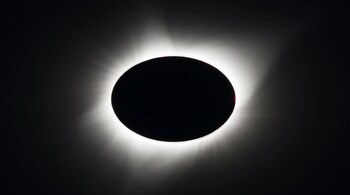
Millions of sky gazers anticipate a remarkable celestial phenomenon as a total solar eclipse sweeps across North America on April 8, 2024, extending from Mexico through the United States to Canada.
During a total solar eclipse, the Moon moves directly between the Sun and Earth, completely blocking the Sun's surface and casting a shadow on the Earth below. As a result, the sky becomes dark. The path of totality, where the eclipse is fully visible, presents prime viewing locations for experiencing the complete spectacle. During a partial solar eclipse, areas outside the path of totality will witness a noticeable change in daylight, although not complete darkness. The sky will appear dimmer than usual, depending on the extent of the Moon's obstruction of the Sun.
Here are some key statistics about the upcoming eclipse as outlined on NASA's website:
1. Duration of totality: The longest duration of totality, lasting 4 minutes and 28 seconds, will be near Torreón, Mexico. In Texas, totality will be up to 4 minutes and 26 seconds, and in some areas like Economy, Indiana, it will extend over 4 minutes. As the eclipse enters Canada, it will last up to 3 minutes and 21 seconds. Along the eclipse's centerline, most areas can expect totality durations between 3.5 and 4 minutes.
2. Temperature drop: During the total solar eclipse, temperatures are expected to drop by around 10 degrees Fahrenheit (5 degrees celsius) as the Moon casts its shadow over the Earth. However, variations may occur based on factors like humidity and cloud cover.
3. Wider path of totality: The path of totality for the upcoming eclipse will be notably wider, spanning between 108 and 122 miles across North America.
Also Read: Don't photograph surya grahan without proper camera filters & 6 more solar eclipse precautions
4. Enhanced accessibility: This path will traverse over numerous cities and densely populated areas, providing increased opportunities for individuals to witness totality. Approximately 31.6 million people reside within the path of totality.
Also Read: Indian-origin scientist Aroh Barjatya-led team to decode total solar eclipse effects
5. Visibility: The eclipse will be observable from all US states, as well as parts of Alaska and Hawaii, ensuring that 99% of the population can experience at least a partial eclipse from their respective locations.
Discover the latest Business News, Sensex, and Nifty updates. Obtain Personal Finance insights, tax queries, and expert opinions on Moneycontrol or download the Moneycontrol App to stay updated!





