

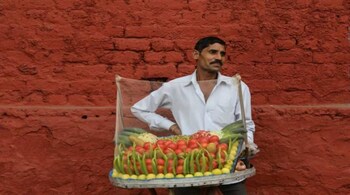
India was already witnessing an unemployment crisis when COVID-19 sneaked into the cities, and worsened the situation. It hit urban India disproportionately hard, with unemployment rates tripling, and nearly 80 percent workers reportedly losing their jobs. The crisis, in turn, triggered a mass migration with millions travelling on foot to reach their home states.
In rural areas, the National Rural Employment Guarantee Scheme (MNREGA) as well as supply of subsidised food became useful buffers that helped offer some security. Largely driven by the migrant workers returning to their villages, demand for work under the MNREGA skyrocketed this fiscal, with 40 million people seeking employment in June, up from the average 23.6 million during the 2013-19 period.
Yet, despite this increase in demand, the gap between those who want work and those who get it is at an all-time high, with more than 33 percent workers still not receiving employment under the MNREGA. Even though India’s overall unemployment rate has declined in the last two months owing to the unlock, the urban unemployment rate — still higher than both the national and rural unemployment rate — remains a cause for concern.
This has brought to the fore an issue successive governments have continued to overlook — the vulnerability of India’s informal urban workforce and the situation this workforce finds itself in, every time a crisis hits. It also strengthened the case for what policymakers have been demanding for long — not piecemeal benefits, but a comprehensive policy in the form of an urban employment job guarantee programme that gives urban poor workers not just a legal right to employment, but also social security.
Because most poverty alleviation schemes in India are largely targeted towards the rural poor, they ignore the needs of the urban workforce, especially the poor.
It is an oversight that needs to be corrected, especially when one considers the size of this segment and its contribution to the economy, with 68.3 percent employed in the informal sector in a non-agricultural role.
It’s not just necessary, but essential to think about their needs, since a majority — 65 to 82 percent of them — have no access to benefits.
As per the Periodic Survey Of India (2017-18), only 41.4 percent workers have regular, salaried jobs, over 70 percent do not have contracts, 54 percent are not entitled to paid sick leave, and 49 percent do not have any form of social security benefits.
What’s more, any means to access welfare and other measures from the government remain considerably difficult, since our systems fail to effectively target the affected informally employed labour force in urban areas.
For informal migrant workers, things are even more difficult due to unfriendly State policies that prevent them from accessing jobs, education, welfare entitlements, housing and health benefits. As per the Interstate Migrant Policy Index 2019, low income migrant workers are unable to get benefits under any scheme, because they become ineligible for it outside their home states.
A well-funded urban job guarantee programme has the potential to fix all these issues, preventing workers from falling into poverty. Its benefits, however, go much beyond raised incomes and improved welfare. If properly implemented the programme can help revive urban economy by addressing underemployment, raise wage rates by providing workers a fall back option and slow down the exceedingly unsustainable concentration of migrant workers in only a few cities.
In fact, some states have already started experimenting with this model in a limited capacity. For example, Odisha has launched an Urban Wage Employment Initiative, and Himachal Pradesh has announced the Mukhya Mantri Shahri Ajeevika Guarantee Yojana which assures urban poor 120 days’ work. Punjab and Rajasthan have requested the support of the Centre for such a programme.
For the programmes to be truly effective and universal, however, requires the Centre’s assistance and support. If it cannot enact such a programme across the country, the Centre could offer financial support to states wishing to introduce such programmes. It can also empower states to take more capital-focused expenditures for urban informal labour to build more public infrastructure, besides increasing allocation for green jobs.
The way this needs to be viewed, however, is not as a dole for unemployed workers, but rather a long term investment in our public goods and services. In that sense, the present crisis hides in it a wonderful opportunity: that of modernising India's social safety net to meet the demands of a changing workforce. The move, if undertaken, can be a true game changer, staving off an employment crisis, and also setting us up against any further shocks in the future.
The time for an urban livelihood guarantee scheme has never seemed more right.
Shikha Sharma is a New-Delhi-based independent journalist and photographer. Twitter: @ShikhaSharma304. Views are personal.
Discover the latest Business News, Sensex, and Nifty updates. Obtain Personal Finance insights, tax queries, and expert opinions on Moneycontrol or download the Moneycontrol App to stay updated!





