

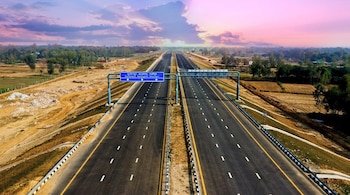
The discussion on the construction of highways, expressways, and national corridors yet again gained momentum with the inauguration of the Purvanchal Expressway last month. The massive investment being made to improve roadway connectivity in times of a pandemic, when the economy is witnessing a slowdown, has often been questioned.
Such doubts ignore the socio-economic opportunities generated from an infrastructure investment. The multiplier effect of the capital expenditure along with the accessibility premium to locations, and wider economic benefits to the economy generated from infrastructure development, help such projects to pass the social cost-benefit analysis test.
The Government of India has planned for 22 green expressways, out of which work has started for about half of them. The Bharatmala Pariyojana, the Centre’s umbrella project for the highways sector, plans to connect more than 600 districts covering 25,000 km in Phase-1 to increase the freight traffic movement. Of the many projects under this programme, the Delhi-Mumbai-Expressway (DME), the Delhi-Katra-Expressway, the Pune-Bengaluru-Expressway, and the Bengaluru-Chennai-Expressway are the most talked about. These expressways not only reduce the travel time but also impact the economy. As Peter Mackie, Daniel Graham and James Laird in their essay ‘The direct and wider impact of transport projects: a review’ say, ‘time savings are the base metal of the system, but the impact on GDP is the gold.’
The DME will be the largest corridor passing through six states, more than 10 major cities, covering 1,350 km, and reducing the travel time to half from the current 24 hours to 12 hours. It aims at the establishment of global manufacturing and commercial hubs with 24 investment nodes. The project will cost around Rs 1 lakh-crore. Though the cost is huge, the benefits of the project are unquantifiable.
On the revenue part, the expressway is expected to raise Rs 1,000-1,500 crore from toll every month. Apart from the toll collection, an infrastructure project opens revenue streams for all levels of government. When the expressway is developed, the land values on both sides of the corridor will shoot up. Also, land uses will change in various districts along with the formalisation of the land market in the adjoining areas. This will give rise to incremental property tax, land use conversion charge, taxation on sale of land, sale of FSI, etc. The infrastructure development can also make use of the value creation-capture-recycle method by levying taxes like betterment levy, impact fee, developer exaction, and vacant land tax.
The expressways also open doors for business activities. Along the highways, different food courts, hospitals, resorts, hotels, fuel stations, etc. will come up providing employment as well as entrepreneurial opportunities to the locals. The connectivity will promote the development of smaller towns, and initiate economic activity in different regions.
Some of the expressways, including the DME, and the Chambal Expressway, will pass through tribal areas. The development in these regions will boost employment opportunities, and the changing face of the economy will change the socio-economic condition of the communities there. The CharDham project will help boost tourism, which will boost allied industries thereby increasing job opportunities.
Road connectivity reduces the proximity from major cities, and leads to the formation of smaller business districts that help in balancing economic growth and the spread of urbanisation. The development of Delhi-Chandigarh, Delhi-Meerut, Delhi-Haridwar, and other such clusters will help in spreading out development, and, in the process reduce congestion.
Connecting a major city such as Delhi to smaller nearby towns such as Meerut, Chandigarh, etc. help in forming a hub and spoke model that can benefit from the positive externalities arising out of increasing returns, while reducing the congestion externalities.
National corridors and highways are important given the backdrop of the SDGs. These expressways reduce the distance, time taken to travel, and improve fuel efficiency of vehicles. It is estimated that the annual fuel saving on the DME would be about 320 million litres, and carbon emissions would reduce by 850 million kilograms. A green feature of these motorways is that the lighting will be powered entirely through solar energy. There are also plans to construct e-highways along the expressway that will be used only by the electric vehicles. Thus, these expressways will have a reduced carbon footprint that traditional roads.
In all, the benefits that arise from the expressways are multi-dimensional. The economic growth, social inclusion and empowerment, environmental conservation, etc. are highlights of the programme. The fillip it will give to tourism, employment generation, and overall development add to this allure.
Given the widespread benefits of the expressway projects, they are a must in times of economic slowdown as they have the potential to revive the economy by creating a multiplier effect.
Abhishek Malhotra specialises in urban economics, and is a consultant in the Office of Chief Economic Adviser, Ministry of Finance, Government of India.
Views are personal, and do not represent the stand of this publication.
Discover the latest Business News, Sensex, and Nifty updates. Obtain Personal Finance insights, tax queries, and expert opinions on Moneycontrol or download the Moneycontrol App to stay updated!





