

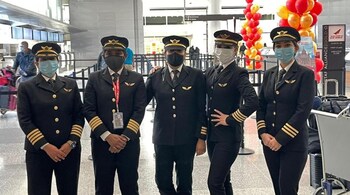
Most Indian households and parents dream of their kids becoming doctors, engineers, civil servants, and entrepreneurs, but not many plan ahead to see their children becoming commercial pilots.
While a pilot enjoys a wide variety of perks, apart from an attractive salary, like the opportunity to explore the world and prestige. It is a challenging job, especially if it’s your starting career.
"Most entry-level pilots are desperate for jobs after having spent lakhs and sometimes even a crore or more on training. They just want to start earning," Dinesh Ram (name changed), a senior pilot working in India, told Moneycontrol.
"In order to get a commercial pilot licence, trainees spend about Rs 70 lakh to graduate from cadet pilot programme and another Rs 15-20 lakh to be trained by an airline before becoming co-captains in their first commercial flight," Ram said.
So after spending around Rs 1 crore to become a pilot, how much do entry-level pilots earn in their first five years?
After completing their commercial pilot licence training, pilots sign a letter of intent with airlines to get training for flying a specific type of aircraft. These simulator training usually lasts for around 4-7 months, during which pilots are paid around Rs 50,000 - Rs 75,000 per month.
On average, most airlines categorise entry-level pilots as first officers or co-captains in India. First officers are sub-divided into three tiers --Junior First Officers, First Officers, and Senior First Officers.
A Junior First Officer is a pilot who has completed 500 hours of flying commercially, while a First Officer is one with less than 2,000 hours of flying commercially.
A Senior First Officer has more than 2,000 hours of flying commercially and waiting to become a Captain or Pilot in Command, based on the requirement of the airline.
Most airlines in India offer pilots a 70-hour-per-month flying contract, which includes fixed income, layover allowance, and allowance for international travel.
Additionally, pilots receive several benefits, such as health insurance, life insurance, and retirement plans, which add to their overall salary package.
Air India offers its pilots a 20-hour-per-month flying contract.
Junior First Officers
IndiGo offers its Junior First Officers an average salary of Rs 2.2 lakh per month for flying 70 hours. Similarly, GoFirst, Vistara, and SpiceJet offer their Junior First Officers average salaries of Rs Rs 1.7 lakh, Rs 2 lakh, and Rs 1.6 lakh per month, respectively, for flying 70 hours.
Air India offers its Junior First Officers an average salary of Rs 1.2 lakh per month for flying 20 hours. Additionally, they are offered anywhere between Rs 1,500 to Rs 2,500 per hour to fly above their 20 hours.
Akasa Air offers its Junior First Officers an average salary of Rs 1.8 lakh per month for flying 70 hours.
First Officers
IndiGo offers its First Officers an average salary of Rs 3.5 lakh per month for flying 70 hours. Similarly, GoFirst, Vistara, and SpiceJet offer their First Officers average salaries of Rs Rs 2.5 lakh, Rs 3.2 lakh, and Rs 2.5 lakh per month, respectively, for flying 70 hours.
Air India offers its First Officers an average salary of Rs 2.5 lakh per month for flying 20 hours. Additionally, they are offered anywhere between Rs 2,000 to Rs 3,500 per hour to fly above their 20 hours.
Senior First Officers
IndiGo offers its Senior First Officers an average salary of Rs 4.5 lakh per month for flying 70 hours. Similarly, GoFirst, Vistara, and SpiceJet offer their Senior First Officers average salaries of Rs Rs 3.8 lakh, Rs 4.2 lakh, and Rs 3.6 lakh per month, respectively, for flying 70 hours.
Air India offers its Senior First Officers an average salary of Rs 3.1 lakh per month for flying 20 hours. Additionally, they are offered anywhere between Rs 3,00 to Rs 4,500 per hour to fly above their 20 hours.
Life as a pilot
Despite all the training, most pilots face a variety of challenges when they start operating on commercial flights, Ram said.
Customer behaviour, punctuality of cabin crew, weather conditions, changing rosters, coordination with Air Traffic Control Officers, coordination with ground handling staff, airport staff, and, in some cases, employees of oil marketing companies are some of the issues pilots come across during everyday operations.
"Nobody trains a pilot on what to do when an OMC (oil marketing company) official refuses to refuel your flight," Ram said, adding, that a simple issue like lag in payment processing, leakage in a pipe used for refueling, or even tire puncture of refueling vehicle can lead to a delay.
He added that most pilots learn to deal with the situation when they start flying.
"I don't think any cadet can honestly answer how they will respond when a passenger starts vomiting at the time of boarding and boarding is stalled for the next 30 minutes and ATC officials and seniors are calling," Ram said.
Most airlines have well-defined flight duty time limitations and rosters that are prepared by pilot unions and airline executives.
The flight duty time limitations specify the working and resting hours for pilots and the rest of the crew.
However, in many cases, rosters are not followed and pilots are required to be available on standby in cases of emergency or staff limitations.
While the challenges faced by pilots seem endless, the life of a pilot does come with a number of perks.
A monthly payslip of upwards of Rs 7-8 lakh after becoming a Pilot in Command (after 6-7 years) and the opportunity to travel to international countries are just some of them.
"The prospect of operating engineering marvels like a wide-body Airbus A380 superjumbo or the Queen of the Skies the Boeing 747, is worth the wait," Ram said.
Discover the latest Business News, Sensex, and Nifty updates. Obtain Personal Finance insights, tax queries, and expert opinions on Moneycontrol or download the Moneycontrol App to stay updated!





