

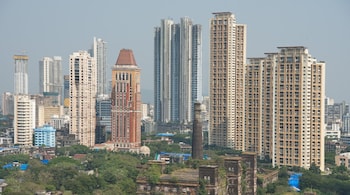
In a messy divorce case, the man and the woman traded various nasty allegations. The man alleged that the woman misled him from the very beginning. He thundered with a tinge of snobbishness that “she said that she is from Mumbai. But she lied. She was from Thane.” For those not familiar with the geography of Maharashtra, Thane is to Mumbai what Gurgaon is to Delhi. Where Mumbai ends on one side, Thane starts. The man’s mind was clear. Mumbai has high property rates and therefore the residents are wealthy. Others pale in comparison. The conclusion is not untrue but the ground is changing.
I was reminded of that decade-old episode after visiting a few housing projects in Thane last week. One project offering in particular, Sheth Zuri, stuck out. Its quoted pricing was almost on a par with a project by the same developer in Mumbai. It’s not the only one. Word on the street is that prices of the upcoming Thane offering of Oberoi Realty will match those of its Mulund project in Mumbai. Prime locations in Navi Mumbai have been priced higher than several locations of Mumbai. It made me think about a trend that is slowly picking up. The default setting of a Mumbai home automatically commanding a premium just by being in ‘Mumbai’ is eroding.
How did this happen? It’s a combination of several uniting factors:
1) Decentralization of economic activity: There was a time around two decades ago when all key economic activity presided primarily in South Bombay at locations like Fort, Nariman Point, etc. That ensured the surrounding areas fetched a steep premium whereas all the distant others languished. New business districts were later created elsewhere, bringing several other locations into consideration.
2) Connectivity: It is undeniable that infrastructure connectivity has been inadequate in the Mumbai Metropolitan Region. It is also equally undeniable that there has been a degree of improvement. That has meant the workforce is able to stay in distant areas and yet travel to their workplace.
3) Quality of projects: There is no market where top developers are slugging it out in the manner that is happening in Thane. The availability of large parcels of land has allowed developers to enter this market with competitive and credible offerings. Given the availability of land, almost every project offers social and recreational amenities like a swimming pool, gym, banquet hall, walking track and the like. Indeed, the choice for many has now come to mean a small apartment by a local developer with no amenities in Mumbai versus a bigger apartment by a branded developer with amenities in Thane.
4) Familiar surroundings: Housing is often local. There is no empirical data on this but it is believed that three-fourths of all demand for a new project is sourced from nearby areas. That means homebuyers will prefer to upgrade within their own locality than relocate into a different micro-market—even if the other micro-market is perceived as being more upmarket.
5) Market being project-specific: There was a phase when the price gap between a good building and a hideous building on the same street was marginal. Location was everything. Today that phenomenon hardly exists. Projects matter. Hence, it’s not uncommon to see the price gap between two buildings next to each other be as high as 25-30 percent. Quality offerings are able to demand a premium while poor projects are discounted.
6) Governance: It is no secret that civic amenities have been on a downward spiral in Mumbai over the last few decades. Governance has suffered with many homebuyers concluding that paying steep prices just to reside in ‘Mumbai’ is simply not a productive decision.
Is this trend widespread yet? Far from it. The example of Sheth Zuri is a small minority. It has features that are peculiar. It has a location that is arguably among the best in the Thane market. Moreover, its current elevated price is after price hikes and the customer response is yet to be tested meaningfully at these levels. Registration data from real estate database platform Zapkey shows that the average cheque-transacted rate for the Thane project since its launch is 10 percent lower than that of its Mulund project.
At a macro level, home prices in Thane have performed better than that of Mumbai in the last decade. According to data from real estate analytics firm Liases Foras, home prices in Thane were only 36 percent of the prices of Mumbai city in 2009-10. Since then, it has outperformed Mumbai. Yet even today rates in Thane are 50 percent of the rates in Mumbai.
Will it ever rival that of Mumbai? No. Mumbai has an inherent economic strength that is hard to displace. But Thane will continue to gain and narrow the gap in property prices to Mumbai. The peak probably will be its rates reaching 55-60 percent that of Mumbai prices.
The game changer for several parts of the Mumbai Metropolitan Region was undoubtedly going to be the Mumbai Metro. Its integrated development had the potential to bring about sharp changes in prices across the board. Ever since progress on that has slowed, it is anyone’s guess when the outcome would materialise.
What is certain is this: If Thane’s administration raises its game, a future divorce battle will not be fought by making a sharp distinction between Thane and Mumbai.
Discover the latest Business News, Sensex, and Nifty updates. Obtain Personal Finance insights, tax queries, and expert opinions on Moneycontrol or download the Moneycontrol App to stay updated!





