

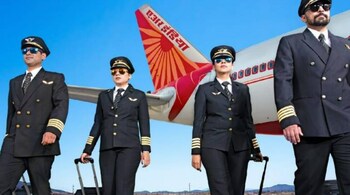
The Air India Maharaja is getting a makeover as the Tata Group plans to merge the four airlines it owns, Air India, and its subsidiary Air India Express, along with Vistara and AirAsia India.
The announcement of the merger of Vistara and Air India came on November 29, the death anniversary of legendary industrialist JRD Tata.
While the takeover of AirAsia India by Air India Express came on November 2. With 2024 set as the target date for the completion of the amalgamation, Air India is expected to grow multifold in the next 16 months.
Air India's market share in the domestic market will jump from around 9 percent in October 2022 to around 27 percent after the amalgamation. Vistara and Air Asia India currently control 9.2 and 7.6 percent of the current market share.
The airline's international market share will also rise to around 25 percent by 2024.
Vistara started flying in January 2015. AirAsia India was launched in 2014, while Air India Express began operations back in 2005.
Recently appointed chief executive officer of Air India, Campbell Wilson last month said that as part of Air India's five-year plan Vihaan.AI the airline aims to control 30 percent market share in both the international and domestic market in India by 2027.
Post-merger, the airline behemoth might have over 15,000 employees and 218 aircraft. Air India in January had a total of 12,085 employees of which 8,084 are permanent and 4,001 are contractual.
In June Air India around 4,500 Air India employees opted for the voluntary retirement scheme (VRS) offered by the new management. Air India offered the first VRS to those above 40 with 20 years of continuous employment.
Additionally, 4,000 more people will retire from Air India in the next two years.
Vistara currently has around 4,700 employees, while AirAsia India has around 2,500-3,000 employees.
Air India's combined fleet after the merger will also rise to around 230 planes, after putting together Air India’s 113 expected planes, Vistara’s expected 70 planes by 2024, AirAsia India’s 28 planes, and Air India Express’s 24 planes.
The group’s airlines operate both Airbus and Boeing aircraft in the narrowbody segment, while the widebody segment has only Boeing aircraft.
The narrowbody segment comprises 68 A320 family aircraft of Air India, 46 of Vistara, and 28 of AirAsia India. The Boeing narrowbody segment includes 24 of Air India Express and five of Vistara.
On the widebody side, there are 43 aircraft of Air India and three of Vistara. A grand total of 217 aircraft, even though not all of them are operational for one or another reason.
Industry insiders expect the Air Operator’s Permit of Vistara will be retired following the merger but Air India and Air India Express will continue to operate as separate entities.
Air India Express may be run as the Tata Group's low-cost carrier while the expertise at Vistara will be essential to revive Air India's brand image.
"The lead for setting and managing the product and domestic operations should, therefore, be given to Vistara, so that their processes take precedence in setting Air India’s domestic operations right," an industry veteran said.
Air India will have to deal with the confusion that Jet Airways and Kingfisher Airlines couldn’t handle: deciding routes for full-service carriers and low-cost carriers. Will both be present on all routes? Will there be a cross-selling of inventory?
Discover the latest Business News, Sensex, and Nifty updates. Obtain Personal Finance insights, tax queries, and expert opinions on Moneycontrol or download the Moneycontrol App to stay updated!





