

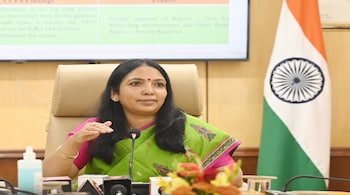
Consumer Affairs Secretary Nidhi Khare says complaints linked to the GST rate cuts have dropped to “nearly negligible” levels after an initial spike of around 3,000 cases in the first few days after implementation on September 22.
The department is also expanding scrutiny of manipulative algorithms and AI-driven advertising, while faster, tech-enabled case handling has cut consumer grievance resolution timelines by more than half to about 21 days, helping recover Rs 7 to 14 crore in refunds across 30 sectors, Khare told Moneycontrol in an interview.
Below are the edited excerpts of the interview with Khare:
In September, you mentioned that around 3,000 complaints were filed after the GST rate cuts. What is the latest figure now, and have most of these complaints been resolved?
The Department of Consumer Affairs did at least two rounds of meetings with e-commerce firms, major wholesalers, and retailers once the GST cuts were announced, because it also involved queries from their side, including on inventories. Along with the Department of Revenue, we were able to help them understand how it would pan out. After that, once the GST Bachat Utsav started on September 22, a lot of queries were received from consumers, so we made arrangements through the National Consumer Helpline by adding manpower and training them to handle the complaints and queries effectively.
We are happy to say that while, during the first week of the announcement, we received around 3,000 complaints, the complaints immediately started dropping. When we analysed this number, we realised one-third of them were general queries about where the cuts apply, so we were able to answer them effectively. There were also questions such as why the price of milk hadn’t reduced, in which case we informed consumers that there was no GST on milk to begin with and made them aware of the same.
I must say that major associations have followed suggestions on clearly displaying what the prices were prior to the GST cuts and what the prices are now, and that has helped with consumer awareness. Now the complaints are nearly negligible. The spike of 3,000 was only for the first two days after the GST cuts came into effect, and later it dwindled. It is no longer an issue.
You have warned platforms against dark patterns, and recently 26 major platforms have filed self-declarations stating that they are avoiding the patterns identified by your department. How will your department ensure they follow through?
We came out with guidelines on dark patterns in 2023 to provide guidance to e-commerce and quick commerce platforms that these are practices which not only violate consumer rights but also mislead and manipulate consumers choice and hence Unfair Trade Practices. At times, we noticed that e-commerce entities themselves were not aware that these were dark patterns and would fall under unfair trade practices. They were of the view that this was a business model or a bright idea by their sales team. It is important that joining a subscription should be as easy as exiting. Therefore, we thought we needed to create awareness among the platforms that these practices are non-negotiable and have to be changed. We came out with Guidelines on Prevention of Dark Patterns in 2023 to provide guidance to e-commerce and quick commerce platforms that these are practices which not only violate consumer rights but also mislead and manipulate consumers.
We held a meeting with them in May and gave them examples of commonly used dark patterns in the industries. We then gave them time to self-audit their own systems and come clean of dark patterns before we audit them. Now, 26 major e-commerce companies have filed affidavits stating that they are not employing any dark patterns and have assured that even in the future they will not employ such practices. We have put this information on our website so that consumers can be assured that these platforms are free from dark patterns and in case any dark pattern is detected, it must be brought to notice on NCH 1915.
Simultaneously, the Central Consumer Protection Authority will remain vigilant on these matters. We have carried out massive campaigns to make consumers aware of dark patterns, and on the National Consumer Helpline we get complaints. Once we start getting complaints, and if in our preliminary inquiry we find a prima facie case of violation of consumer rights or unfair trade practices, law will take its own course.
AI-powered content and deepfakes are becoming increasingly common in digital advertising. How is the Department ensuring consumers are protected from such misuse of AI?
All of us need to understand that AI has entered our lives and it is not going to go away. There are certain positive features of AI, which we will start benefiting from as we use it more and more. But it is the negative aspects such as deepfakes, issues of privacy, and online conning for which we need to have a strong legal framework.
As a nation, we are one of the highest data consumers, so consumers should know when advertisements are AI-generated because when they are not, sometimes it is difficult to differentiate the real from the AI-made. CCPA has come out with guidelines on misleading advertisements, not only for endorsers but also for social media influencers, including virtual influencers. We have already issued dos and don’ts on this. Even virtual influencers are owned by someone and because they are promoting a product and gaining from it, whoever benefits from such advertising that manipulates consumers using AI will be liable for punitive action.
The Bureau of Indian Standards is already working on creating standards for ethical AI and minimum thresholds that will determine what qualifies as AI-driven and what does not.
The ministry is planning to use AI and machine learning to speed up consumer complaint handling. How exactly will AI be used in consumer courts and complaints, and how will you ensure the system remains fair and doesn’t make biased decisions?
We are trying to incorporate AI into the consumer commissions, from districts to states. We have now introduced the e-Jagriti tool, which is a software that enhances the process of filing and listing complaints, better managing cases, and bringing these cases to virtual hearings. In a recent meeting with the NCDRC and other commissions, we have asked them to start using these tools because they help in better organisation. For instance, it helps us identify key words to look up past judgments outside of your state in similar matters. We make a digest every year, sector-wise, for past judgments so our consumer commissions can use them. The manual time and effort can be brought down. There are also some smaller civil matters where we can easily check if they qualify for admission.
AI tools are being encouraged to be used largely for research and to see if something is applicable to a case. It is to cut down the drudgery, but the decision has to be done with application of mind.
We have seen a drop in the timeline for resolving consumer cases. In the past one year, we have been able to dispose of as many cases as are being filed. One indicator of its efficiency is that, because of e-Jagriti, Indians abroad are tracking their cases. About 1,388 NRIs are on e-Jagriti, up from around 600 two months back and they are also participating in the virtual hearings. Most of them are young people who came on a holiday, bought something for their parents and faced a problem, and when they were not satisfied with the resolution from the company, they approached the consumer commissions. In about two to three months, the number of NRIs on e-Jagriti has doubled.
Do you intend to further strengthen the enforcement powers of the Central Consumer Protection Authority (CCPA)?
Now that CCPA has achieved credibility & trust among consumers, it is important to strengthen it through increased manpower so that it can handle rising demands on it.
How are you addressing the misuse of algorithms and dark patterns by e-commerce platforms under existing consumer protection rules?
The E-commerce Rules, 2020 are already in place, and they clearly define the duties, responsibilities and liabilities of e-commerce both marketplaces and inventory based. With the guidelines on dark patterns, the algorithms used to nudge, deceive and manipulate consumers are also being monitored. We have already started taking action on these matters.
Do you have any plans to further upgrade the consumer complaints platform?
We are constantly upgrading the National Consumer Helpline, 1915. NCH 2.0 offers registration of complaints 24x7 through omnichannel IT enabled central portal, through various channels like WhatsApp (8800001915), SMS (8800001915), email, NCH app, Umang App etc. The idea is to ensure it is very fast, hassle-free, and easily accessible.
Increasingly, the age of disposal of consumer complaints has come down from 45 days to about 21 days and our efforts would be to further bring down the time taken to resolve the complaints. NCH at prelitigation stage, has helped consumers recover millions of rupees in refunds, worth Rs 7-14 crores across 30 sectors.
Discover the latest Business News, Sensex, and Nifty updates. Obtain Personal Finance insights, tax queries, and expert opinions on Moneycontrol or download the Moneycontrol App to stay updated!





