

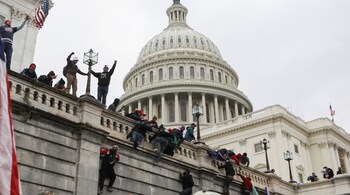
For anyone who has covered political turmoil across the wreckage of the former Soviet Union over the past three decades, the mob that stormed the Capitol in Washington on Wednesday looked shockingly familiar, down to the dress code and embrace of banners trumpeting seemingly lost causes.
In fervor and style, the mob resembled the ragtag bands that seized control of the parliament building in Moscow in 1993 clamoring for the revival of the Soviet Union. Much the same scenes unfolded two decades later, as self-styled militias stormed the regional assembly in Donetsk, a major industrial city in eastern Ukraine and now the capital of a secessionist, pro-Russian “people’s republic.”
Ersatz military gear — shabby jackets, old boots, black wool hats and bandannas — were much in evidence back then, as were the flags of long-dead and, we all assumed, safely buried causes.
In Donetsk, these included not just the Red Flag of the defunct Soviet Union and the black-yellow-white tricolor of the long-gone czarist empire, but at times also the emblem of an even more distant, failed venture, the Confederate States of America. (None of them knew much or really cared about the Confederacy, but they did know it was hated by the kind of people they hated.)
But what was most familiar about the insurrectionists in Washington on Wednesday was their certitude, an unbending conviction that, no matter what anyone else or the law might say, right was on their side. A cabal of elitist traitors had grabbed what was rightfully theirs — whether the country they had grown up in, their economic and physical security or simply their sense of how society should be ordered.
“Victory is ours. All we need is courage,” shouted a self-declared commander of the “army of patriots” who, in the fall of 1993, helped take control of the White House that at the time housed the Russian legislature on the banks of the Moscow River and then led his followers on what turned out to be suicide mission to seize the Ostankino television center. (Scores died in a hail of gunfire from troops loyal to President Boris Yeltsin.)
When insurrections began in Moscow in 1993, and then in eastern Ukraine in 2014, failure looked inevitable. The leaders, along with their followers, seemed deranged, intoxicated by nostalgia, wild conspiracy theories and fantasies about the depth of their public support.
But they believed. In eastern Ukraine, the people who took to the barricades outside the regional administration building were sometimes drunk, often belligerent and disconnected from reality. But all had no doubt that their cause was just.
A barrage of a propaganda on Russian television, the main source of news for much of the population, spread fear and anger, embedding a conviction that anti-Russian protesters in the distant Ukrainian capital, Kyiv, would soon descend on Donetsk with guns and knives to wreak havoc.
I remember sitting in the parlor of a Donetsk economics professor, an earnest and mild-mannered man, who, in the middle of an interview, ran into the bedroom to comfort his wife, who had suddenly started shrieking. She had been watching Russian television while doing the ironing and, terrified by bloodcurdling reports of Ukrainian “fascists” on the march, was certain that “they are coming to slit our throats.” The couple, both nearing retirement age, rushed off to join the barricades.
The war that followed has now dragged on for six years, killing more than 13,000 people, nearly all civilians. People who wanted nothing to do with the “Donetsk People’s Republic,” who, according to opinion polls carried out shortly before its declaration, constituted a large majority, have mostly left the “republic” that no other country, including even Russia, recognizes. That has left only true believers, the elderly and those too poor to move.
In Moscow in 1993, the insurrection fizzled quickly, at least on the streets, though not in minds.
Aleksandr Rutskoi, a former Soviet bomber pilot who led the rebellion against Yeltsin, vowed to “fight to the end,” but barely 24 hours later he surrendered. Dressed in military fatigues, he was bundled onto a battered bus with his captured confederates and driven off to Lefortovo prison.
Rutskoi, highly decorated for his service in Afghanistan, cut a pathetic figure. Defeated and dejected, he was unmistakably a loser.
But the winners squandered the victory, unleashing a wave of crooked privatizations and staging a deeply flawed presidential election in 1996 that kept an infirm and increasingly erratic Yeltsin in the Kremlin for a second term. When that was nearly done, he handed over power to Vladimir Putin.
A former KGB officer who believed in order above all else, Putin had no time for insurrection, but he embraced the revanchist cause, reviving Russia’s ambitions as a global power, the reach of the security services, the music of the Soviet national anthem, Soviet-era emblems for the military and patriotism as a cudgel against his critics.
Two decades after he came to power, the word traitor has become one of the Kremlin’s favorite terms of abuse, democracy the butt of mockery. Commenting on the tumult in Washington, Konstantin Kosachev, head of the Foreign Affairs Committee of Russia’s upper house and a Putin loyalist, scoffed at American democracy as “limping on both feet.”
“The celebration of democracy has ended. It has, unfortunately, hit rock bottom, and I say this without a hint of gloating,” he added, clearly gloating.
By Andrew Higgins
c.2021 The New York Times Company
Discover the latest Business News, Sensex, and Nifty updates. Obtain Personal Finance insights, tax queries, and expert opinions on Moneycontrol or download the Moneycontrol App to stay updated!





