

In the annals of wartime trivia, some of the funniest anecdotes on warring sides taking a break during battles has to do with the Nawabs of Awadh and their colonising British tormentors.
The Nawabs, who were in power in the Awadh region (now part of Uttar Pradesh) during the 18th and 19th centuries, played chess and wouldn't leave their games even if they were under attack. Just like the British who would allow themselves to be pounded by the Gauls in the Gallic wars, so that they could drink their favourite brew - tea.
The fondness of the Nawabs for chess was matched only by their patronage of the Awadh artisans' intricate hand embroidery work called chikankari, which first came to Bengal from Persia, and found its home in Awadh.
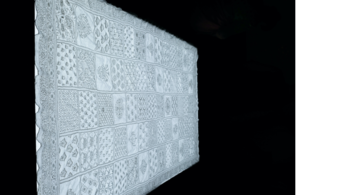
At a new exhibition on India's textile traditions that opened at the National Museum on August 18, one of the highlights is a chikankari work that pays homage to the Nawabs and their passion for chess.
Stitches of Shatranj
Titled Shatranj (the Hindi name for chess), a 2.5x1 metre dupatta in chikankari by designer Anjul Bhandari reflects the millennia-old tradition. The white 500-count handwoven mal mal cotton fabric for the dupatta was sourced from Murshidabad, West Bengal. It took ten chikankari artisans in and around Lucknow 16 months to complete the stitches of Shatranj.
"The only way to introduce all the old blocks and bootis (small flowers) and butas (large flowers) of chikankari was the game of chess," says Bhandari, a self-taught artist who divides her time between Lucknow and New Delhi.
"Chikankari is an art form that is in the hands of women in the Awadh region," adds the artist, who has one more dupatta in kamdani, another of Awadh's embroidery traditions.
Both chikankari, now a GI-tagged embroidery with geographic indication of Lucknow, within a 200-km radius, and kamdani, Bhandari insists, need support to survive.
Textile art like chikankari, kamdani (the Awadh tradition that uses flat strips of silver embellishment), nakshi kantha (hand embroidery on Bengal muslin), chamba rumal (hand embroidery that originated in the Rajput courts of Punjab and Himachal Pradesh), and bandhani (tie and dye) and zardosi indigenous crafts of Gujarat tell the story of the multicultural fabric of a nation that used yarn as a formidable tool of resistance against the Raj.
Fabric and Freedom
"It is very important that we are informed about our past," says Lavina Baldota, who has curated Sutr Santati that means continuity of the yarn in Hindi. "If we can't preserve and revive our dying textile art, then our future generations will never know about it," adds Baldota, who used textile art to mount an exhibition about nation and freedom on the 150th anniversary of birth of Mahatma Gandhi at the Indira Gandhi National Centre for the Arts in 2019.
Baldota's new exhibition, this time at the National Museum, celebrates 75 years of India's independence. "One of the important tools of our freedom movement was the yarn," explains Baldota, who is the custodian of the Abheraj Baldota Foundation, a non-profit to promote responsible citizenship. "During the freedom struggle, every household weaved their own fabric to fight against the British who destroyed our homegrown handloom industry. Mahatma Gandhi's swadeshi movement using khadi was an integral part of our freedom struggle."
As many as 75 participating artists, including artisans, crafts people, designers, artists who work on textile art and students of design institutes across the country, are presenting over 100 textile works in the exhibition (August 18-September 20).
"The weavers and crafts people in the textile sector were among the hardest hit by the pandemic. Orders were cancelled and they were in trouble. The exhibition connects with a community that suffered," says Baldota.
Reviving a Tradition
Mahua Lahiri and Suparna Sen are two young designers from West Bengal who embody the exhibition's aim of preserving the country's textile tradition. Both Lahiri and Sen, former students of the National Institute of Fashion Design, Kolkata, have put their efforts behind revival of kantha, a hand embroidery craft of Bengal that goes back to the 9th century A.D. Rhythm of Charkha, the designers' exhibit at Sutr Santati, is the story of the Indian cotton in kantha work.
"Kantha is all about storytelling," beams Lahiri, whose mother Pritikana Goswami won a National Award for textile craft in 2001 for her work on kantha embroidery. Hand stitched by seven artisans, Rhythm of Charkha has sewn up the story of the Bengal muslin from the pre-Harappa civilisation to the present day around a charkha. There are images of a woman from the 9th century Pala Dynasty wearing a muslin sari to the frightening scene of a British soldier hacking the hand of a Bengal cotton farmer to kill the skill as well as images from the Bengal famine.
Following in her mother's footsteps, Lahiri joined Sen seven years ago to create the Kolkata-based Hushnohana, a venture that works among the kantha artisans of West Bengal to revive the long tradition. "I am an artisan first and then a designer," says Lahiri, who rues the current trend of modernising kantha. "Kantha is not about running stitches alone, it is also about heritage, emotions, expressions and aesthetics," she adds. At Hushnohana's workshop in Kolkata's Sonarpur neighbourhood, 19 women artisans work on their craft to create kantha embroidery.
Respect and livelihood for textile artisans is a recurring theme in the current movement across the country for the culture's revival reflected in the exhibition. "No other country offers the kind of depth, richness and variety in textile art as India does," says Malavika Shivakumar, co-founder of Chennai-based Vastrakala that has exhibited a hand emboriderd charkha in khadi cotton. An Indo-French company in the field of decoration and fashion, Vastrakala employs 250 women and men who do both needles and hook and has a team in Versailles, France, currently redoing the silk bed hanging in its famous palace. Adds Shivakumar: "Crafts people in India come from an unbroken heritage."
Discover the latest Business News, Sensex, and Nifty updates. Obtain Personal Finance insights, tax queries, and expert opinions on Moneycontrol or download the Moneycontrol App to stay updated!





