

Atharva Pandit
Moneycontrol News
Arunachal Pradesh, India's north-easternmost state, has been on the boil since last week. The protests, which quickly became violent, were against the probability of granting permanent residence certificates (PRC) to members of six communities.
What triggered the violence?
Arunachal Pradesh's capital, Itanagar, and the surrounding areas witnessed a spate of violence since February 21, after a Joint High Powered Committee (JHPC) reportedly recommended granting permanent resident certificates to non-native communities in Arunachal Pradesh. These communities include the Adivasi, Deori, Gorkha, Mishing, Moran and Sonowal Kachari.
According to The Indian Express, the communities have been demanding a permanent residence status for a long time now. They have been living in the state for decades, and, in fact, were issued PRCs in 1992-93, but that was subsequently rescinded.
The Arunachal Pradesh Assembly was scheduled to table the JHPC report and its recommendations on February 23, but refrained from doing so following the violence, and Speaker Tenzing Norbu Thongdok had dissolved the session sine die.
Why is the PRC so important and, now, a point of contention?
The argument of the protesters against the PRC is that granting the status to the communities, presently concentrated in the areas of Namsai and Changlang, would compromise the rights and interests of the indigenous people of Arunachal Pradesh.
PRCs are also helpful in availing reservations for jobs and securing admissions in educational institutes in the state.
Who is leading the protests?
According to reports, the protests are being spearheaded by a number of community and student organisations.
During the last such agitation in the state, the Arunachal Pradesh Students' Union (APSU) had led the protests and been successful in coercing the government into not granting PRCs to non-Arunachalis. In 2010, for instance, when the state government had decided to grant PRCs to non-Arunachalis residing in the state, APSU had led the movement to revoke the government's order.
This time around, however, even the APSU has been caught off-guard by the scale of the protests, according to reports.
"We are not behind this violence. Our offices are being burnt down and there is a possibility of attack on our residences. This seems to be politically backed," a senior APSU leader told Indian Express.
The Bharatiya Janata Party (BJP), which is in power in the state, blamed Congress for the violence.
"This violence is definitely politically backed by the Congress. The government has already agreed to not table the recommendations and discuss the matter. It is an attempt to destabilise the BJP government in the state. Goons have been going around Itanagar for the last few days," Tapir Gao, state president of the BJP said, according to the report.
The Congress, meanwhile, has stated that the violence is a failure of state administration and that President's Rule should be imposed.
Assembly polls in Arunachal Pradesh are scheduled for later this year.
Where does the situation stand as of now?
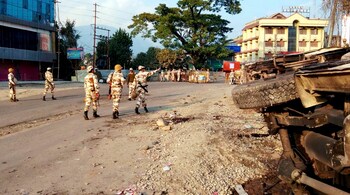
Even though curfew was imposed and Army was brought in, protesters on February 24 set ablaze the private residence of Arunachal Pradesh Deputy Chief Minister Chowna Mein and ransacked the office of the deputy commissioner.
According to reports, at least three people have been killed in the violence, and several have been injured. The protests have caused significant damage to public property. On February 24, even as the Army conducted flag marches and internet in the state remained suspended, protesters attacked Itanagar police station and damaged a number of vehicles outside the collector's office.
On February 23, the agitators had damaged the stage of the Itanagar International Film Festival at the Indira Gandhi Park here. The organisers had later called off the film festival.
The Central government on February 24 dispatched 10 companies of the Indo-Tibetian Border Police (ITBP) to the state.
Meanwhile, Arunachal Chief Minister Pema Khandu said the state government has "already dropped the PRC matter of Namsai & Changlang districts". He told news agency ANI that the "issue is closed" and asked for the protestors to "cooperate with the government".
Union Minister Kiren Rijiju, who hails from the state, said the Arunachal Pradesh government will not be accepting the recommendations of the JHPC report.
Khandu on February 25 called for an all-party meeting after discussions with community leaders regarding the continuing shutdown in Itanagar and adjoining areas. The curfew still remains, though reports have suggested that the state capital has not witnessed any violence today.
Discover the latest Business News, Sensex, and Nifty updates. Obtain Personal Finance insights, tax queries, and expert opinions on Moneycontrol or download the Moneycontrol App to stay updated!





