Ayodhya's journey through time: Historic revelations
As the 'Pran Pratishtha' ceremony for the Ayodhya Ram Temple approaches, we delve into history to present the intricate twists and turns of the temple town.
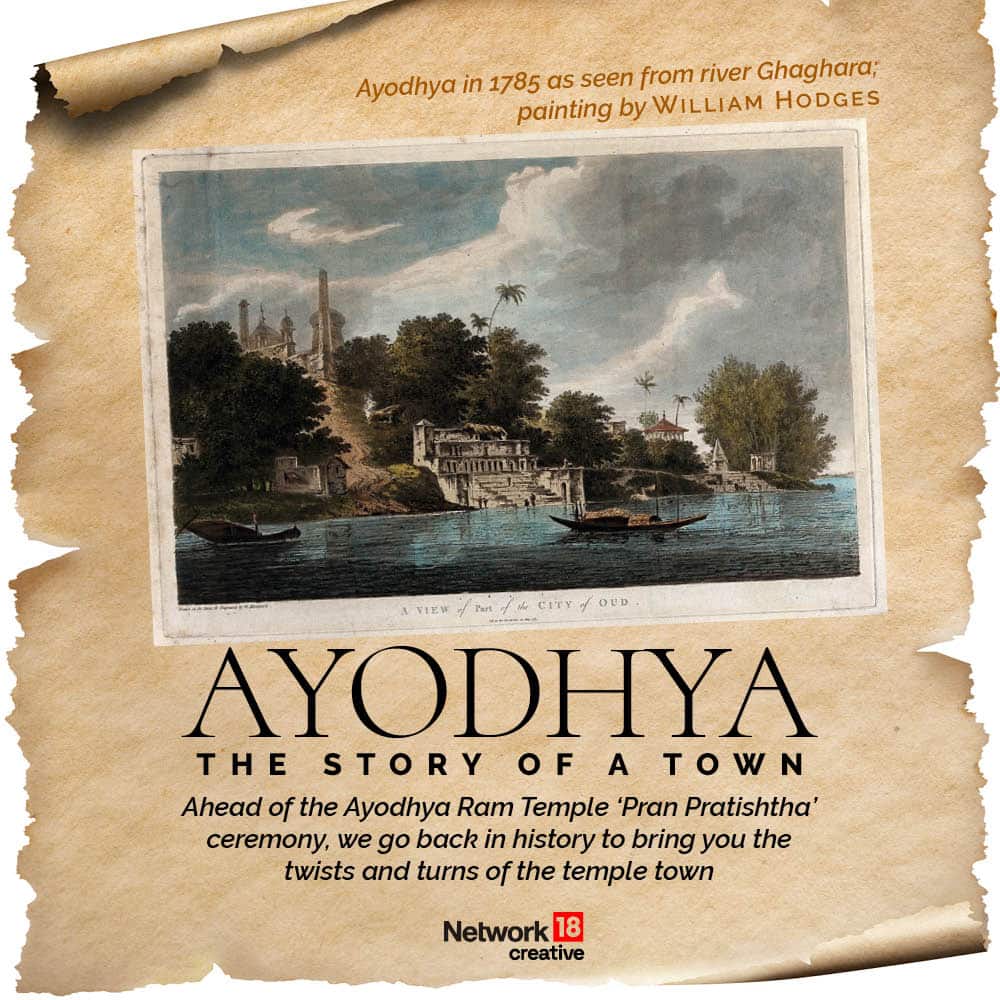
Ayodhya as seen from the Ghaghara River in 1785 (Painting by William Hodges)
2/12
Ayodhya, situated along the Ghaghra River in central Uttar Pradesh, is widely believed to be the birthplace of Lord Ram
3/12
A 19th-century painting shows Ram and Sita enthroned in Ayodhya. According to Valmiki's Sanskrit epic Rāmāyaṇa, Ayodhya was the capital of the Hindu kingdom Kosala, ruled by King Dasaratha, and the birthplace of Dasaratha's son, Ram.
Ayodhya, also known as Śāketa, was named after the Kushan emperor Kanishka, as indicated by a gold coin from around 120 AD.
5/12
Around 1226 AD, Ayodhya became the capital of the Awadh province under the governance of the Delhi Sultanate.
6/12
1853: First recorded incidents of religious violence at the site; 1949: Idols of Lord Ram appeared inside the mosque, leading to protests. Civil suits are filed, and the government declares the area disputed; 1984: Hindus form a committee to build a Ram temple at the site; 1986: District judge orders the gates of the disputed mosque to be opened, allowing Hindus to worship there. Muslims set up the Babri Mosque Action Committee in protest.
1989: Vishwa Hindu Parishad lays the foundation of a Ram temple near Babri Masjid; 1990: BJP president Lal Krishna Advani embarks on the Ram Rath Yatra; 1991: BJP comes to power in Uttar Pradesh.
8/12
1992: The Liberhan Commission set up; 2010: Allahabad HC rules that the site should be split; 2011: SC suspends the ruling
9/12
Nov 2019: SC clears path for Ram Temple, orders land for Muslims for mosque
10/12
Aug 5, 2020: PM Modi performs Bhoomi Pujan for Ram Temple
11/12
The consecration ceremony of Shri Ram Lalla at the temple will be held on January 22