

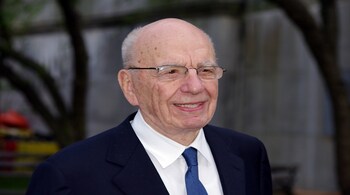
Rupert Murdoch’s decision to retire as chairman of News Corp. and Fox Corp., making way for his eldest son Lachlan, marks the end of an era in the media, the era of the press barons. Or rather it marks the beginning of the end of the era, as it is difficult to believe that a retired Murdoch will devote himself entirely to the art of shuffleboard.
Murdoch is the only contemporary figure who can be spoken of in the same breath as the great press barons of yesteryear: Alfred Harmsworth, the Napoleon of Fleet Street who invented the tabloid; William Randolph Hearst, who perfected the arts of sensationalism, salaciousness and war-mongering; and Lord Beaverbrook, who competed with Hearst in his enthusiasm for blurring the line between reporting the news and making it. If Hearst gave the world Orson Wells’ Citizen Kane, and Beaverbrook Evelyn Waugh’s Lord Copper, Murdoch gave it Logan Roy, the foul-mouthed master of family dysfunction.
Murdoch’s contemporary press barons were bit players by comparison, either because they failed to match his global scope or because they flamed out. Conrad Black came closest in his global ambitions with an empire that stretched from Britain, where he owned the Telegraph and the Spectator, to Israel, Canada and the United States, but ended up in prison for mail fraud and obstruction of justice. (Donald Trump later pardoned him.) Robert Maxwell committed suicide after bankrupting his companies and raiding their pension funds. The Barclay Brothers, who also owned The Telegraph and the Spectator, only mattered in Britain, and their empire is now with the receivers. Arthur Gregg Sulzberger certainly wields enormous power as the sixth member of the Ochs-Sulzberger family to act as publisher of the New York Times, but, with all respect to young Sulzberger, he is no Rupert Murdoch. Perhaps the only person to come close was Axel Springer, the flamboyant owner of Bild and Die Welt, yet while Springer was frequently described as “the German Murdoch,” nobody refers to Murdoch as “the Australian Axel Springer.”
There is little chance that we will see any press barons in the future. The information revolution has moved beyond the newspaper to something more nebulous — a stream of headlines, images, clickbait and quick takes that is updated by the second rather than once a day. Information giants such as Google and Facebook are robbing newspapers of both their advertisers and readers (and, as Murdoch loves to complain, their content as well). It is true that a few moguls still exhibit interest in the print media — Jeff Bezos owns the Washington Post and Steve Jobs’ widow, Laurene Powell Jobs, has a majority stake in The Atlantic. But for the most part, these are luxury brands controlled by people who made their money elsewhere rather than pistons in a financial empire. The Guardian is owned by a trust dominated by the great and the good (the Scott Trust Limited) and the Financial Times by a relatively unknown Japanese company (Nikkei Inc.). In 2021, just under half of all US adults turned to social media for news; a subsequent study in the UK showed that most people under 40 get their news from social media, particularly TikTok, rather than “the legacy media.”
Murdoch relished the raw power that owning newspapers gave him. He not only imposed a clear Thatcherite agenda on his ever-expanding stable of papers — editors might not have been sent an ideological memo, but they knew what got them ahead and what got them sacked. He loved pulling strings. He flirted with Tony Blair for years before throwing his weight behind him, inviting him in 1995 to make the lengthy journey to the Hayman Islands, Australia, to attend a News Corp conference. More recently, Rishi Sunak drafted a resignation letter from Boris Johnson’s cabinet but was persuaded to stay on by Rupert Murdoch executives.
In the 1980s, Murdoch also did something that no other press baron had dared do — freed the newspaper industry from the death grip of the print unions. Thanks to the unions’ ability to stop the presses, newspapers were, as the columnist Bernard Levin put it, “produced in conditions which combined a protection racket with a lunatic asylum,” vastly overmanned and riven with corrupt practices. Murdoch grasped more clearly than anybody else that a combination of modern technology and forward thinking could solve the problem for good and had the courage to weather the demonisation of the establishment as well as the Labour Party.
He moved his titles from Fleet Street to Wapping, broke off negotiations with the unions, withstood a yearlong strike that saw up to 5,000 strikers besieging his Wapping headquarters, hurling missiles and chanting “burn, burn, burn the bastard,” and ended up more convinced than ever that confrontation rather than appeasement was the way forward. The move ushered in the last golden age of the newspaper industry, with innovative technology unleashed and advertising revenue pouring in. By the beginning of 1987, the number of print workers had been reduced from over 2,000 to 570 and the new presses were producing 33 million newspapers a week. Drexel Burnham Lambert estimated that the move to Wapping increased the value of his four London titles from $300 million to a billion. The Independent — the first new quality newspaper in decades and a direct challenge to Murdoch’s Times — would not have been able to get off the ground without Murdoch’s hard-edged policies.
What made Murdoch such a success as a press baron? Half the answer lies in his robustly conservative views. Many billionaires adopt the high-status views of the liberal establishment when they make it. Murdoch remained true to his instincts. Norman Angell once said that Harmsworth “possessed the common mind to an uncommon degree.” That is also true of the man Private Eye dubbed “the Dirty Digger.” Charles Krauthammer explained Murdoch’s success with Fox News by saying that he discovered “a niche market in American broadcasting — half the American people.” That is also true of his newspapers, particularly the British tabloids, which provided a template for Fox.
The other half of the answer lies in his taste for capitalism. Murdoch was the embodiment of the spirit of capitalism as described by Karl Marx — always in motion and always willing to profane all that is holy. (As a student at Oxford the young Murdoch had a bust of Lenin on his mantlepiece.) He took big risks in his relentless pursuit of the next deal. In 1990, his empire was minutes away from imploding as he desperately tried to roll over a $7.6 billion debt he had taken on in a bid to become the world’s biggest media magnate.
He also made some mistakes, as all great entrepreneurs must: He could have used the Wall Street Journal to crush the Financial Times as a global business newspaper but instead, largely out of detestation of elite liberalism, focused on challenging the New York Times. Yet this perpetual motion machine was also capable of investing for the long term: thanks to a successful drive for subscribers (3.78 million of them, 84% digital only) the Journal is worth about $10 billion, more than it was when he bought it in 2007 for what was generally regarded as an inflated figure of $5.6 billion; and, thanks to his sustained investment in digital technology, The Times and the Sunday Times have gone from a £70 million loss in 2009 to a £73 million profit in 2022.
The two more tough questions about Murdoch the press baron are whether he was good for the press and, more importantly, whether he was good for society at large. Murdoch was born with printer’s ink in his veins as the son of an Australian newspaper man. Newspapers are at the heart of his empire — he started his career at 21 by taking control of an Adelaide paper, The News, when his father died, and has been buying them ever since. His passion for print led him to pursue the Wall Street Journal with the same drive that set Captain Ahab to pursue his whale.
He enjoys the company of journalists — particularly what he would regard as “real journalists” who believe in breaking stories rather than producing virtue-puffing screeds designed to impress the Pulitzer Prize judges. People who have worked for him testify to his insatiable interest in news and surprising kindness to colleagues who have fallen ill. He turned down Elizabeth Holmes’ request that he kill the Journal’s expose of Theranos, her blood-testing company, despite becoming the biggest investor in the company in 2015 with a $100 million cash injection. Like Harmsworth, he believes that “news is something someone wants to suppress. Everything else is advertising.”
Yet the argument against him is strong: that he sacrificed journalistic standards in his pursuit of sensationalism and circulation. Evelyn Waugh’s son Auberon praised the “hairy-heeled, tit-and-bum merchant from Oz” for rescuing British newspapers from the tyranny of the unions but condemned him for banning alcohol in Wapping. “Free drunks produce better newspaper than sober slaves.” Murdoch can be forgiven for replacing some of the brilliant but less rough-and-tumble types who used to edit The Times and The Sunday Times such as Charles Douglas-Home and Harold Evans with more pugnacious figures such as Charlie Wilson, otherwise known as “the arse-kicking machine,” and his fellow Glaswegian, Andrew Neil. The times demanded it. But it’s impossible to forgive the behavior of his tabloids.
Back in 1969, he justified his decision to buy the News of the World to his formidable mother, who had expressed worries that the poor Brits had to have such entertainment because their lives were so wretched. But his willingness to rescue the Brits from a life of wretchedness through tabloid entertainment led inexorably to a mounting number of horrors: the routine invasion of privacy, most appallingly when Murdoch employees illegally accessed the voicemails of the murdered schoolgirl Milly Dowler; a campaign against the royal family that let in far too much light on the royal magic; and a culture of sexual exploitation which led The Sun to crown Russell Brand as its “shagger of the year” three years in a row.
This points to the argument against his impact on society at large. Murdoch’s combination of enthusiasm for capitalism and disdain for traditional values undoubtedly made sense when he burst onto the global scene in the 1970s. The Keynesian consensus had reached its limits. The establishment’s habit of appeasing the unions threatened to sink the economy. The press needed to adjust to the 1960s revolution in mores.
But over time the downside of Murdoch’s Manichean view of the world has become clearer. Rather than destroying the establishment, the entrepreneurial revolution has produced a new global establishment of unaccountable tycoons. As well as liberating us from outmoded conventions, the sexual revolution has exacted a price in the breakdown of the family and selfish behavior.
Murdoch is now in danger of becoming a victim of his own two great passions. Capitalism is marginalising his beloved newspapers in pursuit of clicks and shares and user-generated content. Rather than holding the powerful to account, they pander to the prejudices of their audiences, doing away with the need not only for print workers but also for journalists themselves. Populism is also out of control. Murdoch is rightly criticised for doing his bit to unleash US populism by creating Fox News, his most successful cash cow. But the network has also released forces that do not always fit in with his world view: isolationism in foreign policy, hostility to immigration, support for big government and, above all, Trumpism. The monster is now a threat to Frankenstein.
At the height of the phone-hacking scandal, when Murdoch was summoned to give evidence to the House of Commons Select Committee, Conrad Black wrote an article in the Financial Times in which he dubbed Murdoch “a great bad man.” His success breaking the print unions and ushering in a golden age of print journalism qualify him as a great man. But his willingness to stoke the forces of Trumpism over the years undoubtedly justify the modifier of “bad.” The great question hanging over the United States, as it goes into the next election, and indeed the world, as Trumpian populism strengthens and mutates, will be just how “bad” is “bad.”
Adrian Wooldridge is the global business columnist for Bloomberg Opinion. Views are personal, and do not represent the stand of this publication.
Credit: Bloomberg
Discover the latest Business News, Sensex, and Nifty updates. Obtain Personal Finance insights, tax queries, and expert opinions on Moneycontrol or download the Moneycontrol App to stay updated!





