

Just two years ago, Panama’s President Laurentino Cortizo boasted about his country’s success, saying it was the result of political unity, close government-business partnerships and logistical wonders. Little did he know that by the time his term was about to end in mid-2024, all the pillars that made Panama the most successful Latin American economy of the past 30 years would be shaking.
Since Cortizo’s remarks, the Central American nation has endured social unrest, the cancellation of a $10 billion copper mine (the country’s biggest private investment) and serious doubts about the government’s fiscal sustainability after losing its investment grade with Fitch Ratings. The country’s engineering marvel, the Panama Canal, has been hit by a historic drought that has created a cargo bottleneck and forced emergency plans to fix a channel that handles $270 billion a year in global trade.
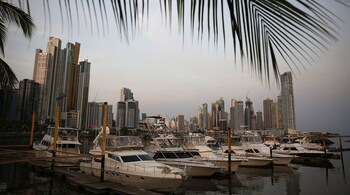
This combination represents an existential crisis for Panama: The country that captivated corporations and bankers with open trade, business-friendly legislation and its dollarized economy — turning Panama City into a high-rise-packed financial center akin to Miami — requires urgent
reinvention.
It’s through this prism that the presidency of José Raúl Mulino, who won
Sunday’s elections and will take power on July 1, should be seen: Despite the vote’s largely muted international repercussions, we should pay close attention to the new government’s approach because Panama’s
geopolitical weight transcends its slender geography (slightly smaller than South Carolina). In fact, the problems that Mulino will inherit are a
microcosm of Latin America’s big challenges: political divisions, popular discontent amid corruption and lack of quality jobs, increasing migration, fast-deteriorating public finances and the impact of climate change on business. Despite doubling the region’s average GDP per capita this century and achieving the income levels of an Eastern European country,
Panama remains embroiled in the same difficulties as its neighbours.
The good news is that unlike some of his regional peers, the incoming
president has a strong pro-private sector bias: “We will promote a pro-investment, pro-private company government,” he told supporters during his first rally as president-elect on May 5, also pledging to build a team “with the best people” without forgetting the needy.
The bad news is that Mulino came to power via the kind of unorthodox arrangement that has all too often destabilized other Latin American countries: He owes his win to popular former president Ricardo Martinelli, who gave up his frontrunner status in order to seek asylum at the Nicaraguan embassy in Panama and avoid prison after losing an appeal to overturn his conviction for money laundering.
Mulino, who was Martinelli’s running mate, inherited the candidacy. He has vowed to constitute a “national unity” government after capturing just 34 percent of the vote: That’s key considering the atomized unicameral assembly, where independents are the first force. He will need to cut deals to be able to pass legislation, but the lingering question continues to be how the new president will deal with the former one. “Mulino must first address the issue of Ricardo Martinelli, and then ensure governance with the different political, social, and civic groups of the country,” Rita Vásquez, director of La Prensa newspaper, told me from Panama City. “Once that’s achieved, address the other important issues that his government must solve.”
The combination of a long to-do list and a brittle public mood bodes ill: One of the lessons of the past two administrations is that support can quickly evaporate in this young democracy. The 64-year-old lawyer campaigned promising to return to the super growth rates of Martinelli’s years, when the economy expanded more than 7 percent per year on average. That’s now a chimera, with Panama constrained by a growing pension crisis and the threat of additional downgrades after the surge in indebtedness following the pandemic.
The International Monetary Fund sees the country growing just 2.5 percent this year, improving to 3 percent in 2025. Others are much more pessimistic: Economists at JPMorgan Chase & Co expect a 0.5 percent expansion in 2024, putting the economy in a virtual recession.
Accelerating growth will only be one of Mulino’s pressing issues. There is no easy, quick resolution to either the dispute with First Quantum Minerals Ltd. over the giant shuttered mine or the drought afflicting water management for the canal. In addition, Panama has a crucial role to play in addressing the humanitarian crisis of migrants crossing the dangerous
Darien Gap connecting South with Central America as they venture toward the US.
“All these challenges, plus the depletion of funds to meet pension spending, have Panama with its back against the wall,” JPMorgan’s Steven Palacio and his colleagues wrote in their May 6 report. “The problems are easily identifiable, the solutions are not clear.”
Mulino can’t afford a paint-by-numbers presidency. Panama needs to rewire its economic and political system to adapt it to a new world where supply chains and trade flows are shifting and nearshoring and energy transition emerge as opportunities for Central America. The country can’t just be a paradise for capital and maritime refugees anymore; it also needs to satisfy the growing societal demands of its 4.4 million people, not least for greater transparency and accountability. And it has to do so while regaining fiscal credibility.
A new government always offers the chance for a radical course correction.
Mulino’s initial consensus-building, head-on strategy goes in the right direction. But for all its short-term appeal, relying on the disgraced Martinelli as the mainstay of his political support will come at a cost. Mulino can’t govern if he’s seen as the puppet of a strongman in the shadows. And an electorate already angry about corruption will become even angrier if Panama doesn’t regain its economic momentum. Mulino needs to solve his Martinelli problem quickly, and rally the broad-based support necessary to put Panama back on the path to prosperity.
Credit: Bloomberg
Discover the latest Business News, Sensex, and Nifty updates. Obtain Personal Finance insights, tax queries, and expert opinions on Moneycontrol or download the Moneycontrol App to stay updated!





