

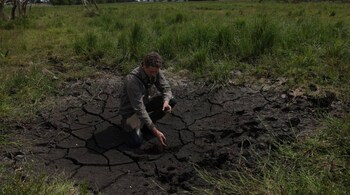
To the untrained eye, nothing seems extraordinary about the landscape beneath my feet. But those who know better understand, practically speaking, that it’s akin to being on fire. But it’s easy to overlook a blaze without flames.
Repairing and preserving drained peatlands like the one I’m standing on, Ridge Graham, in north England, should be a top priority in the fight against climate change. The site is currently undergoing restoration. The trick will be securing enough funding.
Peatlands store twice as much carbon as the world’s forests. In a healthy bog, the waterlogged conditions prevent plant material from fully decomposing, so rather than releasing carbon dioxide into the atmosphere, the greenhouse gas is trapped in the ground. Growing by about 1 millimeter a year, a meter of peat contains a thousand years of history. If you’re lucky — or perhaps unlucky — you might find an ancient relic: a horsehair hat, a bronze cauldron or even a human body.
Unfortunately, the condition of peatlands is having an outsize impact on the planet. We’ve drained bogs and fens in many areas to transform the spongy ground into something useful for grazing and crops. This has had the adverse effect of exposing peat to the air, sending tons of carbon dioxide into the atmosphere — as well as affecting water quality and increasing the risk of flooding.
About 11 percent of peatlands globally have been modified and drained. These degraded wetlands cover less than 0.4 percent of the Earth’s land area but are responsible for 5 percent of human-caused emissions — more than aviation. In the UK, degraded peat emits more CO2 than all its trees sequester.
Restoring an area of upland peat involves reestablishing the conditions for the landscape to once again function as a sponge. Work at the project I visited, developed by Ridge Carbon Capture Ltd, was focused on reprofiling the harsh banks of gullies to stop erosion, adding dams to slow the flow of water off the hillside and covering areas of bare peat with heather brash to encourage the growth of key blanket bog species such as sphagnum moss.
The UK provides public funding for peatland restoration, but it’s not nearly enough to cover all the work that needs to be done, Betsy Glasgow-Vasey, managing director of Ridge Carbon Capture, explained to me. Plus, rewetting the landscape is only half the challenge. Regular monitoring of projects, alongside any maintenance, also needs financing. But the government doesn’t currently fund that. Hence, private cash is essential.
The Peatland Code is the main mechanism for directing private investment to restoration and maintenance. Developed by the International Union for the Conservation of Nature (IUCN) UK Peatland Program, the code allows project developers such as Ridge Carbon Capture to quantify the climate benefit of their work and sell carbon units on the voluntary carbon market. Launched in 2015, almost 250 projects are generating peatland carbon credits in the UK.
However, there are concerns that standards around the corporate use of carbon offsets are blocking vital private support.
The IUCN UK Peatland Program has sent a letter, signed by companies, investors and organisations including Diageo Plc, the Global Peatlands Initiative, Ridge Carbon Capture and Federated Hermes Inc, among others, to the Science-Based Targets Initiative (SBTi). It says the global body’s guidance is “significantly constraining international efforts” to remedy degraded peatland emissions.
The SBTi is a collaboration between CDP Worldwide, the United Nations Global Compact, World Resources Institute and the World Wide Fund for Nature, which develops standards, tools and guidance to aid companies in setting emissions reduction targets consistent with reaching net zero by 2050. It’s hugely influential: According to the initiative’s online target dashboard, 4,950 firms had their climate objectives approved, including the likes of Kering SA, Apple Inc and Diageo.
The crux of the problem is SBTi dictates that only carbon removal credits, in which activities lead to long-term sequestration of carbon dioxide, can be used to offset residual emissions. Peatland credits are classified as emissions avoidance, and sales of these credits are reportedly falling through as companies realise their limited value to their targets under SBTi standards.
The SBTi stance is logical: To negate a ton of CO2 entering the atmosphere, a ton has to be removed and stored durably. But Renée Kerkvliet-Hermans, the peatland code coordinator at the IUCN UK Peatland Program, told me that ignores the fact that restoration actively halts emissions. Think of it this way: The difference between peatland credits and, for example, a REDD+ credit, in which carbon units are purchased to protect an existing forest, is that the former is paying to extinguish a fire. The latter is more like paying someone to promise not to start an inferno in the first place.
The SBTi responded to the letter on Monday, saying that it is open for a meeting. It also replied to me:
“When peatland restoration occurs within a company’s value chain, reductions and removals associated with peatland restoration must be covered in the company’s FLAG [Forest, Land and Agriculture] target. When it falls outside of corporate value chains, it is considered beyond value chain mitigation (BVCM) under SBTi standards. The SBTi's recent BVCM report states: ‘Funding to protect and restore natural ecosystems … is critical in maintaining the land sink and avoiding tipping points.’”
Kerkvliet-Hermans’ problem with the beyond-value-chain mitigation point is it doesn’t offer a real incentive for business investment in rewetting. The letter’s signatories would like to see peatlands better represented in future SBTi guidance, ideally with an option for restoration to offset unavoidable emissions, given the importance of these unique landscapes to the climate fight.
There are strong points to make either way, but it’s clear a more nuanced view that aims to differentiate between passive avoidance and active emissions reduction might help funnel money into worthy firefighting.
Lara Williams is a Bloomberg Opinion columnist. Views do not represent the stand of this publication.
Credit: Bloomberg
Discover the latest Business News, Sensex, and Nifty updates. Obtain Personal Finance insights, tax queries, and expert opinions on Moneycontrol or download the Moneycontrol App to stay updated!





